High-traffic trading apps and token-aware fintech products live or die on data quality.
If prices are stale, charts freeze, or balances drift from reality, users churn fast. The challenge is that “blockchain data API” now covers several layers—RPC, indexing, and market data—and no single provider is best at everything.
This ranked guide compares 7 leading blockchain APIs across:
- Latency and reliability
- Multi-chain support and coverage
- Data model (raw nodes vs enriched tokens vs market feeds)
- Fit for Web3 trading apps and token-aware fintech products
It’s written for Heads of Product, CTOs, and lead engineers at CEXs, DEXs, wallets, trading terminals, and analytics platforms who need trading‑grade UX—sub‑second responses, consistent pricing, and real‑time balances—without building their own data pipeline.
We’ll rank the platforms, but the real goal is to help you design a resilient multi‑provider stack, not chase a mythical “single best API.”
How we ranked these blockchain APIs
This is a directional, product-focused ranking, not a lab benchmark.
We looked at:
-
Trading-grade latency
- Can it realistically keep p95 response times under ~150–200ms for critical flows?
- Does it publish benchmark/latency data or uptime SLAs?
-
Reliability and resilience
- Uptime claims (99.99%+ vs best effort)
- Failover/freshness routing and production readiness
-
Multi-chain and asset coverage
- How many chains, tokens, and markets?
- Long‑tail and newly launched tokens vs only majors
-
Data model fit for trading UX
- Enriched tokens, OHLCV, liquidity, balances, prediction markets
- Or just low‑level RPC calls and logs?
-
Who it actually serves best
- Based on public claims, docs, and observed usage patterns
Now let’s walk the list.
1) Codex — Best overall for token‑aware trading UX & prediction markets
What it is
Codex is a specialized blockchain data infrastructure platform built around enriched token, wallet, and prediction‑market data—not generic RPC.
It ingests and normalizes raw data across 80+ networks, 70M+ tokens, and 700M+ wallets, indexing thousands of transactions per second. It powers apps like Coinbase, TradingView, Uniswap, Magic Eden, Rainbow, MoonPay, Farcaster, and pump.fun, positioning it as trading‑grade infrastructure.
Key capabilities (via an all‑in‑one GraphQL‑style API):
- Real‑time and historical prices (USD & native) for long‑tail tokens
- Trading‑ready OHLC/candles, volume and liquidity metrics
- Cross‑chain holders, balances, and wallet views
- Token metadata and scam filtering
- Aggregates like unique wallets and TVL‑like stats
- Prediction markets: events, markets, trades, trader analytics across platforms like Polymarket and Kalshi (beta)
Latency and freshness
Codex’s product pages and benchmarks emphasize:
- Typical query times under 1s for complex calls
- Token search in <500ms
- Filter endpoints often in the 60–150ms range
- Wallet balance freshness around 1.8s after chain finalization on average
These numbers are tuned to Codex’s own trading UX guidance: p95 HTTP/GraphQL under 150–200ms, WebSocket updates within <1s of finalization.
Why it ranks #1
Codex ranks first because it gives you exactly what trading UIs need, without requiring you to build your own indexing stack:
- Enriched, normalized token objects instead of raw logs
- Consistent prices, charts, and aggregates across 80+ networks
- Cross‑chain wallet and holders out of the box
- Prediction market data in the same API as tokens
For teams building high‑traffic token apps, this saves months or years of in‑house data engineering.
Pros for trading apps
- Purpose-built for trading UX: OHLC, volume, liquidity, holders, and balances are first‑class, not side products.
- Massive coverage: 70M+ tokens and 700M+ wallets, including long‑tail and launchpad assets.
- Unified token + prediction market data: Single source of truth for spot tokens and markets like Polymarket/Kalshi.
- Production‑proven: Powers Coinbase, TradingView, Uniswap, Magic Eden, etc.
- Developer‑friendly: GraphQL‑style API with filter endpoints (e.g., filterTokens, filterPredictionMarkets) designed around common app queries.
Limitations / tradeoffs
- It’s not an RPC/node provider. You still need a node service (e.g., QuickNode or Alchemy) for transaction submission and low‑level reads.
- Optimized for token and prediction‑market data, not for every niche chain primitive.
Best for
- CEX/DEX frontends that need fast, reliable prices and charts across many chains
- Multi‑chain wallets and portfolio apps with accurate cross‑chain balances
- Social and consumer apps that need searchable long‑tail tokens
- Prediction market frontends wanting Polymarket/Kalshi data through a single API
- Teams that want to consolidate multiple data vendors into one trading‑grade layer
2) QuickNode — Best RPC backbone for latency‑sensitive execution
What it is
QuickNode is a leading multi‑chain node provider and RPC/streaming platform.
Its Core API covers 80+ blockchains / 130+ networks, with Streams for more than 60 chains. It’s the backbone for low‑level read/write access to networks, raw logs, and mempool data.
Performance & reliability
QuickNode publishes live benchmarks and uptime stats:
- Claims sub‑50ms latency for Core API
- One captured Ethereum/global benchmark showed 61.9ms P95
- Uptime history snapshot showed 100% uptime for July, August, and September 2026
- Advertises a 99.99% uptime SLA
QuickNode also notes that a 50ms difference in RPC latency can determine whether a transaction lands before a competitor’s—critical for professional traders.
Pros for trading apps
- Ultra‑low RPC latency ideal for order submission, liquidations, and bots
- Great multi‑chain support (80+ chains, 130+ networks)
- Benchmarks and SLAs provide transparency for infra‑level decisions
- Strong support for mempool and streaming patterns
Limitations / tradeoffs
- Provides raw execution data, not trading‑ready token aggregates, pricing, or holders.
- You’ll still need an enriched data layer (e.g., Codex, The Graph) or a market‑data API for charting.
Best for
- Teams needing fast, reliable RPC across many chains
- Trading apps where slippage and MEV make latency critical
- Builders who want to own the execution path and compose it with a higher‑level data API
3) Alchemy — Best for mature, full‑featured multi‑chain RPC
What it is
Alchemy is another top‑tier blockchain infrastructure platform offering RPC, enhanced APIs, and tools across 100+ blockchains.
It focuses on reliability and developer experience, with dashboards, monitoring, and enhanced APIs (e.g., NFT and token endpoints) tailored to application builders.
Performance & reliability
Alchemy’s public EVM benchmark snapshot shows:
- 17.99ms global average response time in one captured view
- 100% success rate in that benchmark
- A platform‑wide 99.99% uptime claim
Alchemy also emphasizes that moving from 99% to 99.99% uptime dramatically reduces outage time over a year—key for trading apps.
Pros for trading apps
- Very low latency for EVM reads and writes
- 100+ chains: ideal for teams expanding aggressively cross‑chain
- Strong tooling and monitoring—useful for larger teams managing complex infra
- Enhanced APIs for common use cases (NFTs, some token data)
Limitations / tradeoffs
- Enhanced token/NFT APIs are still not a full trading‑grade token data layer; they don’t replace specialized providers like Codex for pricing, charts, and prediction markets.
- Pricing and plans are often optimized for serious production traffic, which may be overkill for some early‑stage prototypes.
Best for
- Teams building large, multi‑chain products that need robust RPC and tooling
- Enterprises that value observability and SLAs as much as raw speed
- Builders combining Alchemy RPC with a specialized market‑data layer
4) The Graph — Best indexed‑data layer for balances and transfers
What it is
The Graph is the indexing protocol behind many Web3 dashboards. Instead of direct RPC reads, you query indexed subgraphs (or Substreams) for normalized views of on‑chain data.
Its Token API (currently in beta) provides normalized balances, transfers, pricing, and other token data across multiple chains.
Scale & performance
- 60+ chains supported across the platform
- 1.27 trillion queries served and 75K+ projects, per docs
- Token API/Substreams case study claims 24x faster multi‑chain indexing by splitting work into 1k‑block segments
- Status page shows 100% uptime over the past 90 days for Token API and other core services in the captured view
Pros for trading apps
- Great for indexed historic data: balances, transfers, event‑driven analytics
- Substreams architecture can index thousands of blocks per second for multi‑chain workloads
- Ideal if you want custom data models without running your own indexers
Limitations / tradeoffs
- The Token API is still in beta; coverage and stability are evolving.
- The Graph is an indexing layer, not an execution or pricing layer; you still need RPC and market data.
- For high‑frequency trading flows, raw latency may not match specialized token APIs tuned for trading UIs.
Best for
- Analytics platforms needing deep historical token data
- Products with complex multi‑chain queries that would be painful via straight RPC
- Teams willing to combine The Graph with Codex‑style enriched pricing data and a node provider
For NFT‑heavy products, you can go deeper into indexed and rarity‑driven analytics in this related guide: blockchain data analytics and rarity tools for trading‑grade NFT insights.
5) Tatum — Best for intelligent routing, failover, and freshness
What it is
Tatum is a multi‑chain blockchain API platform that emphasizes intelligent routing and reliability over any single node.
It abstracts multiple underlying nodes and networks into a unified API for 130+ blockchains.
Performance & routing model
- Supports 130+ blockchains
- Claims sub‑50ms latency and 200 req/s capacity
- Advertises 99.99% uptime
- Implements “intelligent data routing”: traffic is sent to the endpoint with the freshest blocks, not just one that is online
Tatum’s docs argue that “online but stale” nodes can still serve outdated data, so freshness‑aware routing is a critical differentiator.
Pros for trading apps
- Built‑in failover and freshness: reduces your need to orchestrate multiple nodes yourself
- Wide chain coverage for token and NFT operations
- Helpful for teams that want high availability with less infra overhead
Limitations / tradeoffs
- Like other node‑centric APIs, it’s not a dedicated trading data layer; you don’t get rich token aggregates or prediction markets out of the box.
- If you already have a strong internal failover system using providers like QuickNode/Alchemy, Tatum’s key value may be partially redundant.
Best for
- Teams who want a single RPC endpoint with built‑in freshness logic
- Wallets and consumer apps where consistency and uptime are critical but ultra‑low single‑digit millisecond latency is less important than resilience
- Builders who don’t want to run their own multi‑provider orchestration
6) Finage — Best crypto market‑data API with DEX depth
What it is
Finage is a market‑data provider covering equities, forex, and crypto. For trading apps, its crypto API is the relevant piece.
Crypto capabilities include:
- 7,000+ crypto pairs across 100+ markets
- Millisecond‑level WebSocket delivery
- Tick‑by‑tick pricing
- 8+ years of historical crypto data
- DEX‑oriented data: order books and OHLCV
Pros for trading apps
- Strong centralized & DEX market coverage for spot pairs
- Tick data and order books for building order‑book‑style UIs and backtesting
- Deep historical OHLCV for analytics and quant research
Limitations / tradeoffs
- Focused on market data, not direct on‑chain indexing; you’re not getting per‑wallet token holdings or raw chain logs.
- Coverage is pair‑centric, not token‑centric; long‑tail unlisted tokens may not appear until they trade on supported venues.
Best for
- CEX‑like frontends and analytics tools needing robust order‑book and tick data
- Quant and backtesting platforms that value multi‑year historical series
- Teams pairing Finage with a token‑aware chain indexer like Codex for holistic views
7) CryptoCompare — Best for real‑time and historical order‑book feeds
What it is
CryptoCompare is a long‑standing digital asset market‑data provider.
It offers:
- Real‑time order‑book feed for 3,000+ pairs
- Historical minute/hour/daily OHLCV
- Tick‑by‑tick trade data
- Blockchain data, social data, and metadata
Pros for trading apps
- Real‑time order‑book level 1/2 data for thousands of pairs
- Extensive historical OHLCV and trade data—great for backtesting and analytics
- Additional metadata and social data that can enrich discovery and risk models
Limitations / tradeoffs
- Not an on‑chain token indexer; doesn’t replace Codex or The Graph for holders/balances.
- Coverage optimized for listed pairs, not every contract deployed on‑chain.
Best for
- Trading terminals and quant tools needing deep market‑microstructure data
- Platforms that blend order‑book analytics with on‑chain token and wallet data from another provider
Summary: comparison table of the top 7 blockchain APIs
Here’s a quick overview of how these providers line up for Web3 trading apps and token‑aware fintech products.
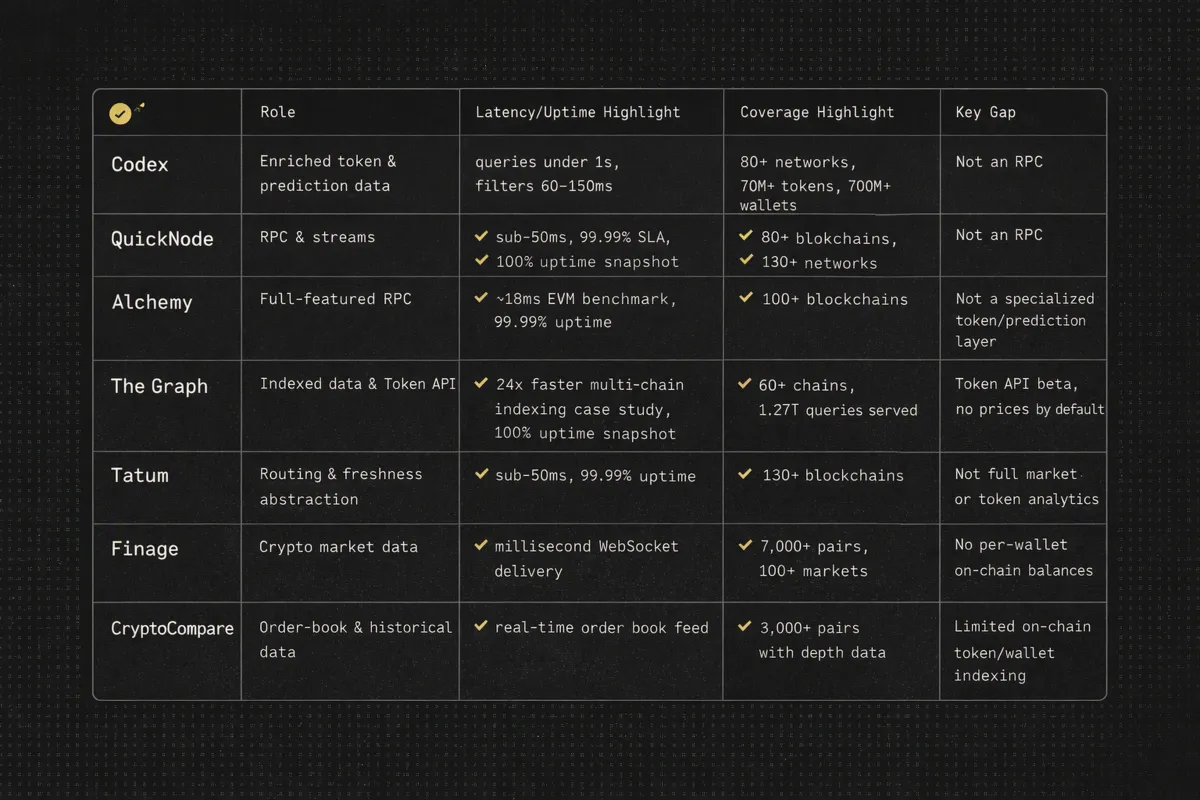
| # | Provider | Primary Role | Key Strengths | Main Gaps for Trading UX |
|---|---|---|---|---|
| 1 | Codex | Enriched token & prediction data | 80+ networks, 70M+ tokens, 700M+ wallets, sub‑second queries, charts, PM data | Not an RPC; focused on token & prediction markets |
| 2 | QuickNode | Low‑latency RPC & streams | 80+ blockchains, 130+ networks, sub‑50ms, 99.99% SLA, 100% uptime snapshot | No built‑in trading‑grade token aggregates or prediction data |
| 3 | Alchemy | Full‑featured RPC infra | 100+ blockchains, ~18ms avg EVM read, 99.99% uptime, mature tooling | Enhanced token/NFT APIs don’t replace specialized trading data |
| 4 | The Graph | Indexed subgraph/Token API layer | 1.27T queries, 60+ chains, 24x faster multi‑chain indexing (Substreams) | Token API in beta; not a pricing/execution layer |
| 5 | Tatum | Routing & freshness abstraction | 130+ blockchains, sub‑50ms, 99.99% uptime, freshness‑aware routing | Not a full market‑data or enriched token analytics platform |
| 6 | Finage | Crypto market‑data overlay | 7,000+ pairs, 100+ markets, tick data, DEX order books, 8+ years history | No per‑wallet on‑chain holdings; pair‑driven, not token‑driven |
| 7 | CryptoCompare | Order‑book & historical data | 3,000+ real‑time pairs, order books, OHLCV, tick trades, metadata, social | Limited on‑chain wallet/token indexing; focused on listed pairs |
How to design a resilient trading‑grade data stack
Instead of trying to anoint a single “best blockchain API,” most high‑traffic trading apps end up with a layered stack:
-
RPC / execution layer
- Primary: QuickNode or Alchemy (with Tatum as a resiliency abstraction in some setups)
- Responsibilities: send transactions, read low‑level state, watch mempools
-
Enriched on‑chain token & prediction‑market layer
- Primary: Codex
- Responsibilities: prices, OHLCV, liquidity, volumes, cross‑chain balances, holders, prediction market events/markets/trades
-
Indexed analytics layer (optional but powerful)
- Primary: The Graph (Token API / custom subgraphs)
- Responsibilities: complex historic queries, transfers, protocol‑level analytics
-
Off‑chain exchange & market‑microstructure data
- Primary: Finage and/or CryptoCompare
- Responsibilities: centralized/DEX order books, tick data, deep historical OHLCV
Practical recommendations by use case
If you’re building a cross‑chain trading terminal
- Use QuickNode or Alchemy for RPC
- Use Codex for prices, charts, liquidity metrics, and wallet balances
- Add Finage or CryptoCompare for centralized/DEX order books and tick data
If you’re building a mobile wallet or portfolio app
- Use Codex as your primary token & wallet data source across 80+ networks
- Pair with Tatum or a primary RPC provider for transaction submission
If you’re building a prediction‑market frontend
- Use Codex for Polymarket/Kalshi markets, events, trades, and trader analytics
- Complement with a node provider for transaction flows and settlement
If you’re building an analytics dashboard or research tool
- Use Codex for token prices and aggregates
- Use The Graph for historical balances/transfers and custom metrics
- Add CryptoCompare or Finage if you need order‑book microstructure