GeckoTerminal API uptime risks: the short answer
If your cross-chain trading UI or price widgets depend directly on the public GeckoTerminal API (or similar DEX feeds), you’re exposed to soft failures far more often than hard downtime: 429 rate limits, intermittent timeouts, maintenance windows, and shared-IP throttling.
To keep cross-chain price feeds and order routing stable, you need:
- A primary, trading-grade data layer (e.g. Codex) with higher throughput and reliability
- Redundant price oracles across providers and networks
- Fallback logic that downgrades gracefully (less frequent updates, partial coverage, cached values) instead of breaking UX
- A hybrid delivery model (queries + subscriptions + webhooks) so you don’t rely on brittle, high-frequency polling
This article breaks down common GeckoTerminal-style uptime risks, then walks through concrete architectural patterns to design resilient cross-chain price feeds using Codex’s onchain data APIs.
GeckoTerminal API outage and degradation patterns
Public DEX data feeds rarely disappear entirely; they degrade. Understanding those patterns is the first step to designing robust fallbacks.
1. Rate limits and throttling
GeckoTerminal’s public API:
- Is explicitly marked “beta”
- Has a 30 calls/minute free limit
- Covers more than 1M tokens across 2,000+ DEXs and 220+ networks
In practice, the main failure mode for high-traffic widgets is:
- 429 Too Many Requests when you exceed RPM
- “Soft” throttling on shared IPs
- Limited burst capacity for sudden volume spikes
DexScreener exposes similar patterns:
- 60 RPM for token-profile/community/ad endpoints
- 300 RPM for pairs endpoints
For any trading UI with:
- Thousands of concurrent users
- Multi-symbol watchlists and portfolio views
- Aggressive re-fetch intervals
…it’s easy to exceed these limits and start seeing errors, especially if calls originate from the browser rather than a backend.
2. Intermittent downtime and maintenance windows
CoinGecko’s official status page (which includes GeckoTerminal incidents) shows:
- Multiple “Service GeckoTerminal API seems to be down” incidents across 2023–2024
- A March/April 2024 market data incident affecting broader endpoints
- A Jan 2026 CoinGecko Pro incident where onchain table bloat caused intermittent issues
Today’s snapshot shows “All systems operational” with 100% uptime, but also scheduled maintenance where:
- Services stay mostly up
- Some requests see slower responses or intermittent errors for up to 5 minutes
- The official guidance is exponential backoff on retries
For trading UIs, 5 minutes of intermittent errors is enough to:
- Stall live charts
- Break auto-refresh widgets
- Confuse order routers that depend on real-time pricing
3. Soft failures: 408, 429, 503, and 1020 responses
CoinGecko’s error docs highlight the typical degradation pattern:
- 408 Request Timeout – slow or overloaded backend
- 429 Too Many Requests – rate limit exceeded
- 503 Service Unavailable – temporary overload or maintenance
- 1020 Access Denied – firewall or bot protection
They also note that:
- All requests count toward rate limits (including those returning errors)
- Browser-based integrations are fragile due to shared-IP limits and CORS
- You should proxy calls through your backend and handle retries centrally
In other words, simply “hitting the REST API harder” is not the solution. You need an architecture that can tolerate these soft failures without breaking the UX.
4. Beta surfaces and non-SLA delivery methods
CoinGecko now offers:
- REST
- WebSocket
- Webhooks
…but WebSocket and Webhooks are still beta and explicitly excluded from the SLA.
So if you’re:
- Building real-time cross-chain trading views
- Streaming DEX prices for bots or auto-routing
…you’re likely depending on a delivery method that doesn’t have formal uptime guarantees.
How DEX price feed downtime impacts cross-chain trading UX
What actually breaks when GeckoTerminal or similar DEX feeds degrade?
Price widgets and charts
When a DEX price source goes down or starts returning errors:
- Tickers freeze or disappear
- OHLC candles stop updating, making charts look stale or “stuck”
- Volume and liquidity stats lag, confusing users during volatile moves
For GeckoTerminal-style integrations, the likely user-visible symptoms are:
- Last price stuck at an old value
- 24h change or volume showing
0or— - Widgets oscillating between data and error states
Order routing and execution logic
If your router relies heavily on one source of price data:
- Routes may be chosen based on stale prices
- Slippage limits can be miscalculated
- Best-execution logic may be disabled or fall back to naive routing
This is particularly dangerous in cross-chain contexts where:
- Bridge quotes depend on current onchain DEX prices
- MEV-aware routing optimizes across paths based on real-time liquidity
Without robust fallback logic, an outage can degrade from “charts look stale” to “orders execute at obviously bad prices.”
Trust, support load, and regulatory optics
Frequent soft failures in price feeds:
- Erode user trust in your app’s data quality
- Generate support tickets (“my chart is frozen”, “your prices are wrong”)
- Can raise compliance questions for regulated entities if portfolio valuations or risk metrics depend on unreliable feeds
For serious builders, this is why trading-grade data infra matters: reliability isn’t just a technical concern, it’s a product and reputational one.
Designing cross-chain price feed fallback: core principles
Before diving into Codex-specific patterns, it’s useful to define the general rules for resilient price layers.
Principle 1: One primary, multiple fallbacks
You want a single, normalized primary source and multiple backup sources, not a chaotic mix of equal-tier providers.
- Primary: high-performance, unified API with strong uptime and coverage
- Secondary: other aggregators or direct chain indexers
- Tertiary: your own cached data and last-known-good values
The router should:
- Prefer the primary source whenever healthy
- Detect degradation fast (latency, error rates, data gaps)
- Switch to secondary/tertiary sources in a predictable way
Principle 2: Separate UX tiers by freshness requirements
Not every component needs tick-level freshness.
-
Tier A: Trading-critical (order routing, slippage, margin checks)
- Needs real-time or near-real-time data
- Must be backed by the most reliable feed and aggressive fallback logic
-
Tier B: Live charts and widgets
- Can tolerate a few seconds of lag
- Can gracefully degrade to slower update intervals
-
Tier C: Portfolios, analytics, historical views
- Can tolerate minutes-level lag
- Prefer accuracy and consistency over low latency
Designing these tiers explicitly lets you:
- Use faster, lower-finality feeds (e.g.
processeddata) for Tier A - Use confirmed, aggregated data for Tier C
Principle 3: Prefer hybrid delivery over pure polling
Modern data platforms support:
- Queries for page loads and historical ranges
- Subscriptions/WebSockets for live updates
- Webhooks for backend-triggered events
Using all three reduces your reliance on:
- High-frequency polling
- Browser-origin requests subject to shared IP limits
Hybrid delivery also makes it easier to:
- Apply backoff to queries under load
- Keep live feeds running even as you slow down history queries
Codex as the primary price layer for cross-chain feeds
Codex provides a single GraphQL-style API across:
- 80+ networks
- 70M+ tokens (76M+ in some messaging)
- 700M+ wallets
It’s built specifically for trading-grade token and prediction market data, with:
- Real-time and historical prices (USD and native)
- Charting-ready OHLC/candles and volumes
- Aggregates like liquidity, volume, unique wallets, TVL-like stats
- Holders, balances, launchpad coverage, and scam-filtered metadata
Performance and rate limits
Codex documents per-second rate limits, e.g.:
- 5 req/sec on the “Almost free” tier
- 300 req/sec on the Growth tier
- 10,000 free requests/month on the entry tier
Endpoints like getTokenPrices are tuned for batching:
- Up to 25 tokens per request
- Extra inputs may be dropped or error out, depending on endpoint
This batching + higher RPS profile makes Codex suitable as the primary price layer for high-traffic trading UIs, especially when combined with subscriptions.
Delivery semantics designed for resilience
Codex offers:
- Queries: best for page loads, initial data hydration, historical ranges
- Subscriptions: live feeds for price ticks, candles, and event streams
- Webhooks: backend notifications for specific events
Key reliability features:
- Subscriptions default to
confirmeddata, withprocessedavailable for lower latency on chains like Solana and Base - Webhooks require a 2xx within 3 seconds, with up to 4 retries ~5 seconds apart
- Errors often arrive as HTTP 200 with an
errorsarray, includingOVER_CAPACITYandTOO_MANY_REQUESTScodes withretryAfterSeconds
This error model is retry-aware by design, but only if your client inspects the response body rather than just HTTP status.
Architectural pattern: resilient price widgets with Codex + secondary feeds
Let’s turn this into concrete design patterns.
1. Aggregated price widget pattern
Goal: A cross-chain price widget that stays online even when GeckoTerminal or other DEX feeds degrade.
Baseline architecture:
- Primary source: Codex
getTokenPriceswith batched inputs - Secondary source: GeckoTerminal or DexScreener REST
- Tertiary source: Local cache (Redis/DB), storing last-known prices per token
Implementation steps:
-
Backend-only orchestration
- All external API calls from the backend
- Frontend subscribes to your own
/pricesstream via WebSocket or SSE
-
Health monitoring per provider
- Track:
- Average response time
- Error rate (HTTP + application-level errors)
- Coverage (tokens successfully returned vs requested)
- Define provider health states:
HEALTHY,DEGRADED,UNAVAILABLE
- Track:
-
Provider selection logic
- For each token batch:
- Try Codex first
- If Codex returns
OVER_CAPACITYorTOO_MANY_REQUESTSwith high retryAfterSeconds, fall back to GeckoTerminal/DexScreener - If both external providers are
UNAVAILABLE, serve from cache
- For each token batch:
-
Graceful UX degradation
- When serving from cache, mark the widget with:
- A small “stale data” badge
- A timestamp of last successful update
- Decrease update frequency (e.g., 250–500ms for live, 5–10s for degraded)
- When serving from cache, mark the widget with:
-
Retry strategy respecting provider semantics
- For Codex:
- Parse
retryAfterSecondsfrom errors - Use exponential backoff capped at a sensible maximum
- Parse
- For GeckoTerminal/DexScreener:
- Back off on 429/503/timeout errors as per CoinGecko guidance
- For Codex:
This pattern ensures that widgets don’t go blank even under strain, and users can see when data is temporarily stale.
Architectural pattern: order routing during price feed outage
Order routing is more sensitive than widgets; you must avoid routing off clearly wrong prices.
1. Routing based on prioritized price tiers
Design your router to use multi-level price inputs:
- Tier 1 (primary): Codex real-time prices via subscriptions (
processedwhen latency is more critical,confirmedwhen accuracy is paramount) - Tier 2 (secondary): Other aggregators (GeckoTerminal/CoinGecko Pro, DexScreener) via REST or WebSocket
- Tier 3 (local): Last-known-good prices + onchain spot from local indexers
Routing rules:
-
Primary-only routing when healthy
- If Codex is
HEALTHY, use only Codex prices for routing decisions - Ensure you’re using consistent timestamps and networks (via
networkIdin Codex)
- If Codex is
-
Hybrid routing when primary is degraded
- If Codex is
DEGRADEDbut notUNAVAILABLE:- Use Codex where fresh data is available
- Fill gaps with secondary providers
- If Codex is
-
Fail-safe routing when all external feeds are degraded
- If both Codex and secondary providers are degraded/unavailable:
- Tighten slippage limits
- Prefer onchain spot from your own node/indexer where possible
- Surface clear UX messaging: “Live price data temporarily degraded; orders may execute with additional slippage.”
- If both Codex and secondary providers are degraded/unavailable:
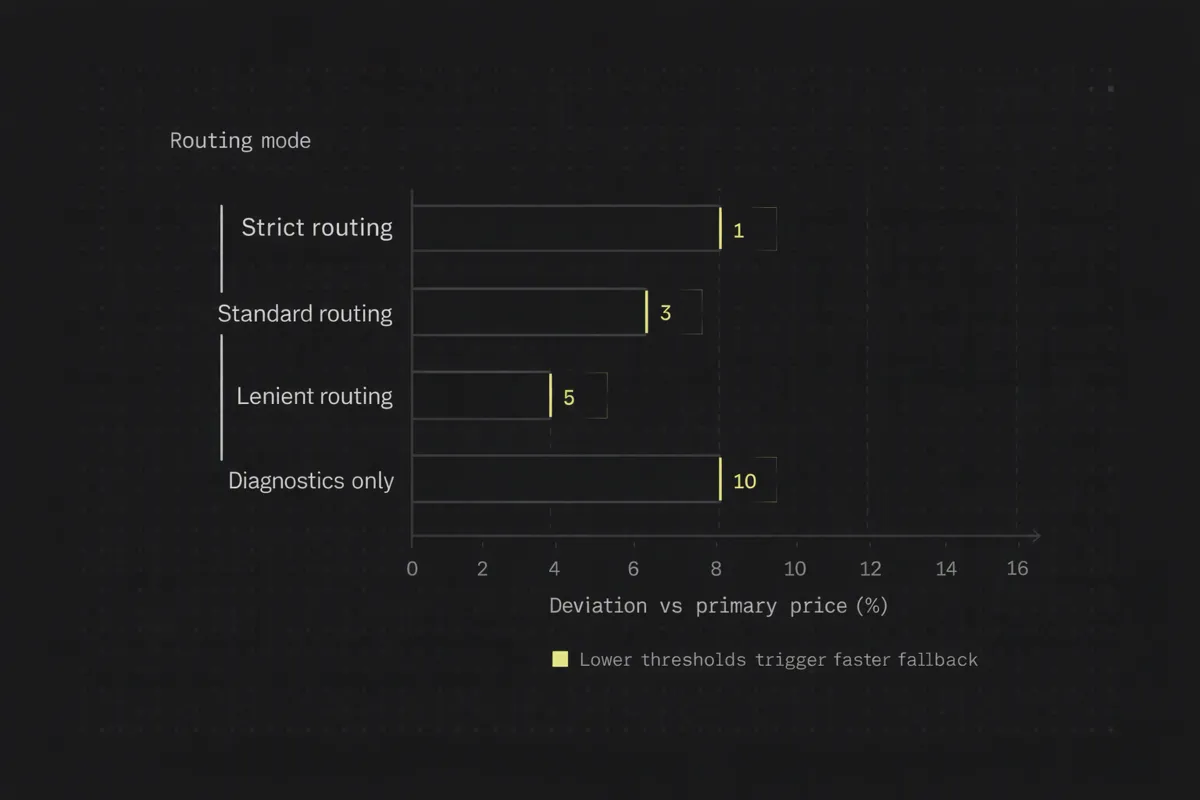
2. Validating cross-provider consistency
To avoid routing off a bad feed, implement consistency checks:
- Compare Codex prices to secondary feeds periodically
- Define thresholds, e.g.:
- If secondary price deviates more than X% from Codex for the same token/network, mark secondary as
DEGRADED
- If secondary price deviates more than X% from Codex for the same token/network, mark secondary as
This helps detect:
- Partial outages where one provider returns stale or corrupted data
- Network-specific issues (e.g., a single chain has lagging data)
Pattern: detecting degraded API responses (WebSocket vs REST)
To react quickly to outages, you need to monitor delivery methods, not just endpoints.
1. REST query health
Track for each provider:
- Response time percentiles (p50, p95)
- Error code distribution (408, 429, 503, 1020, application-level errors)
- Successful vs failed batch ratio
Mark REST as:
HEALTHYif p95 latency is within target and error rate < thresholdDEGRADEDif latency spikes or error rate crosses thresholdUNAVAILABLEif sustained failures occur
2. WebSocket/subscription health
For WebSockets/subscriptions (Codex and others):
- Track message frequency vs expected (e.g., ticks per second)
- Detect connection drops and reconnections
- Monitor gaps in price updates longer than your tolerated window
When a subscription stream slows or stalls:
- Keep the UI connected, but fall back to less frequent REST refresh
- Show a subtle indicator: “Live stream degraded; updating via snapshots.”
Codex’s queries vs subscriptions guidance maps well here:
- Use subscriptions for live feeds where you want the lowest latency
- Use queries for accuracy-first views and for backfilling missing data
Putting it together: reference architecture for resilient cross-chain price feeds
A reference architecture for a high-traffic, GeckoTerminal-style cross-chain trading UX could look like this:
-
Data layer
- Codex as the primary onchain data supergraph
- Secondary providers (GeckoTerminal/CoinGecko Pro, DexScreener) for backup
- Optional direct chain indexers for critical pairs
-
Delivery layer
- Codex subscriptions for live prices and candles
- Codex queries for historical data and initial page loads
- Webhooks for backend events (e.g., large trades, prediction market moves)
- REST/WebSocket integrations with secondary providers
-
Resilience layer
- Central health monitor for each provider and delivery method
- Provider selection and fallback logic for widgets and routing
- Exponential backoff respecting each provider’s error guidance
- Local cache for last-known prices with age-aware validity checks
-
UX layer
- Clear, unobtrusive indicators when data is stale or degraded
- Tiered data freshness: trading-critical vs charts vs portfolios
- Consistent behavior during outages (no random widget failure modes)
Using this pattern lets you treat GeckoTerminal and similar APIs as useful but non-critical components instead of single points of failure.
For the primary price layer, many teams now reach for specialized infra such as codex.io, which is built to power Coinbase, TradingView, Uniswap, Magic Eden, Rainbow, MoonPay and other high-traffic apps without custom indexing.