Overview: Choosing the Right Blockchain Data API for High‑Traffic Apps
If you’re building a trading interface, wallet, NFT marketplace, or prediction market frontend, your blockchain data API is mission‑critical.
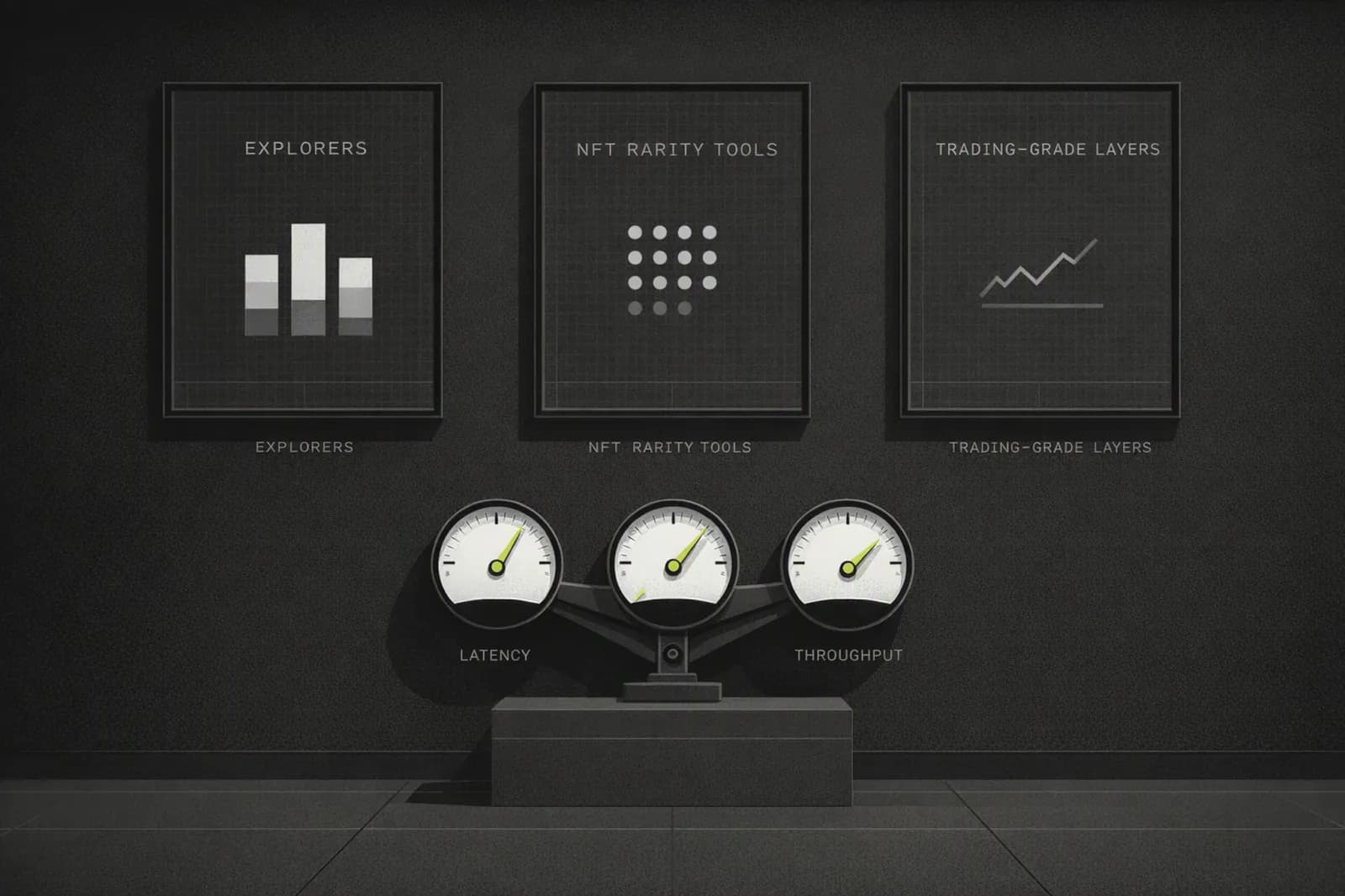
The challenge: many APIs that look similar on the surface (explorers, NFT rarity tools, generalized data platforms, trading‑grade layers) are designed for very different workloads.
This comparison breaks down:
- Polygon block explorer APIs (e.g., PolygonScan)
- NFT rarity tooling APIs (NFTGo, OpenRarity, HowRare, GoRarity)
- Multi‑chain data platforms (The Graph, Bitquery, Moralis, Pinax)
- Trading‑grade data layers (with a focus on Codex)
We’ll evaluate them on latency, coverage, enrichment depth, and fit for analytics on blockchain in high‑traffic products.
For a wider survey of the landscape, see the pillar guide: “Top Crypto On‑Chain APIs: From Raw Blockchain Data to Analytics Dashboards.”
The Three Main Categories of Blockchain Data APIs
Before comparing individual products, it’s useful to separate three core categories.
1. Block Explorers (Lookup‑First APIs)
Block explorers like PolygonScan are built for human and developer lookup, not streaming trading data.
Typical capabilities:
- Transaction lookup by hash or address
- Contract source code and ABI verification
- Event log inspection and gas price data
- Basic token transfer and balance queries
PolygonScan explicitly positions its developer API as a community service, with a 5 requests/second rate limit.
This is perfect for:
- Lightweight backend lookups
- Debugging and verification tools
- Internal dev utilities
But it’s not suited to:
- High‑traffic trading terminals
- Consumer apps with thousands of concurrent users
- Real‑time charting and analytics
2. NFT Rarity Tools (Collection‑Focused APIs)
NFT rarity tools solve a different problem: ranking collectables within collections.
Examples:
- NFTGo v1.1 API
- Ethereum‑only in v1.1
- Focused on NFT metadata, holders, pricing, transactions, trading flows
- Free trial rate limit at 5 RPS, with a separate multichain v2
- OpenRarity / GoRarity / HowRare
- Standardize rarity scoring
- Aim to make rarity formulas more transparent and verifiable
Key takeaway:
- Great for NFT marketplace discovery, collector dashboards, and trait‑based ranking.
- Narrow by design – they do not aim to be full token/wallet/trading data layers.
OpenRarity itself highlights that rarity models historically diverge across publishers, which is important for product teams designing rarity‑based UX.
3. Trading‑Grade Blockchain Data Layers
A newer category focuses on normalized, multi‑chain, real‑time, enriched data.
Representative platforms:
- The Graph Token API
- Bitquery
- Moralis
- Pinax
- Codex (trading‑native, token + prediction markets)
These platforms converge on a similar promise:
- Multi‑chain coverage through a unified schema
- Normalized token and wallet data
- Aggregated metrics (volume, liquidity, holders)
- Low‑latency access via queries, streams, or subscriptions
Codex, Pinax, and The Graph also explicitly mention AI/MCP and streaming‑ready access, positioning themselves as backbones not just for apps, but for agentic workflows as well.
Evaluation Criteria: What Matters for High‑Traffic Products?
When your app is trading‑adjacent or consumer‑grade, four criteria matter most.
1. Latency & Throughput
You need predictable, low‑latency responses and sufficient rate limits.
Key questions:
- Can the API handle thousands of concurrent users or bots?
- Are there regional endpoints and streaming options to minimize round‑trip time?
- What happens when you hit rate limits (429s, throttling, unpredictable lag)?
2. Coverage (Networks, Assets, Wallets)
Multi‑chain and long‑tail coverage is increasingly table stakes.
Look for:
- Number of supported chains
- Coverage of long‑tail tokens and new launchpad assets
- Wallet coverage at scale
3. Enrichment Depth
Raw RPC or explorer data is messy.
Trading‑grade pipelines should expose:
- Clean token and wallet entities
- Historical and real‑time prices
- OHLC candles and chart data
- Aggregated metrics (liquidity, volume, unique wallets)
- Prediction market events and markets
4. Fit for High‑Traffic Analytics & Trading UX
Finally, match the product to your workload.
Ask:
- Is this API designed for lookup, analytics, or trading‑grade workloads?
- Does it handle streaming updates vs. polling loops?
- Does it consolidate multiple data categories (tokens, wallets, NFTs, prediction markets) into one API?
Explorers vs Trading‑Grade APIs: Why PolygonScan Isn’t Your Trading Backend
PolygonScan’s API is a good example of a polygon block explorer API that’s fantastic for verification but limited for trading.
PolygonScan: Strengths
- Human‑friendly explorer with contract source code and ABI
- Transaction, block, and token transfer lookup
- Event log inspection for debugging
For many engineering teams, it’s the first stop when:
- Inspecting a contract
- Verifying a transaction
- Checking gas prices and basic network stats
PolygonScan: Constraints for High‑Traffic Apps
However, several documented constraints make it a poor fit for high‑traffic analytics:
- Rate limit: 5 requests/second
- Explorer‑style endpoints, not trading‑grade metrics
- No native OHLC, liquidity, or multi‑chain abstraction
In practice, that means:
- You must build and maintain your own indexers, ETL pipelines, and caches.
- You’ll struggle to serve thousands of concurrent users with real‑time charts.
- Latency and consistency become your responsibility instead of the provider’s.
For serious trading apps, explorers are better used as secondary tools for verification rather than as the primary data substrate.
NFT Rarity APIs: Specialized, Powerful, but Narrow
For NFT marketplaces, rarity APIs are indispensable.
What NFT Rarity APIs Do Well
Tools like NFTGo, OpenRarity, HowRare, and GoRarity are optimized for:
- Trait‑based rarity scoring and ranking
- NFT metadata normalization
- Collection‑level analytics like holder distribution and floor prices
NFTGo v1.1 in particular:
- Focuses on Ethereum NFTs
- Offers holders, pricing, transactions, analytics, and trading flows
- Starts with a 5 RPS free‑trial limit
Where Rarity APIs Fall Short for General Analytics
Beyond rarity UX and collection analytics, these APIs are not:
- Comprehensive token data engines
- Multi‑chain trading analytics platforms
- Wallet‑centric data layers
OpenRarity and HowRare themselves emphasize that there are many ways to compute rarity, and no single model is perfect.
For marketplace product teams, this is a UX consideration, not just a data problem.
But if you’re building:
- A general crypto trading terminal
- A DeFi or cross‑chain portfolio dashboard
- A prediction market frontend
You will still need a dedicated token and wallet data layer alongside your rarity API.
Multi‑Chain Data Platforms: The Graph, Bitquery, Moralis, Pinax
Several platforms now operate between explorers and trading‑grade infra.
The Graph Token API
The Graph’s Token API beta was launched in part to fill the gap left by SimpleHash’s shutdown.
Key characteristics:
- Built on Substreams, emphasizing direct streams of data rather than RPC polling.
- Powers apps, analytics, and AI on 60+ chains overall.
- Token API beta starts with Ethereum, Arbitrum, BSC, Polygon, Optimism, and Base.
It is well‑suited for:
- Wallets and dashboards needing normalized token data
- Block explorers upgrading from raw RPC
- AI‑agent workflows requiring token metadata and balances
Bitquery
Bitquery is a broad analytics engine.
Highlights:
- 40+ chains supported
- Multiple delivery modes: GraphQL, WebSocket, Kafka, gRPC
- Regional endpoints to optimize latency
- WebSocket concurrency caps: 100 (Pro), 1,000 (Scale), unlimited (Enterprise)
- Rate limits: 30/min (Personal), 90/min (Pro), 240/min (Scale), custom (Enterprise)
Bitquery’s docs recommend batching multiple addresses/tokens per query to avoid rate‑limit issues and competition for shared compute.
Moralis
Moralis focuses on developer‑friendly data APIs.
Key traits:
- Throughput‑based rate limits over a rolling 4‑second window
- 40 req/s (free and starter), 80 req/s (pro), 200 req/s (business), custom enterprise
- Multichain support with first‑class REST endpoints
Moralis is strong for:
- General Web3 backend data needs
- Moderate‑traffic consumer apps
- Teams that prefer REST over GraphQL or custom streams
Pinax
Pinax is an emerging player focused on performance.
Claims:
- 11 chains supported
- 99.99% endpoint uptime
- Sub‑second hot paths
- <80ms p50 read latency for Token API
Pinax also productizes prediction market data, which positions it closer to trading‑grade use cases alongside token and wallet data.
Trading‑Grade Layers: Why Codex is Designed for High‑Traffic Trading Apps
A trading‑grade blockchain data API must handle millions of users, sub‑second UX, and complex aggregates.
Codex is explicitly positioned as a trading‑native layer.
Codex at a Glance
Codex’s public positioning includes:
- 70M+ tokens
- 80+ networks
- 700M+ wallets
- Thousands of transactions per second indexed and enriched
Codex emphasizes:
- "Fastest & most reliable blockchain data API"
- Trading‑grade, sub‑second latency
- All‑in‑one token + prediction market data
It already powers leading apps including:
- Coinbase
- TradingView
- Uniswap
- Magic Eden
- Rainbow
- MoonPay
- Farcaster clients
- pump.fun and other DeFi/consumer apps
This social proof matters for teams that prioritize reliability and correctness over "hacky" free solutions.
Enrichment Depth: Beyond Raw Logs
Codex’s data pipeline turns raw chain events into structured objects.
The API exposes:
- Real‑time and historical token prices (USD and native)
- Trading‑ready chart data (OHLC, candles, volume)
- Aggregated metrics: liquidity, volume, unique wallets, TVL‑like stats
- Cross‑chain holders and balances
- Scam filtering, token metadata, launchpad coverage
- Prediction market data for Polymarket and Kalshi (events, markets, trades, trader analytics)
This aligns directly with high‑traffic trading UX requirements.
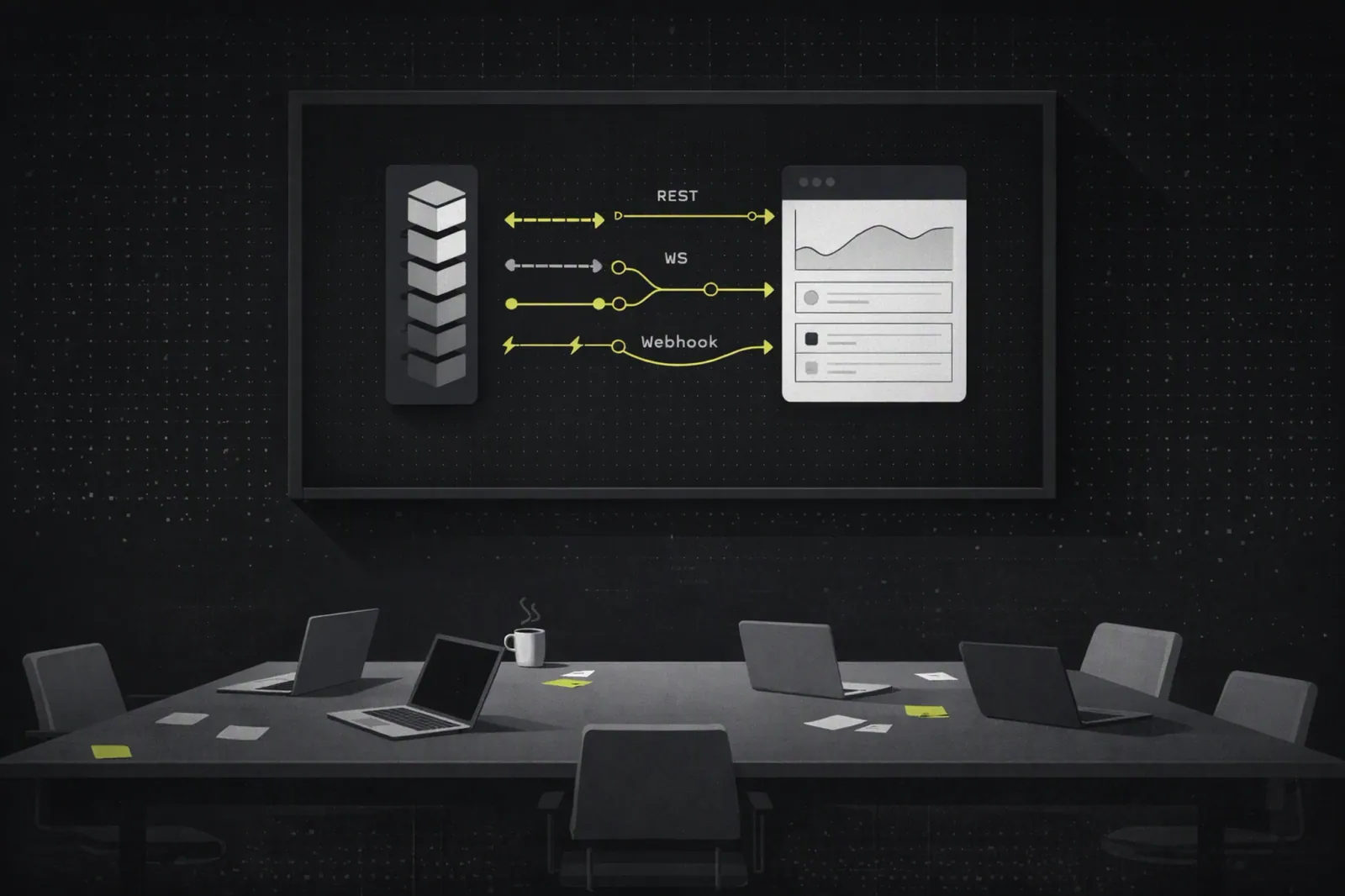
Streaming, Subscriptions, and AI/MCP
Modern trading apps avoid constant polling.
Codex supports:
- Queries for historical/backfill data
- Subscriptions and webhooks for live updates
- AI/MCP‑friendly surfaces for agentic workflows
That allows product teams to:
- Drive real‑time charts without noisy polling loops
- Power bots and automated trading strategies
- Feed AI agents consistent, trading‑ready data
"We Index the Chain So You Don’t Have To"
Codex’s core belief is that builders shouldn’t waste time parsing raw chain data.
In practice, this means:
- No need to run your own indexers or RPC clusters.
- No custom ETL pipelines per chain.
- No stitching together separate providers for tokens, wallets, NFTs, and prediction markets.
Engineering teams can focus on features, not on maintaining fragile backend infra.
Comparison Table: Explorers vs Rarity Tools vs Trading‑Grade Layers
Below is a high‑level comparison focused on latency, coverage, enrichment depth, and workload fit.
| Category | Example APIs | Rate Limits / Latency (Indicative) | Coverage | Enrichment Depth | Best Fit |
|---|---|---|---|---|---|
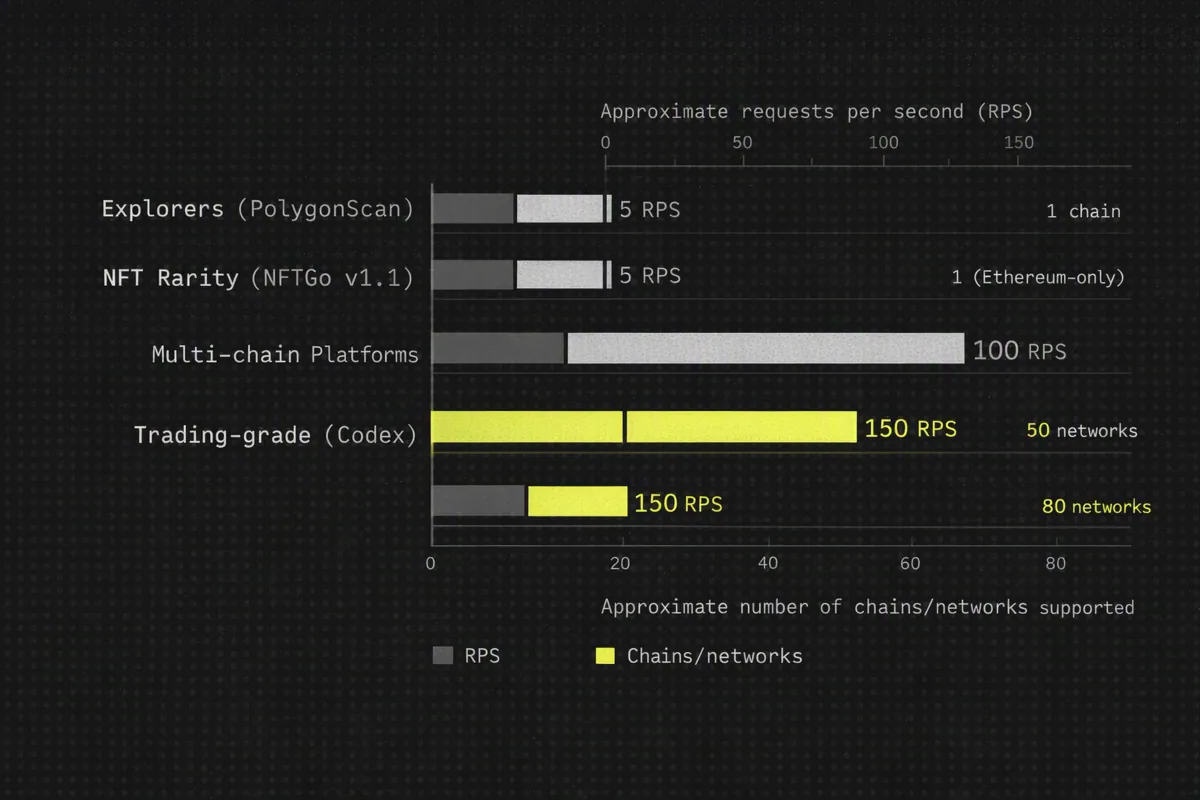
| Block Explorers | PolygonScan | 5 RPS (community service) | Single chain (Polygon) | Raw transactions, balances, logs | Lookup, debugging, verification |
| NFT Rarity Tools | NFTGo v1.1, OpenRarity, HowRare | ~5 RPS free (NFTGo), formula‑driven rarity | Mostly Ethereum, some multichain via separate APIs | Rarity scores, metadata, holders, NFT prices | NFT marketplaces, collector tools |
| Multi‑Chain Data Platforms | The Graph, Bitquery, Moralis, Pinax | 30–240/min (Bitquery); 40–200 req/s (Moralis); sub‑second p50 (Pinax) | 40–60+ chains typical | Token balances, transfers, holders, some OHLC | Wallets, dashboards, analytics, block explorers |
| Trading‑Grade Layers | Codex | Sub‑second positioning; production‑grade throughput | 80+ networks, 70M+ tokens, 700M+ wallets | Prices, OHLC, aggregates, holders, scam filters, prediction markets | High‑traffic trading UIs, CEX/DEX frontends, consumer apps |
Here’s a simplified visual comparison of rate limits and chain coverage across major categories.
Recommendations by Use Case
Choosing the “best blockchain data API” depends on what you’re building.
1. Debugging, Contract Verification, and Light Backend Lookups
Use:
- PolygonScan (and similar explorers)
Why:
- Excellent for per‑transaction and per‑contract inspection.
- Low volume, human‑centric workflows.
Avoid:
- Using explorers as your primary analytics backend for high‑traffic apps.
2. NFT Rarity UX and Marketplace Discovery
Use:
- NFTGo, OpenRarity, HowRare, GoRarity
Why:
- Specialized rarity scoring, trait analytics, collection stats.
- Great for ranking, filtering, and collection insights.
Pair with:
- A token/wallet data layer for portfolio views, cross‑chain balances, and trading metrics.
3. Cross‑Chain Wallets, Dashboards, and Analytics Tools
Use:
- The Graph Token API
- Bitquery
- Moralis
- Pinax
Why:
- Unified token schema across many chains
- Streaming options (Substreams, WebSocket, gRPC)
- Reasonable throughput for dashboards and analytics queries
4. High‑Traffic Trading Interfaces, CEX/DEX Frontends, and Consumer Apps
Use:
- Codex as a trading‑grade data layer
Why:
- Sub‑second, trading‑ready data for prices, candles, aggregates, holders.
- Coverage across 80+ networks, 70M+ tokens, 700M+ wallets.
- Dedicated prediction market endpoints (Polymarket, Kalshi).
- Proven at scale powering Coinbase, TradingView, Uniswap, Magic Eden, Rainbow, MoonPay, and more.
This is the category where latency, correctness, and breadth of coverage are non‑negotiable.
Actionable Steps for Product & Engineering Teams
If you’re evaluating blockchain APIs today, here’s a pragmatic approach:
Define your primary workload.
- Trading, portfolios, dashboards, NFT rarity, AI agents, or debugging?
Map your data requirements.
- Chains: which networks and launchpads do you need?
- Assets: tokens, NFTs, prediction markets?
- Metrics: prices, OHLC, liquidity, volume, holders, rarity?
Benchmark latency and rate limits.
- Measure p50/p95 latencies for your key endpoints.
- Check rate limit policies (per second/minute, rolling windows, concurrency caps).
Assess enrichment depth.
- Does the API expose trading‑ready candles or just raw transfers?
- Are scam filtering and token metadata handled for you?
- Can you query cross‑chain wallets and prediction markets in one place?
Evaluate operational complexity.
- Do you need to run your own indexers and ETL pipelines?
- Will you stitch together multiple vendors (tokens, NFTs, prediction markets), or can you consolidate?
Start with a narrow integration, then expand.
- Many teams begin with charts or pricing endpoints.
- Once latency and coverage are validated, they expand to holders, aggregates, and prediction markets.
For trading‑adjacent workloads, a trading‑grade layer like Codex typically saves months to years of in‑house data engineering and reduces infra risk.