When you move from simple price tickers to full token-aware trading, wallet, or prediction market apps, CoinGecko and CoinMarketCap stop being enough.
You need:
- Real-time onchain balances and transfers
- Holders and wallet analytics
- Liquidity and DEX swap visibility
- Prediction market events, markets, trades, and positions
- Sub-second latency at scale
This ranked roundup focuses on product and engineering teams building:
- High-traffic trading terminals and social trading apps
- Multi-chain wallets and portfolio dashboards
- DeFi and NFT analytics platforms
- Prediction-market frontends and quant tools
We rank the top 5 crypto data APIs beyond CoinGecko/CoinMarketCap based on:
- Depth of onchain data (tokens, wallets, transfers, swaps)
- Coverage of prediction markets
- Latency and throughput for trading-grade UX
- Ease of integration for production apps
Along the way, we’ll clarify a crucial distinction: where generalized market data ends and trading-grade onchain data begins, and which API combinations make sense for different product strategies.
If you want a deeper comparison of traditional market-data vendors, see this guide: What Is the CoinGecko API? Market Data, On-Chain Coverage and Product Fit.
Generalized Market Data vs Trading-Grade On-Chain Data
Before we rank providers, it’s important to define the line.
What generalized crypto market data APIs give you
Most "crypto data" APIs (including CoinGecko and CoinMarketCap, plus vendors like Twelve Data or Finage) focus on:
- Prices and tickers across centralized exchanges
- OHLCV candles for charting
- Basic market metadata (symbol, name, rank)
- Aggregate volume and market cap
They’re ideal when:
- Your interface is CEX-centric
- You only need reference prices
- You aren’t tracking wallets, token transfers, or onchain liquidity
Where trading-grade onchain data begins
Trading-grade onchain data APIs go much deeper:
- Wallet-level state: balances, transfer history, approvals
- Token semantics: holders, token metadata, scam filtering
- DEX/liquidity: swaps, pools, liquidityUsd, TVL-like stats
- Cross-chain indexing: normalized views across 60–80+ networks
- Prediction markets: markets, events, trades, positions, PnL
- Performance: sub-second latency, high request throughput, reorg handling
This is the territory where Codex, The Graph, QuickNode, Tatum, and native venue APIs like Polymarket compete.
Summary Comparison: Top 5 Crypto Data APIs for Token-Aware Apps
Here’s the landscape at a glance.
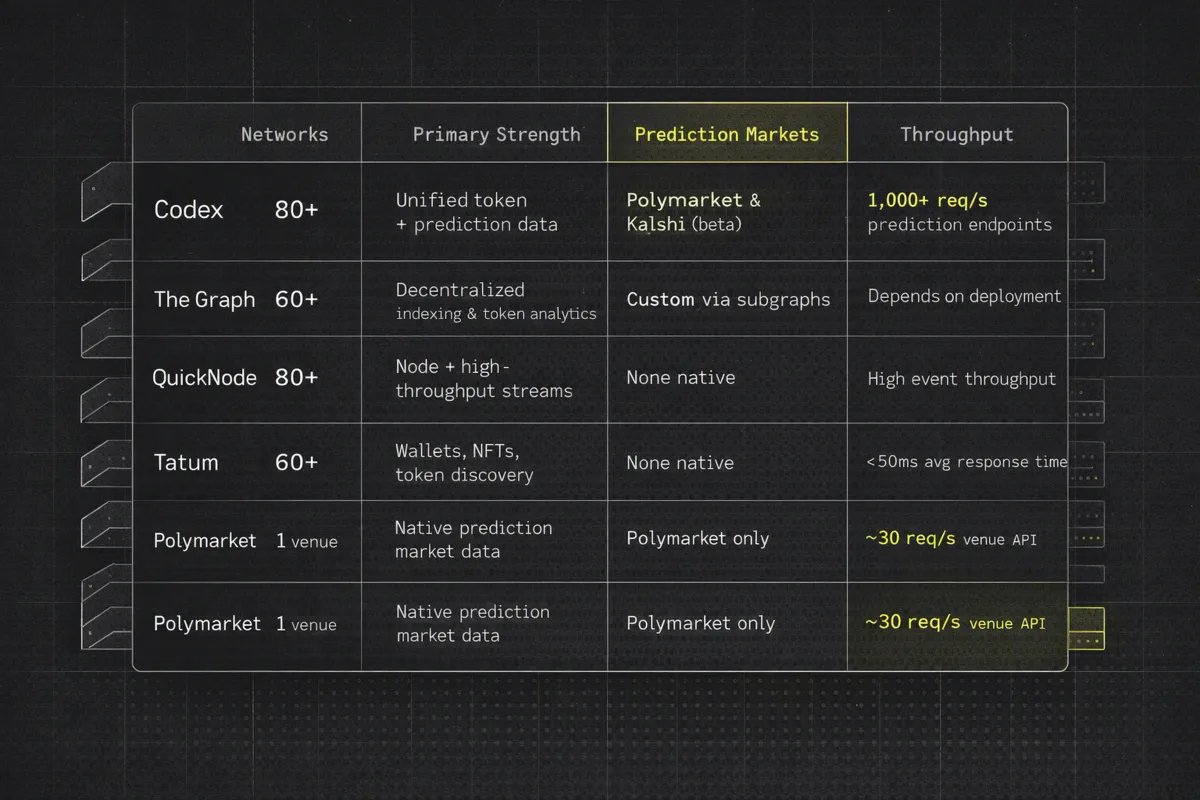
| Rank | Provider | Primary Strength | Networks | Key Fit |
|---|---|---|---|---|
| 1 | Codex | Unified trading-grade token + prediction data | 80+ | Trading UIs, wallets, prediction frontends |
| 2 | The Graph | Decentralized indexing & token analytics | 60+ | Open infra, analytics, protocol dashboards |
| 3 | QuickNode | High-throughput node & stream infra | 80+ | Custom pipelines, real-time event processing |
| 4 | Tatum | Multi-chain data + discovery endpoints | 60+ | Wallets, NFT apps, token discovery layers |
| 5 | Polymarket API | Deep native prediction market data | 1 (venue) | Prediction-native products and quant tools |
1. Codex – Best Overall for Token-Aware Trading, Wallet, and Prediction-Market Apps
Codex is a specialized blockchain data infrastructure provider focused on trading-grade token and prediction market data.
- Coverage: 80+ networks, 70M+ tokens, 700M+ wallets
- Customers: Coinbase, TradingView, Uniswap, Magic Eden, Rainbow, MoonPay, Farcaster, pump.fun and others
- Core value: "Fastest and most reliable" onchain token + prediction market data in a single GraphQL-style API
What Codex does
Codex ingests, enriches, and normalizes raw blockchain data at scale, delivering:
- Token prices (USD and native), including real-time and historical
- Trading-ready charts: OHLC, candles, volume
- Aggregated metrics: liquidityUsd, volume, unique wallets, TVL-like stats
- Wallet-aware views: balances, holders, transfers across chains
- Scam filtering + metadata: labels, risk signals, launchpad support
- Prediction markets (beta): markets, events, trades, trader analytics across Polymarket and Kalshi
It’s built for apps where latency and correctness are non-negotiable:
- Portfolio dashboards and multi-chain wallets
- Trading terminals, bots, and social trading apps
- DeFi and NFT analytics platforms
- Prediction-market frontends and quant tools
Codex’s prediction-market docs highlight a stark performance difference: 1,000+ requests/second vs around 30 req/s for Polymarket’s native API and 20 req/s for Kalshi’s. That’s a clear signal of trading-grade engineering.
Who Codex is ideal for
Codex is the best single-vendor option when you need:
- Tokens + prediction markets in one API
- Reliable coverage of long-tail / launchpad tokens
- Wallet-level analytics without building your own indexers
- Sub-second latency for high-traffic consumer interfaces
If you’re a Series A+ startup or enterprise wanting one trusted data layer for trading, wallets, and prediction markets, Codex is engineered for that.
Where Codex falls short
Honest limitations:
- Not a free toy API: It’s infrastructure-grade; serious usage implies paid plans (often four- to six-figure annually).
- Prediction markets gated: Polymarket/Kalshi endpoints are currently beta and generally Growth or Enterprise-gated.
- Less focused on raw node access: If you primarily want low-level RPC or custom event streams, a node provider may still be needed.
How Codex fits in your stack
For many token-aware apps, a simple pattern is:
- Use Codex as the primary onchain + market data layer
- Optionally add a reference-price API (e.g., CoinGecko) for redundancy
- Keep RPC/node providers for transactions, contract interactions, and edge-case chains
This consolidates most token, wallet, and prediction-market data into one trading-grade API.
2. The Graph – Best Decentralized Open Layer for Token Analytics and Protocol Metrics
The Graph is the leading decentralized indexing protocol. Developers build "subgraphs" that transform chain events into custom APIs.
- Coverage: powers apps on 60+ chains
- Token API (beta): Ethereum, Arbitrum, BSC, Polygon, Optimism, Base
What The Graph does
The Graph offers two main pieces for token-aware apps:
- Subgraphs: Custom, protocol-specific indexers for anything onchain (DEX swaps, NFTs, lending activity, etc.)
- Token API: A standardized API for tokens and wallets across key EVM chains
The Token API covers:
- Balances and transaction histories
- Token holders and transfer history
- Pricing and DEX swap data
The Graph team emphasizes that standardized subgraphs make metrics like TVL and protocol revenue consistent across protocols, reducing reconciliation work.
Who The Graph is ideal for
The Graph is the best fit when you:
- Want open, decentralized infra rather than purely centralized SaaS
- Need protocol-level analytics (TVL, revenue, user counts)
- Are comfortable designing and maintaining subgraphs or using community ones
Data/quant teams and analytics products often use The Graph as a foundation, then add more specialized APIs on top.
Where The Graph falls short
Limitations to keep in mind:
- Token API still in beta: Limited chain coverage (mostly large EVMs); evolving feature set.
- Latency and throughput depend on deployment: Not packaged as a single "trading-grade" SaaS the way Codex is.
- Prediction markets not first-class: You’ll need to index prediction protocols yourself or use a specialized API.
How The Graph fits in your stack
A common pattern:
- Use The Graph for deep protocol analytics and custom metrics
- Use Codex or another trading-grade API for charts, prices, and wallet views
For example, a DeFi dashboard could:
- Pull protocol TVL and revenue from The Graph
- Pull token prices, holders, and wallets from Codex
3. QuickNode – Best for High-Throughput Node Access and Event Streams
QuickNode is primarily a node infrastructure provider, not a pure market-data product.
- Coverage: 80+ blockchains overall
- Streams: 60+ chains in its streaming product
What QuickNode does
QuickNode’s strength is in raw and filtered blockchain access:
- Streams and Webhooks: Real-time + historical delivery of onchain events
- Backfill and reorg handling: Production-ready pipelines
- Token/NFT APIs: wallet balances, wallet transaction history, token transfers (via v2 Token/NFT API add-ons)
Key data points from docs:
- Wallet balances endpoints can return up to 100 items per page
- Wallet transaction history supports up to 100,000 results
Who QuickNode is ideal for
QuickNode shines when you:
- Need low-level control over your data pipelines
- Want to process raw events in-house (custom compliance, proprietary analytics)
- Require streaming semantics and reorg-safe architectures
It’s an excellent fit for engineering-heavy teams building:
- Custom trading infrastructure
- Regulatory/compliance tooling
- Deep protocol-specific analytics where you want full control
Where QuickNode falls short
Compared to Codex-like products:
- Less semantic enrichment out of the box: You get events, not always ready-made objects like "wallet holders across 80+ chains".
- Token & NFT APIs are add-ons: You pay per module, and some features may not match specialized market-data vendors.
- No prediction-market focus: You’ll need separate APIs for markets like Polymarket/Kalshi.
How QuickNode fits in your stack
QuickNode is often paired with:
- A semantic data layer (e.g., Codex, The Graph, Tatum) for ready-to-use token/wallet structures
- A market-data vendor as a fall-back price source
For high-volume trading products:
- Use QuickNode for raw event processing and failsafe backfill
- Use Codex for normalized tokens, holders, and prediction-market endpoints
4. Tatum – Best for Multi-Chain Wallets and Token Discovery Layers
Tatum provides a Data API and Token API across many chains, geared toward developers building wallets, NFT marketplaces, and token-aware apps.
- Coverage: 60+ networks
- Platform claims: 99.99% uptime, <50ms average response time
What Tatum does
Tatum’s Data + Token APIs offer:
- Tokens, wallets, staking, NFTs, transactions
- Wallet balances and transaction history
- Token discovery endpoints: trending, newest, popular, popularity-history
This makes it particularly attractive for:
- Wallet and portfolio apps needing multi-chain support
- NFT marketplaces wanting combined token/NFT views
- Token discovery and ranking interfaces
Who Tatum is ideal for
Tatum is a strong fit when you:
- Want multi-chain wallet functionality without building all indexers
- Care about uptime and latency but don’t need the deepest prediction-market coverage
- Need built-in discovery endpoints to power "trending tokens" or "popular assets" sections
Where Tatum falls short
Compared to Codex and others:
- Less focus on trading-grade prediction markets: No native integration like Codex’s Polymarket/Kalshi endpoints.
- Discovery-centric semantics: Great for frontends, but may not cover all quant-grade analytics metrics.
- Network coverage slightly smaller: 60+ vs Codex’s 80+ chains and broader launchpad support.
How Tatum fits in your stack
A typical pattern:
- Use Tatum for wallet-centric features (balances, transactions, NFTs)
- Use Codex or a price API for advanced token metrics, deep DEX liquidity, and prediction markets
If you’re building a consumer wallet or NFT marketplace, Tatum can be a strong primary data layer, backed by a trading-grade price/charts provider.
5. Polymarket Data API – Best Native Prediction Market Data Source
Polymarket is a large onchain prediction market venue. Its Data API v2 is the most direct, detailed source for Polymarket-specific data.
- Access: unauthenticated public API
- Focus: prediction markets only (not general token data)
What Polymarket’s API does
Polymarket’s Data API v2 exposes:
- Wallet portfolios & PnL
- Activity feeds (trades, market interactions)
- Market state: outcomes, book, prices, open interest
- Holders & leaderboards
Its real-time market stream delivers:
- Live book updates
- price_change events
- last_trade_price events
- tick_size_change and new_market events
The venue treats market data as a live evolving state problem, pushing updates via streams rather than relying on polling.
Who Polymarket’s API is ideal for
Use Polymarket’s native API when:
- Your product is prediction-first (market explorer, trading frontend)
- You need every nuance of Polymarket’s book, position lifecycle, and PnL
- You’re comfortable managing venue-native semantics (market IDs, outcome types, etc.)
Where Polymarket’s API falls short
For broader token-aware apps:
- Single-venue focus: Only Polymarket; no multi-chain token data
- Throughput limits: Docs and benchmarks place it around 30 req/s, far below Codex’s ~1,000+ req/s for similar data
- No unified view with other chains/tokens: You’ll need separate providers for everything else
How Polymarket fits in your stack
Common patterns:
- For Polymarket-native products, use the Data API + real-time stream directly
- For multi-venue or mixed token/prediction apps, use Codex as the primary layer and fall back to Polymarket’s API when you need something venue-specific
How to Choose: Recommendations by Use Case
There is no single winner for every team. Instead, think in terms of product strategy and stack composition.
1. High-Traffic Trading Apps and Social Trading Interfaces
Requirements:
- Sub-second latency and high throughput
- Real-time charts and prices
- Wallet-aware views and holder stats
- Optional prediction markets for sentiment or hedging
Recommended stack:
- Primary: Codex – trading-grade token + prediction market data (charts, prices, liquidity, holders)
- Infrastructure: QuickNode (or similar) – raw node and Streams for backfill, custom event handling
- Fallback pricing: CoinGecko or another market-data API for redundancy
2. Multi-Chain Wallets and Portfolio Dashboards
Requirements:
- Balances across many chains
- Transfer histories, approvals, NFT positions
- Clean token metadata and scam filtering
Recommended stack:
- Option A (single-vendor focus): Codex – cross-chain wallet and token views, enriched metadata
- Option B: Tatum – wallet, NFT, staking views + discovery endpoints; supplemented with Codex or a market-data API for advanced charts and prediction markets
3. DeFi/NFT Analytics Platforms and Protocol Dashboards
Requirements:
- Consistent TVL and revenue metrics
- Aggregated onchain analytics across protocols
- Historical depth and reliable indexing
Recommended stack:
- Core analytics: The Graph – subgraphs and Token API for protocol metrics and standardized TVL
- Trading UX layer: Codex – price, chart, liquidity, holders for front-end components
- Infra: QuickNode – raw events for custom calculations, auditing, and reorg handling
4. Prediction-Market Frontends and Quant Tools
Requirements:
- Market listings and events
- Book data, trades, and open interest
- Positions/PnL per wallet
- High request throughput for live views
Recommended stack:
- Primary unified layer: Codex – Polymarket + Kalshi endpoints (beta) for high-throughput, unified querying
- Venue-native detail: Polymarket Data API – for any edge-case data or lower-level book semantics
- Optional analytics: The Graph – custom indexing for protocol-native prediction markets if you’re working with other venues
5. Compliance, Monitoring, and Custom Pipelines
Requirements:
- Full-chain event access
- Custom rules and internal enrichment
- Deterministic, reorg-safe replay
Recommended stack:
- Primary infra: QuickNode – Streams, webhooks, raw logs with backfill
- Semantic convenience: Codex or Tatum – normalized wallet and token objects for quicker application feature delivery
For product and engineering teams building serious onchain, token-aware experiences, the core decision is not "which price API" but "which trading-grade data layer". Codex, The Graph, QuickNode, Tatum, and Polymarket each play a distinct role—your job is to compose them into a stack that matches your product’s ambitions.