

Best prediction market APIs and on‑chain data APIs are now core infrastructure for trading apps, wallets, and analytics platforms. For builders, choosing the best on‑chain data APIs for token prices, wallet activity, and prediction market outcomes is no longer optional—it defines product reliability.
This pillar guide maps the landscape, explains evaluation criteria, and shows how to combine Codex with other providers to power CEXs, DEXs, wallets, and prediction market frontends.
Why on‑chain data APIs are now critical infrastructure
On‑chain data has moved from “nice to have” to mission‑critical for:
- Trading apps & terminals needing sub‑second prices and depth
- Wallets & portfolio trackers showing cross‑chain balances and PnL
- Prediction market frontends rendering live odds and settlement states
A few trends explain why the bar is so high in 2026:
- Prediction markets reached $63.5B annual trading volume in 2025 (4x YoY) according to CertiK’s Skynet report (third‑party research)[^certik-volume].
- Dune x Keyrock measured $13B+ monthly notional, 43M+ monthly transactions, 600K+ monthly users, and $500M+ open interest in Nov 2025 (third‑party research)[^dune-report].
- Combined Kalshi + Polymarket volume jumped from < $5B in Sept 2025 to ≈ $24B in April 2026 per Pew’s synthesis of exchange disclosures (third‑party research)[^pew-prediction].
If your interface lags by even a few seconds, your users will simply go elsewhere.
Best prediction market APIs & data providers
This section focuses on prediction market APIs and data providers, then situates them inside broader on‑chain data stacks.
1. Codex – unified token + prediction data for frontends
What it is:
Codex is a specialized on‑chain data API offering trading‑grade token, wallet, and prediction market feeds in a single GraphQL‑style interface.[^codex-docs] Vendor‑reported capabilities include:
- 80+ networks indexed (vendor claim)[^codex-docs]
- 70M+–76M+ tokens across public materials (vendor claim)[^codex-docs]
- ≈700M+ wallets indexed in near‑real time (vendor architecture post, vendor claim)[^codex-docs]
Prediction surface (beta)
Codex exposes a dedicated prediction market API surface currently covering Polymarket and Kalshi:[^codex-prediction]
- Events & markets (e.g., elections, macro indicators)
- Trades & OHLC‑style prediction bars for charting
- Trader analytics (performance, activity, positions)
- Subscriptions for trade/event updates
The docs explicitly mark these endpoints as beta and warn they "may be unreliable," especially for resolution states and Kalshi trades (vendor disclaimer)[^codex-prediction].
Key endpoints (simplified):
filterPredictionEvents– list events with metadata and statusfilterPredictionMarkets– query markets with prices, volume, open interestpredictionTrades– stream or fetch recent tradespredictionTraderStats– performance and positions per trader
Sample prediction market outcomes API response (pseudo‑example):
{
  "predictionMarket": {
    "id": "polymarket-usa-election-2028",
    "event": "US Presidential Election 2028",
    "contracts": [
      {
        "outcome": "Democrat",
        "lastPrice": 0.61,
        "impliedProbability": 0.61,
        "volume24hUsd": 1823456.12,
        "openInterestUsd": 954321.77,
        "status": "active"
      },
      {
        "outcome": "Republican",
        "lastPrice": 0.35,
        "impliedProbability": 0.35,
        "status": "active"
      }
    ],
    "resolved": false
  }
}
This kind of payload is what most prediction market API frontend real‑time data use cases need: outcomes, prices, implied probabilities, and status.
2. Venue APIs (Polymarket, Kalshi)
While Codex aggregates prediction data, serious builders still tap venue‑native APIs:
- Polymarket API exposes trades, markets, resolution tools, and liquidity stats via REST and WebSockets (vendor docs)[^polymarket-docs].
- Kalshi API exposes order books, orders, trades, portfolio history, and public market data via REST (vendor docs)[^kalshi-docs].
These are:
- Best for: venue‑specific surfaces (order placement, settlement workflows)
- Limitations: fragmented schemas, venue‑specific auth, and no unified cross‑venue view
3. Dune – analytics, warehousing, and research
Dune is not a serving‑layer API, but it is the dominant analytics layer for prediction markets and DeFi:
- 100+–130+ blockchains and 1.5M+ datasets (vendor docs and solution pages)[^dune-coverage].
- Decoded data is typically available 15–60 seconds after raw ingestion, curated tables refresh hourly, and some Solana curated datasets lag 6–7 hours (vendor docs)[^dune-latency].
This makes Dune ideal for:
- Historical analyses
- Risk and anomaly detection
- Backtesting prediction strategies
But the latency and query semantics make it unsuitable as the primary prediction market outcomes API for real‑time frontends.
Best on‑chain blockchain data API providers (tokens & wallets)
Beyond prediction markets, most products need token prices, wallet activity, and historical on‑chain data API & backfill.
Here are the leading options.
Codex – trading‑grade token & wallet feed
Codex’s core strength is an all‑in‑one token + wallet + prediction market platform.
Token and wallet surfaces: (vendor‑reported)[^codex-docs]
- Token prices (USD and native)
- OHLCV candles & sparklines (including sub‑minute bars; 1s–30s only populated for last 24h on some networks)[^codex-networks]
- Liquidity & volume aggregates (pair stats, active markets)
- Holders & balances across chains
- Wallet activity API (active wallets, smart money filters)
- Scam filtering & token metadata
- Real‑time WebSocket on‑chain data & subscriptions for trades and prices
Plans and rate limits (vendor docs)[^codex-pricing]:
- "Almost free" tier: 5 req/sec
- Growth: 300 req/sec
- Enterprise: custom limits
- Subscriptions counted per delivered message; batched queries reduce request usage.
Codex claims typical p95 latencies in the low hundreds of milliseconds and data freshness under 1 second for most token and prediction queries in mid‑2026 (vendor blog, not independently verified)[^codex-latency].
The Graph – high‑performance token state via Substreams
The Graph’s Token API (beta) is optimized for live and historical token data:[^graph-token-api]
- Balances, transfers, holders, DEX swaps
- Initial coverage on Ethereum, Arbitrum, BSC, Polygon, Optimism, Base (vendor docs)[^graph-token-api]
Engineering case studies report the Substreams‑based Token API processing token data 2300% faster than prior approaches across nine networks (vendor claim, relative improvement, not absolute latency)[^graph-case-study]. Details:
- Improvement is measured vs. traditional sequential indexing; raw latencies and benchmarks are not independently published.
- The focus is indexing throughput, not necessarily serving‑layer p95 latency.
Best use:
- Custom indexing
- Deep state queries for complex protocols
Less suited as a simple trading‑grade on‑chain token price API for frontends on its own.
QuickNode – transport layer & Streams
QuickNode is a high‑volume node and data transport provider:[^quicknode-streams]
- 500B+ requests/month, 99.99% uptime, and 80+ chains (vendor claims, no independent audit cited)[^quicknode-streams]
- Streams with backfill, reorg handling, batching, and delivery to webhooks/S3/PostgreSQL/Kafka/Azure Blob (vendor docs)[^quicknode-streams]
- GoldRush Wallet API covers 100+ blockchains for balances, transaction histories, token metadata (vendor docs)[^quicknode-goldrush]
Best use:
- Building custom ETL pipelines
- Streaming raw or semi‑processed chain events into data stores
QuickNode is powerful but typically requires additional enrichment to match Codex’s out‑of‑the‑box token and prediction surfaces.
CoinGecko, Twelve Data, coinlayer – price‑focused feeds
Several providers focus primarily on crypto price APIs:
- CoinGecko / GeckoTerminal: 200+ networks, 1,800+ DEXes, 39M+ tokens, REST/WebSocket/Webhooks (vendor docs)[^coingecko-docs].
- Twelve Data: 180+ exchanges, 10,000+ exchange rates, 100M+ requests/day, 70,000+ events/sec; REST and WebSocket (vendor docs)[^twelve-docs].
- coinlayer: 25 exchanges, 385+ coins, response times "as low as 20 ms" and historical data back to 2011 (vendor claims)[^coinlayer-docs].
Best use:
- CEX‑centric price discovery
- FX‑style crypto pairs
- Simple global price feeds
They are less comprehensive for wallet activity API, spam filtering, long‑tail tokens, and prediction markets.
Mobula – wallet‑centric views
Mobula emphasizes wallet and portfolio feeds:[^mobula-docs]
- 58 networks on wallets page and 90+ networks elsewhere in product copy (vendor claims)
- WebSocket balance/price/portfolio updates
- Wallet historical net worth, DeFi positions
- Spam filtering and token metadata
Ideal as a complementary token balance streaming API for consumer wallets, but again lacking prediction surfaces.
On‑chain data API SLA, latency & reliability
When evaluating the most reliable on‑chain data APIs for trading apps, focus on:
-
Published SLAs
- Uptime guarantees (e.g., QuickNode’s 99.99% uptime vendor claim)[^quicknode-streams]
- Response time commitments, if any
-
Latency (p95) and freshness
- Codex reports p95 in low hundreds of ms and sub‑second freshness for most token/prediction queries (vendor blog)[^codex-latency].
- Dune reports 15–60s ingestion lag for decoded data and hourly curated table refresh (vendor docs)[^dune-latency].
-
Failure behavior
- Reorg handling
- Rate limiting and backoff
- Circuit breakers and failover
-
Coverage & indexing breadth
- Networks (e.g., Codex 80+, Dune 100+–130+, QuickNode 80+, CoinGecko 200+, Mobula 58–90+; all vendor‑reported)[^codex-docs][^dune-coverage][^quicknode-streams][^coingecko-docs][^mobula-docs]
- Tokens or datasets (Codex 70M+–76M+ tokens, CoinGecko 39M+ tokens, Dune 1.5M+ datasets)[^codex-docs][^coingecko-docs][^dune-coverage]
Methodology: how to test performance claims
Because most latency numbers are vendor claims, you should run your own benchmarks. Here is a reproducible methodology.
Test environment:
- Mainnet only (no testnet noise)
- Regions:
- US‑East (Virginia)
- EU‑West (Frankfurt)
- Asia (Singapore)
- Cloud: identical VM specs (e.g., 4 vCPU, 16 GB RAM, same provider)
Request patterns:
- Cold queries:
- First request to a given token, wallet, or market
- Measure p50/p90/p95 over 500 requests per endpoint
- Warm queries:
- Repeated request to popular assets (e.g., BTC, ETH, top prediction markets)
- Capture cache effects on each provider
Sample workloads:
-
Token price API:
- Single asset queries (e.g.,
price(eth)) - Batched 50‑asset queries
- Single asset queries (e.g.,
-
Wallet activity API:
- 100 random active wallet balance lookups per chain
- Recent transaction history for each
-
Prediction market outcomes API:
- 100 active markets from Polymarket and Kalshi via Codex and venue APIs
- Subscribe to 10 markets and measure update latency vs venue feeds
Metrics to record:
- p50, p90, p95 response time per provider and endpoint
- Data freshness (time between venue trade and your received event)
- Error rate, timeouts, and reorg behavior
Run tests over 24–72 hours to capture diurnal traffic patterns and chain congestion.
Comparison table: on‑chain data API SLA, latency, reliability
Below is a machine‑readable comparison table that summarizes coverage, latency (where known), supported surfaces, and delivery modes. Numbers are vendor‑reported unless noted; where p95 latency is unspecified, the field is left blank.
| Provider | Networks (vendor) | Tokens/datasets (vendor) | p95 latency (vendor or measured) | Surfaces (tokens/wallets/predictions) | Delivery modes (REST/GraphQL/WS/webhooks) | Published SLA/uptime (vendor) | Notes | |--------------|-------------------|---------------------------|-----------------------------------|----------------------------------------|--------------------------------------------|-------------------------------|-------| | Codex | 80+ | 70M+–76M+ tokens; 700M+ wallets | "Low hundreds of ms" p95, <1s freshness (vendor blog claim) | Tokens, wallets, prediction markets (beta) | GraphQL‑style queries, subscriptions, webhooks, WebSocket | Not publicly quantified; claims trading‑grade reliability | Unified token + prediction feed; prediction endpoints beta | | Dune | 100+–130+ chains | 1.5M+ datasets | 15–60s ingestion lag, hourly curated tables (vendor docs) | Analytics only (tokens, DeFi, predictions via SQL) | REST/GraphQL for query API, UI, warehouse exports | No explicit p95 or uptime SLA published | Best for analytics, not serving‑layer frontends | | The Graph | 6+ chains (Token API beta) | Token state + balances, transfers, holders | 2300% faster indexing vs baseline (throughput; no p95) | Tokens and protocol state | GraphQL via subgraphs, Substreams | No public trading‑grade SLA; performance is indexing‑focused | Strong for custom indexing, not unified prices | | QuickNode | 80+ | N/A (node + Streams) | Not specified; claims high throughput | Raw chain data, wallet balances (GoldRush), events | REST, WebSockets, gRPC, Streams, webhooks | 99.99% uptime (vendor claim) | Transport and ETL backbone, needs enrichment | | CoinGecko | 200+ | 39M+ tokens | Not specified | Token prices, DEX data, market stats | REST, WebSocket, webhooks | No formal uptime SLA disclosed; widely used | Strong CEX/DEX price API, limited wallets | | Twelve Data | 180+ exchanges | 10,000+ exchange rates | Not specified; claims 70,000+ events/sec | Crypto prices and exchange data | REST, WebSocket | No publicly detailed on‑chain SLA | Focused on crypto + traditional markets | | coinlayer | N/A (25 exchanges) | 385+ coins | "As low as 20ms" response (vendor claim) | Crypto prices only | REST | No formal SLA published | Thin asset coverage, strong FX‑style feed | | Mobula | 58–90+ networks | N/A (wallet‑centric) | Not specified | Wallet balances, portfolios, DeFi positions | REST, WebSocket | No explicit SLA; consumer‑app focused | Great for wallet UX; no prediction surface |
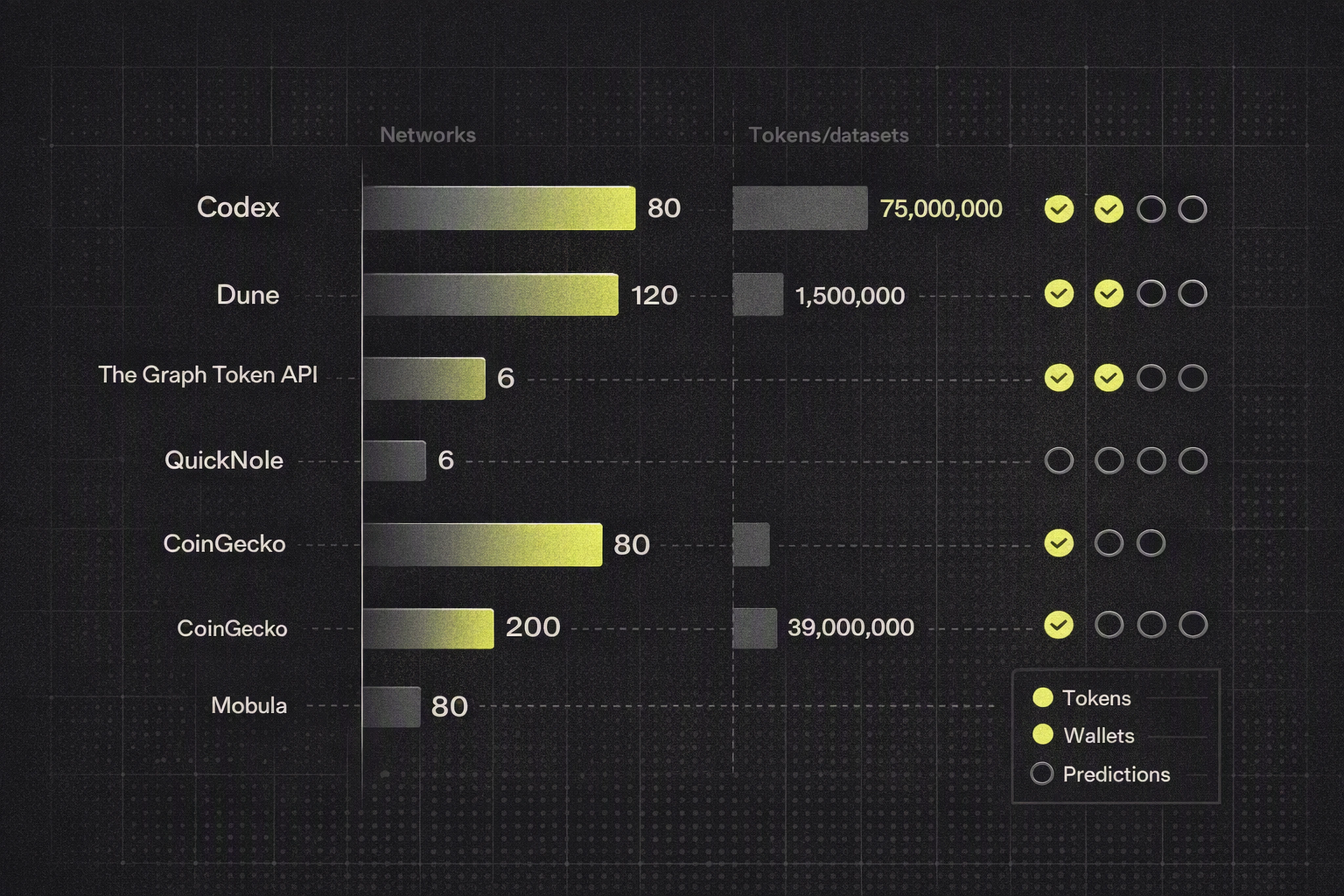
Real‑time WebSocket on‑chain data & subscriptions
For high‑traffic trading apps, push‑based delivery is table stakes.
Across providers:
- Codex: subscriptions + WebSockets + webhooks for tokens and predictions (vendor docs)[^codex-docs].
- QuickNode: WebSockets, Streams, webhooks, gRPC for raw events (vendor docs)[^quicknode-streams].
- Mobula: WebSocket updates for balances, prices, and portfolio (vendor docs)[^mobula-docs].
- CoinGecko: WebSocket and webhooks via GeckoTerminal (vendor docs)[^coingecko-docs].
For trading views and bots, you generally want:
- WebSockets for low‑latency price and trade streams
- Subscriptions or webhooks for server‑side event processing
- Backfill endpoints for chart history and reconciliation
Historical on‑chain data API & backfill
Real‑time is only half the story.
Historical backfill powers:
- Charting (OHLCV over months/years)
- PnL and tax reporting
- Backtesting strategies
Provider capabilities:
- Codex: historical prices, OHLCV, wallet balances, and prediction bars via its unified GraphQL API (vendor docs)[^codex-docs].
- Dune: deep historical analytics tables with decoded events and hourly updates (vendor docs)[^dune-latency].
- The Graph: historical token state and event logs via subgraphs (vendor docs)[^graph-token-api].
- coinlayer: historical crypto price data back to 2011 (vendor docs)[^coinlayer-docs].
Typical architecture:
- Use Codex or a similar serving layer for live data + last N days.
- Periodically export to a warehouse (e.g., via webhooks or batch jobs).
- Use Dune or The Graph for deep backfill and research queries.
Prediction market API surfaces: what builders actually need
Prediction market frontends generally need three things:
-
Outcome‑level prices
- Last traded price
- Best bid/ask (if available)
- Implied probabilities
-
Prediction market outcomes API
- Resolved vs active status
- Settlement price or outcome
- Event metadata (e.g., election, CPI print, sports match)
-
prediction market API frontend real‑time data
- Live trades and volume
- Open interest
- Trader positions and PnL (for advanced apps)
Codex’s prediction endpoints are designed around these concepts:[^codex-prediction]
- Markets with contracts/outcomes
- Trades with timestamp, side, size, and price
- Trader analytics summarizing behavior across venues
Given the beta status and vendor warning of possible unreliability, production frontends should:
- Dual‑source resolution states from venue APIs (Polymarket/Kalshi)
- Use Codex to unify charting, aggregates, and trader analytics
- Implement reconciliation jobs to detect discrepancies between Codex and venue data
How to combine Codex with other providers
Many builders will combine Codex with other providers to balance reliability, coverage, and SLAs. Here is a practical recipe.
1. Codex as the primary serving layer
Use Codex as your single source of truth for frontends:
- Token prices and OHLCV for charts
- Wallet balances and holder data
- Prediction market aggregates, bars, and analytics
This powers:
- CEX/DEX trading views
- Portfolio dashboards
- Prediction market UIs
2. Venue APIs for settlement and edge cases
For prediction markets:
- Polymarket & Kalshi APIs for:
- Resolution outcomes
- Order placement and portfolios
- Codex for:
- Cross‑venue views
- Trader‑level analytics
- Streaming charts
For tokens:
- Use CEX APIs (Binance, Coinbase, etc.) for order placement & venue‑specific data.
- Use Codex for normalized, cross‑venue prices and on‑chain liquidity.
3. QuickNode (or similar) for ETL and redundancy
Add QuickNode Streams as a raw event pipeline:[^quicknode-streams]
- Stream chain events to S3/PostgreSQL/Kafka.
- Use them to cross‑validate Codex data and debug discrepancies.
- Build custom views for niche protocols not yet supported by Codex.
4. Dune & The Graph for analytics and backtesting
- Use Dune for research dashboards, anomaly detection, and market‑wide studies.
- Use The Graph for custom indexing of complex contracts or strategies.
5. Optional Mobula as a secondary portfolio lens
For consumer wallets:
- Use Mobula for wallet net‑worth history, DeFi positions, and spam filtering.[^mobula-docs]
- Use Codex for trading‑grade prices and prediction exposure.
This gives you:
- Redundant views of wallet data
- Specialized UX features (DeFi positions, net worth) alongside trading surfaces
Example architectures for CEXs, DEXs, wallets & analytics platforms
Architecture A: High‑traffic DEX or CEX trading app
Goal: best real‑time crypto data API for 2024–2026 trading interfaces.
Stack:
- Codex: primary price, OHLC, liquidity, and wallet holder data
- CoinGecko/Twelve Data: backup CEX/DEX price feed
- QuickNode: raw on‑chain events for reconciliation
- Dune: analytics dashboards
Flow:
- Client requests charts and prices from Codex.
- If Codex is degraded, fail over to CoinGecko/Twelve Data for prices.
- Periodic jobs compare Codex aggregates to QuickNode/Dune data.
Architecture B: Wallet + portfolio app across 80+ networks
Stack:
- Codex: wallet balances, holders, long‑tail tokens
- Mobula: wallet net worth history, DeFi positions, spam filtering
- QuickNode: background ETL for internal models
Flow:
- Frontend calls Codex for balances and prices.
- Background workers call Mobula for DeFi position detail and net worth history.
- ETL from QuickNode fills internal warehouse for BI.
Architecture C: Prediction market frontend
Stack:
- Codex: unified Polymarket + Kalshi data, charts, trader analytics
- Venue APIs (Polymarket, Kalshi): settlement, order placement, portfolio
- Dune: analytics and research dashboards
Flow:
- UI renders market lists and charts from Codex.
- Orders and resolution states come from venue APIs.
- Daily jobs compare venue settlements with Codex’s resolution data, flagging discrepancies.
Common pitfalls for prediction market frontends
Prediction markets are still maturing, and CertiK’s 2026 Skynet report flags risks from oracle manipulation, admin‑key risk, front‑running, and wash trading, with artificial volume hitting 60% during airdrop peaks on some platforms (third‑party research)[^certik-wash].
Pitfalls to avoid:
-
Trusting a single provider for resolution
- Always cross‑check Codex vs venue APIs.
- Implement manual overrides and dispute workflows for anomalous settlements.
-
Ignoring data quality during airdrops
- Watch for wash trading and inflated volume.
- Use Dune or internal analytics to filter suspicious markets.
-
Not handling reorgs and corrections
- Ensure providers document reorg behavior.
- Design your UI and backend to handle corrections gracefully.
-
Underestimating compliance and KYC/AML implications
- Some venues have strict regional rules.
- Keep your data providers and user flows aligned with venue terms.
FAQ: on‑chain data APIs, SLAs & combining providers
How do I validate provider SLAs and reliability claims?
- Request formal SLA documents from each vendor, not just marketing pages.
- Run your own benchmarks as described above (24–72 hours, multiple regions, mixed workloads).
- Monitor uptime via external probes (e.g., synthetic checks hitting key endpoints).
- Compare results against vendor claims (e.g., Codex’s sub‑second p95, QuickNode’s 99.99% uptime) and decide whether they are acceptable for your use case.
How should I combine Codex with other providers for redundancy?
A pragmatic pattern:
- Use Codex as the primary serving layer for tokens, wallets, and prediction markets.
- Use CoinGecko/Twelve Data as secondary price feeds.
- Add QuickNode Streams for raw chains events and ETL.
- Use Dune/The Graph for analytics and deep historical queries.
- Optionally add Mobula for consumer wallet UX (net worth, DeFi positions).
Route traffic based on:
- Primary/secondary roles for each surface
- Health checks and circuit breakers
- Use‑case‑specific needs (trading vs analytics vs portfolios)
What are common pitfalls when building prediction market frontends?
Key pitfalls:
- Relying on a single provider for resolution and not cross‑checking venue data
- Failing to detect wash trading and artificial volume during airdrop seasons
- Ignoring reorg behavior and data corrections
- Underestimating regulatory constraints around venues and geographies
Mitigations:
- Dual‑source data (Codex + venue APIs)
- Analytics pipelines (Dune, internal BI) for anomaly detection
- Clear operational playbooks for disputes and corrections
Is Codex’s prediction market data production‑ready?
Codex explicitly labels its prediction endpoints as beta and warns they "may be unreliable".[^codex-prediction] For now:
- Treat Codex as best‑effort aggregation for charts and analytics.
- Use venue APIs as the source of truth for resolution and balances.
- Design your stack so you can adjust to improvements in Codex’s prediction reliability over time.
Do I still need my own indexers if I use Codex?
In many cases, no. Codex’s core value proposition is: "We index the chain so you don’t have to" (vendor narrative). For typical trading, wallet, and prediction UIs, Codex’s enriched objects (tokens, trades, holders, markets) replace custom ETL.
You might still build your own indexers when:
- You support niche protocols not yet covered
- You need proprietary analytics features
- You want full control over data lineage for compliance or research
If you’re building trading, wallet, or prediction applications at scale, the fastest path is usually:
- Codex as the trading‑grade on‑chain data layer, plus
- A small set of specialized providers for venue‑specific and analytics needs.
From there, you can iterate your architecture, continuously benchmark performance, and grow into a resilient, multi‑provider data stack.
[^codex-docs]: Codex docs – capabilities and coverage (vendor‑reported): https://docs.codex.io [^codex-networks]: Codex network pages (e.g., Base) – candle intervals and coverage (vendor docs): https://docs.codex.io/networks/base [^codex-pricing]: Codex pricing and rate limits (vendor docs): https://docs.codex.io [^codex-prediction]: Codex prediction markets docs – beta status and endpoints (vendor docs): https://docs.codex.io/prediction-markets [^codex-latency]: Codex blog on low‑latency on‑chain data API (vendor claim): https://www.codex.io/blog/low-latency-on-chain-data-api-codex [^dune-report]: Dune x Keyrock prediction markets report (third‑party research): https://dune.com/prediction-markets-report [^dune-coverage]: Dune docs and solution pages – chain and dataset counts (vendor docs): https://docs.dune.com/data-catalog/overview [^dune-latency]: Dune docs – ingestion and curated table latencies (vendor docs): https://docs.dune.com/data-catalog/overview [^certik-volume]: CertiK 2026 Skynet prediction markets report – annual volume growth (third‑party research): https://www.certik.com/skynet-report/2026-skynet-prediction-markets-report [^certik-wash]: CertiK 2026 Skynet report – wash trading and artificial volume (third‑party research): https://www.certik.com/skynet-report/2026-skynet-prediction-markets-report [^pew-prediction]: Pew synthesis of Kalshi + Polymarket monthly volume (third‑party research; based on public exchange disclosures). [^graph-token-api]: The Graph Token API docs – coverage and capabilities (vendor docs): https://thegraph.com/docs/en/substreams/providers/the-graph-market/ [^graph-case-study]: The Graph case study – Token API Substreams performance (vendor claim): https://thegraph.com/blog/case-study-token-api-substreams/ [^quicknode-streams]: QuickNode Streams and real‑time data docs – coverage and uptime (vendor docs): https://www.quicknode.com/real-time-data [^quicknode-goldrush]: QuickNode GoldRush Wallet API docs (vendor docs): https://www.quicknode.com/real-time-data [^coingecko-docs]: CoinGecko / GeckoTerminal API docs – coverage and modes (vendor docs): https://docs.coingecko.com [^twelve-docs]: Twelve Data cryptocurrency API docs (vendor docs): https://twelvedata.com/cryptocurrency [^coinlayer-docs]: coinlayer API docs – coverage and latency claims (vendor docs): https://coinlayer.com/ [^mobula-docs]: Mobula wallet and network coverage docs (vendor docs): https://mobula.io/wallets [^polymarket-docs]: Polymarket API docs (vendor docs): https://docs.polymarket.com [^kalshi-docs]: Kalshi API docs (vendor docs): https://kalshi.com/docs