

Most Reliable On‑Chain Data APIs for Trading Apps — Blockchain APIs for Trading
Modern trading apps live or die on data.
If your wallet views, charts, and order flows lag or show wrong numbers, users churn and risk teams panic.
This guide explains how to design a three‑layer blockchain API stack for trading:
- Raw RPC for writes and low‑level debugging
- Indexed data for wallet history and market views
- Enriched, trading‑grade APIs for PnL, holders, prediction markets, and risk
We’ll cover wallet history, trace transaction endpoints, decentralized wallet Web3 patterns, and how providers like Codex, The Graph, Bitquery, and Nodit fit together.
Meta title & description
- Meta title: Most Reliable On‑Chain Data APIs for Trading Apps | 2024
- Meta description: Learn how to choose the most reliable on‑chain data APIs for trading apps. Compare Codex, The Graph, Bitquery & Nodit and design a trading‑grade data stack.
Why trading apps need more than a node
Most teams start with an RPC node, then discover it’s not enough.
Ethereum’s JSON‑RPC is designed for sending transactions and reading basic state, not for full trading analytics.[^eth-rpc] Geth explicitly notes that receipts only show success/failure; full insight requires tracing and replaying execution locally.[^geth-trace]
For trading‑grade UX, you need three layers:
-
Node/RPC layer
- Send transactions, read blocks and logs
- Debug low‑level behavior
-
Indexed data layer
- Wallet history, transfers, simple aggregates
- Cross‑block queries (e.g., all swaps for a pair)
-
Enriched trading layer
- Prices, OHLC, liquidity, holders, PnL, labels
- Prediction market data, trader analytics
Codex, The Graph, Bitquery, and Nodit all position above raw nodes in this stack.[^eth-rpc][^codex-docs][^graph-token-api]
Methodology: how we compare blockchain APIs
To make this guide useful for product and engineering teams, we use consistent definitions.
How we define key metrics
- Networks: Distinct L1s and L2s exposed via public docs or marketing pages (e.g., Ethereum, Arbitrum, Polygon).[^ graph-scale][^bitquery-scale][^nodit-scale]
- Tokens: Unique token contracts indexed and exposed as queryable assets (Codex cites 70M+ tokens as of 2024).[^codex-scale]
- Wallets: Unique addresses with activity or holdings, deduplicated at provider level (Codex reports 700M+ wallets).[^codex-scale]
- Latency (sub‑second): Median API response times under 1,000 ms for common read queries, per vendor claims (e.g., BlockchainAnalysis.io cites <500 ms responses).[^blockchainanalysis-scale]
- Throughput: Indexed or processed transactions per second, as reported by vendors.
All figures are vendor claims as of 2024–2025, cited to public docs or launch blogs. Always benchmark in your own environment before committing.
The three‑layer stack: RPC, indexers, and enriched trading APIs
1. RPC / node layer
The RPC layer is your write surface and low‑level debug tool.
What RPC gives you
- Send transactions (
eth_sendRawTransaction) - Read blocks, receipts, basic logs (
eth_getBlockByNumber,eth_getTransactionReceipt) - Chain configuration (gas price, chain ID)
Limitations for trading apps
- No built‑in wallet history
- No PnL, price, or OHLC data
- No holder aggregates or prediction market stats
Ethereum’s docs are explicit: JSON‑RPC is a low‑level interface, not a trading API.[^eth-rpc]
2. Indexed data APIs
Indexed APIs sit on top of nodes, replaying blocks and transactions into queryable stores.
What indexers provide
- Wallet transaction history across blocks
- Transfers and token holder snapshots
- Basic aggregates (e.g., volume by day)
Examples:
- The Graph: Subgraphs over 60+ networks, with 1.27T queries served and 75K projects as of mid‑2024.[^graph-scale]
- Bitquery: GraphQL + WebSocket/gRPC across 40+ chains, with 300+ DEX datasets and 40,000+ developers.[^bitquery-scale]
3. Enriched trading‑grade APIs
Enriched APIs solve the final mile: they expose trading objects, not raw events.
What enriched trading APIs add
- Real‑time and historical prices (USD + native)
- Chart data: OHLC, candles, volumes
- Wallet‑level PnL, labels, scam/bot scores
- Prediction markets: events, markets, trader stats
Codex is a leading example here, with 70M+ tokens, 80+ networks, and 700M+ wallets indexed, plus Polymarket/Kalshi prediction markets in beta.[^codex-scale][^codex-prediction]
Wallet history: from raw logs to trader dashboards
Wallet UX is now the primary control plane for trading, not just a key manager.[^eth-wallets]
Building a trading‑grade wallet history requires more than eth_getLogs.
Raw vs indexed wallet history
Raw RPC approach
- Filter logs per address for each token contract
- Resolve transfers, swaps, mints/burns manually
- Stitch data across networks and protocols
Indexed / enriched approach
- One API call returns:
- Full transaction history for a wallet
- Token holdings and changes over time
- Network breakdown (e.g., Ethereum vs Arbitrum)
- PnL per token and overall portfolio
Codex’s wallet Trader Dashboard recipe shows how this can look: identity, PnL, trading history, holdings, labels, and first funding data in a single view.[^codex-wallet]
Key wallet transaction fields for trading apps
For trading UX, wallet history should expose:
-
Asset‑level detail
- Token symbol, address, decimals
- Side: buy/sell, mint/burn, transfer in/out
-
Price & PnL
- Fill price and current price
- Realized and unrealized PnL
- Holding period estimates
-
Risk & behavior signals
- scammerScore, botScore (where supported)
- First funding source (CEX, faucet, other wallets)
- Token creation/migration counts
Codex models many of these directly in its wallet stats (including rolling windows like 1D/1W/30D/1Y and last transaction time).[^codex-wallet]
Trace transaction: when you need full execution detail
Trading apps often need to know exactly what happened inside a transaction.
Geth’s tracing docs explain why: receipts only show outcome, while traces replay execution to expose call flow, gas usage, state changes, and touched addresses.[^geth-trace]
When to use trace transaction APIs
Use trace APIs when you need:
-
Complex DeFi decoding
- Multi‑step swaps via routers and aggregators
- Nested calls, flash loans, MEV bundles
-
Risk & compliance
- Full path of funds through contracts
- All addresses touched during execution
-
Performance tuning
- Gas profile for specific contracts
- Identifying hotspots in trading strategies
Tracing vs indexed vs enriched
-
Tracing
- Pros: Maximum detail, precise call tree
- Cons: Heavy, slow, complex to maintain
-
Indexed wallet/market views
- Pros: Fast, good for history and simple aggregates
- Cons: Limited insight into inner call paths
-
Enriched trading APIs (like Codex)
- Pros: Tracing complexity is abstracted into trading‑grade objects (swaps, trades, wallets, events)
- Cons: Less control over raw traces, though often exposed via advanced endpoints
For most high‑traffic trading apps, you want enriched APIs for 95% of flows, with trace APIs reserved for debugging and specialized analytics.
Decentralized wallet Web3 patterns: account abstraction & wallet‑call RPCs
Wallet infrastructure is changing fast.
Ethereum’s roadmap frames account abstraction as a way to improve UX via batching, gas sponsorship, and flexible security.[^eth-aa]
Key standards and proposals
-
ERC‑4337 (Account Abstraction via EntryPoint)
- Smart account wallets with bundlers and paymasters
- Enables sponsored gas and custom validation logic
- Official spec: https://eips.ethereum.org/EIPS/eip-4337
-
EIP‑5792 (Wallet Calls API, draft)
- Proposes new wallet‑call RPCs for batched calls and capability discovery
- Explicitly states legacy transaction RPCs are insufficient for modern wallet UX.[^eip-5792]
These changes matter because they shift more logic into the wallet, and the wallet needs better data.
What this means for trading data APIs
Trading‑grade wallet APIs must:
- Support smart accounts and EOAs
- Surface batched transaction semantics
- Provide per‑call pricing and impact analysis
Codex’s unified wallet model — including PnL, holdings, labels, and network breakdowns — is designed to adapt as smart accounts become the norm.[^codex-wallet]
Best on‑chain data APIs for trading apps (2024)
Teams searching for the best on‑chain blockchain data API providers for trading apps tend to compare Codex, The Graph, Bitquery, and Nodit.
Below is a concise comparison across coverage, latency, features, cost, and best use case.
Provider comparison: Codex vs The Graph vs Bitquery vs Nodit vs DIY
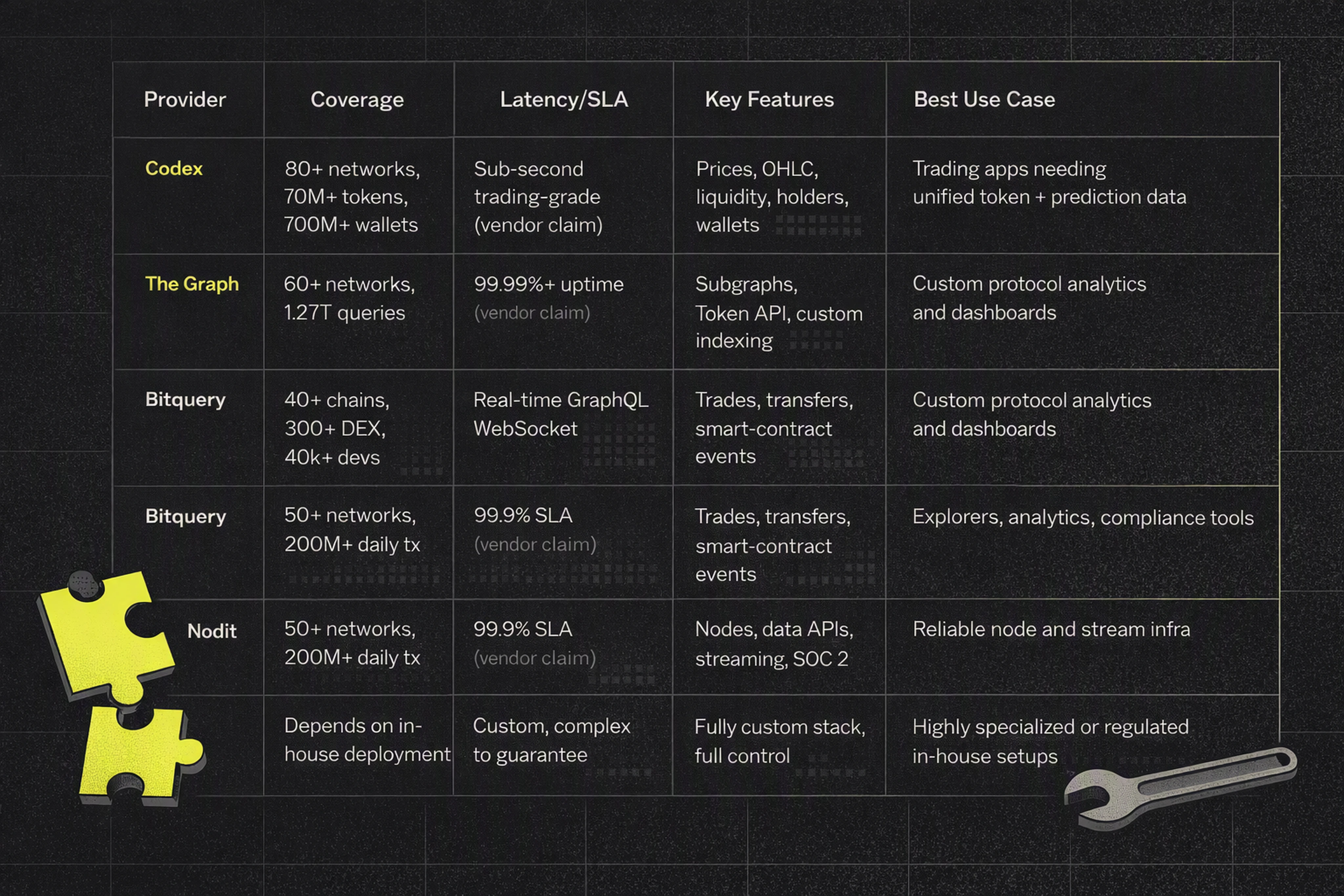
Codex (trading‑grade on‑chain data)
- Coverage
- 80+ networks, 70M+ tokens, 700M+ wallets, 16 launchpads as of 2024.[^codex-scale]
- Latency / SLA
- Positioned as sub‑second, trading‑grade performance; used in high‑traffic apps (Coinbase, TradingView, Uniswap, Magic Eden, Rainbow, MoonPay, Farcaster, pump.fun).[^codex-home]
- Features
- Token prices (USD + native), OHLC/candles, volume
- Liquidity, volume, unique wallets, TVL‑like aggregates
- Holders and balances across chains, scam filtering, token metadata
- Prediction market data (Polymarket & Kalshi, markets/events/trades/trader analytics) in beta.[^codex-prediction]
- Cost model
- Premium infra, suitable for four‑ to six‑figure annual contracts
- Best use case
- Best on‑chain data provider for trading apps needing unified token + prediction market data and production‑grade wallet analytics.
The Graph (indexing and query engine)
-
Coverage
- 60+ networks on main site, 1.27T queries served, 75K projects, 100+ indexer nodes as of 2024.[^graph-scale]
-
Latency / SLA
- Claims 99.99%+ uptime and 60–98% lower monthly costs vs self‑hosted infra; performance depends on subgraph and network.[^graph-scale]
-
Features
- Subgraphs for custom indexing and queries
- Token API beta for Ethereum, Arbitrum, BSC, Polygon, Optimism, Base after SimpleHash shutdown, built on Substreams.[^graph-token-api]
-
Cost model
- Query‑based pricing on The Graph Network
-
Best use case
- Flexible indexing for custom protocols and analytics dashboards; strong building block for best crypto data APIs for high traffic trading apps when paired with specialized trading‑grade layers.
Bitquery (multi‑chain data platform)
-
Coverage
- 40+ chains, 30+ data products, 300+ DEX datasets, and 40,000+ developers as of 2024.[^bitquery-scale]
-
Latency / SLA
- Real‑time GraphQL, WebSocket, Solana gRPC; performance tuned for streaming.
-
Features
- Trades, transfers, smart‑contract events
- Analytics powering companies like Nansen, Chainalysis, Binance.[^bitquery-scale]
-
Cost model
- Tiered plans and enterprise deals
-
Best use case
- Detailed protocol‑level data and API for blockchain explorers, analytics tools, and compliance‑oriented use cases.
Nodit (node + stream infrastructure)
-
Coverage
- 50+ blockchain networks, 200M+ daily transactions as of 2024.[^nodit-scale]
-
Latency / SLA
- 99.9% SLA; real‑time node/data/stream products.
-
Features
- Nodes, data APIs, streaming pipelines (WebSocket, gRPC)
- SOC 2 Type II compliance.[^nodit-scale]
-
Cost model
- Usage‑based + enterprise contracts
-
Best use case
- Reliable node and stream infra underneath indexers and enriched APIs.
DIY (build your own stack)
-
Coverage
- Whatever you deploy: your own nodes/indexers per chain
-
Latency / SLA
- Fully your responsibility; can match best‑in‑class with significant investment
-
Features
- Full control but you must build:
- Wallet history
- Price and chart pipelines
- Holder aggregates, labels, risk scores
- Full control but you must build:
-
Cost model
- High engineering + DevOps cost; infra bills across multiple clouds and chains
-
Best use case
- Only justified for very specialized or regulated contexts where in‑house control outweighs speed to market.
For most reliable on‑chain data APIs for trading apps, Codex plus a node provider (or Nodit) is a pragmatic, high‑leverage combination.
Designing your stack: API layers over RPC providers
To ship fast and avoid data headaches, use a layered approach.
1. Choose a robust RPC provider
Pick a provider that covers your core networks with strong SLAs.
- Focus on: Ethereum, major L2s (Arbitrum, Optimism, Base), and any alt‑L1s you support
- Requirements:
- High uptime
- Clear rate limits
- Good observability
You can also self‑host critical nodes for redundancy.
2. Add indexed wallet & protocol views
Use indexers or hosted subgraphs for:
- Wallet transaction history
- Protocol‑specific views (DEX, lending, NFTs)
- Custom analytics tables
The Graph, Bitquery, or your own indexing pipeline can serve here.
3. Layer enriched trading APIs (Codex)
Codex gives you trading‑grade objects so you don’t have to stitch raw data.
Use Codex for:
-
Token data
- Real‑time prices, OHLC, liquidity, volume
- Holders and balances across chains
- Scam filtering and clean token metadata
-
Wallet data
- PnL, holdings, labels, network breakdowns
- First funding, scammerScore, botScore
-
Prediction markets
- Polymarket and Kalshi markets, events, trades
- Trader analytics, OHLC‑style bars for markets[^codex-prediction]
This unified layer lets you build wallet transaction history and prediction market API frontend real‑time data without a bespoke pipeline per chain.
4. Use tracing selectively
Reserve trace transaction endpoints for:
- Deep debugging of complex DeFi calls
- Compliance investigations
- Advanced protocol R&D
In most trading apps, indexed and enriched APIs should cover the main UX.
Practical implementation patterns: wallet, charts, prediction markets
Pattern 1: Decentralized wallet Web3 trading dashboard
Combine RPC + Codex to create a single wallet view.
-
Authentication
- Connect wallet via Web3 provider (e.g., MetaMask, smart account SDKs)
-
Data fetch
- Use Codex wallet endpoints for:
- Holdings, PnL, network breakdown
- Trading history (swaps, mints, transfers)
- Labels and risk scores
- Use Codex wallet endpoints for:
-
Optional tracing
- If a transaction fails or looks suspicious, call a trace endpoint to inspect the call tree.
Result: A trading dashboard where users see not just balances, but performance, risk, and history in one place.
Pattern 2: Trading‑ready charts and prices
You need best real‑time crypto data API trading 2024 style performance for charts.
-
Use Codex for:
- Price streams and OHLC candles
- Volume and liquidity metrics per token
-
Implement:
- WebSocket subscriptions for live updates
- Local cache for historical bars
This avoids reconciling multiple price feeds or building your own candle engine.
Pattern 3: Prediction market frontends
Prediction markets are becoming mainstream infra.[^codex-prediction][^graph-token-api]
To build prediction market API frontend real‑time data:
-
Use Codex prediction market endpoints for:
- Events (e.g., elections, sports)
- Markets and contracts per event
- Trades, positions, and trader stats
- OHLC‑style bars for market prices
-
UX features:
- Live odds and implied probabilities
- Trader leaderboards and PnL
- Market depth and volume
Codex’s unified API makes it the best on‑chain data provider prediction market frontends for many teams.
FAQ: blockchain APIs for trading apps
What are the best on‑chain data APIs for trading apps?
For most teams, the best on‑chain data APIs for trading apps combine:
- A robust RPC provider for transaction writes
- Codex for trading‑grade token, wallet, and prediction market data
- Optional indexers like The Graph or Bitquery for custom protocol views
Codex’s breadth (70M+ tokens, 80+ networks, 700M+ wallets) and focus on PnL, holders, charts, and prediction markets make it a strong default for trading‑adjacent products.[^codex-scale]
What are the best crypto data APIs for high traffic trading apps?
High‑traffic apps (CEXs, DEXs, wallets) typically use:
- Codex for prices, charts, wallet analytics, prediction markets
- Nodit or similar for reliable multi‑chain nodes
- The Graph or Bitquery for tailored analytics
This combination balances performance, reliability, and flexibility for millions of requests per day.[^codex-home][^graph-scale][^bitquery-scale][^nodit-scale]
What are the best prediction market APIs data providers?
The best prediction market APIs data providers today include:
- Codex: Live Polymarket and Kalshi data (markets, events, trades, trader analytics, OHLC‑style bars) in beta.[^codex-prediction]
- The Graph: Polymarket subgraphs and position/time‑series queries.[^graph-token-api]
- Dune: Dedicated prediction market datasets for Polymarket and Kalshi.[^dune-scale]
Codex stands out for unified trading‑grade wallet + token + prediction market data in one API.
How do I choose an API for blockchain data vs a node provider?
Use a node provider when you need:
- To send transactions and manage mempool interactions
- Low‑level access to blocks, receipts, and logs
Use an API for blockchain enriched data (Codex, Bitquery, The Graph) when you need:
- Wallet history and PnL
- Prices, charts, and liquidity metrics
- Holders, labels, and prediction markets
Most trading apps need both layers.
When do I need tracing vs indexed on‑chain data?
You need trace transaction APIs when:
- Investigating complex DeFi flows
- Doing compliance or forensic work
- Optimizing gas usage at the call‑tree level
For normal UX (wallet history, charts, PnL), indexed and enriched APIs like Codex are usually sufficient and far easier to operate.
How can decentralized wallet Web3 apps expose trading‑grade wallet data?
Decentralized wallet Web3 apps can expose trading‑grade wallet data by:
- Connecting users’ wallets via Web3 providers or smart account SDKs
- Fetching holdings, PnL, labels, and history from enriched APIs like Codex
- Using optional trace endpoints when deeper inspection is required
This pattern lets wallets behave like full trading terminals without building custom indexers per chain.
If you’re building a trading app, wallet, or prediction market frontend at scale, the fastest path is:
- Plug into Codex for unified, trading‑grade on‑chain data
- Pair it with your preferred node provider for writes
- Add custom indexing only where you truly need bespoke views
You index the chain only where it’s strategic.
Codex indexes the rest so you don’t have to.
[^eth-rpc]: Ethereum.org, "JSON-RPC API," accessed 2024, https://ethereum.org/developers/docs/apis/json-rpc/ [^geth-trace]: Geth, "EVM Tracing," accessed 2024, https://geth.ethereum.org/docs/developers/evm-tracing [^codex-docs]: Codex Docs, overview, accessed 2024, https://docs.codex.io/ [^codex-scale]: Codex.io, homepage scale claims (70M+ tokens, 80+ networks, 700M+ wallets, 16 launchpads, thousands of tx/s), accessed 2024, https://www.codex.io/ [^codex-home]: Codex.io, customer logos and positioning (Coinbase, TradingView, Uniswap, Magic Eden, Rainbow, MoonPay, Farcaster, pump.fun), accessed 2024, https://www.codex.io/ [^codex-wallet]: Codex Docs, "Trader Dashboard" wallet recipe (PnL, holdings, labels, scammerScore, botScore, first funding, rolling windows), accessed 2024, https://docs.codex.io/recipes/wallets/trader-dashboard [^codex-prediction]: Codex Docs, "Prediction Markets" (Polymarket and Kalshi data in beta, markets/events/trades/trader analytics, OHLC bars), accessed 2024, https://docs.codex.io/prediction-markets [^graph-scale]: The Graph, main site metrics (1.27T queries, 75K projects, 100+ indexers, 60+ networks, 99.99%+ uptime, 60–98% cost savings), accessed 2024, https://thegraph.com/ [^graph-token-api]: The Graph Blog, "Announcing The Graph Token API," including chain coverage and Substreams performance claims in response to SimpleHash shutdown, accessed 2024, https://thegraph.com/blog/token-api-the-graph/ [^bitquery-scale]: Bitquery, platform scale (40+ chains, GraphQL/WebSocket/Solana gRPC, 30+ data products, 300+ DEX, 40,000+ developers; customers like Nansen, Chainalysis, Binance), accessed 2024, https://bitquery.io/ [^nodit-scale]: Nodit, infra claims (50+ networks, 99.9% SLA, 200M+ daily tx, SOC 2 Type II), accessed 2024, https://www.nodit.io/ [^blockchainanalysis-scale]: BlockchainAnalysis.io, API metrics (52 chains, sub‑500ms responses, 1B+ labeled addresses), accessed 2024, https://blockchainanalysis.io/api [^dune-scale]: Dune, platform scale (130+ chains, 1.5M+ datasets, 1,000+ customers, prediction‑market datasets), accessed 2024, https://dune.com/home [^eth-wallets]: Ethereum.org, "Wallets," accessed 2024, https://ethereum.org/wallets/ [^eth-aa]: Ethereum.org, "Account abstraction" roadmap, accessed 2024, https://ethereum.org/roadmap/account-abstraction [^eip-5792]: EIP‑5792, "Wallet Calls API," draft, accessed 2024, https://eips.ethereum.org/EIPS/eip-5792