Overview: TVDatafeed vs On‑Chain Prediction Market APIs
If you’re building a prediction market frontend or a trading-style dashboard, you face a core architectural choice:
- Pull odds/price data from off‑chain feeds like TVDatafeed
- Integrate enriched, on‑chain prediction market APIs (Polymarket, Kalshi, Codex, The Graph, etc.)
This comparison walks through TVDatafeed vs leading prediction market API providers across:
- Reliability and correctness
- Granularity and real-time UX
- Crypto‑native coverage and on‑chain analytics
We’ll close with concrete recommendations for common product scenarios so you can decide when off‑chain chart bootstrapping is enough, and when you need a trading‑grade on‑chain data layer.
This article complements our pillar guide, “Prediction Market APIs: TVDatafeed, On‑Chain Markets and Trading Apps”, which dives deeper into architectural patterns and integration recipes.
Why This Decision Matters for Product & Engineering Teams
For web3 and fintech builders, data infra is not just a backend detail.
It directly impacts:
- Latency: Can you deliver sub‑second updates to traders and power users?
- Correctness: Are prices, candles, and volumes trustworthy enough for real money?
- Feature velocity: Can you ship new prediction features without rebuilding data pipelines?
If you choose the wrong data layer:
- You end up maintaining custom ETLs and indexers across multiple networks
- Your charts and odds can desync from the underlying markets
- You waste engineering cycles on infra instead of product
Codex, Polymarket, Kalshi, The Graph’s Token API, and TVDatafeed all solve parts of the puzzle—but with very different tradeoffs.
Quick Comparison Table: TVDatafeed vs Key Prediction Market Data Providers
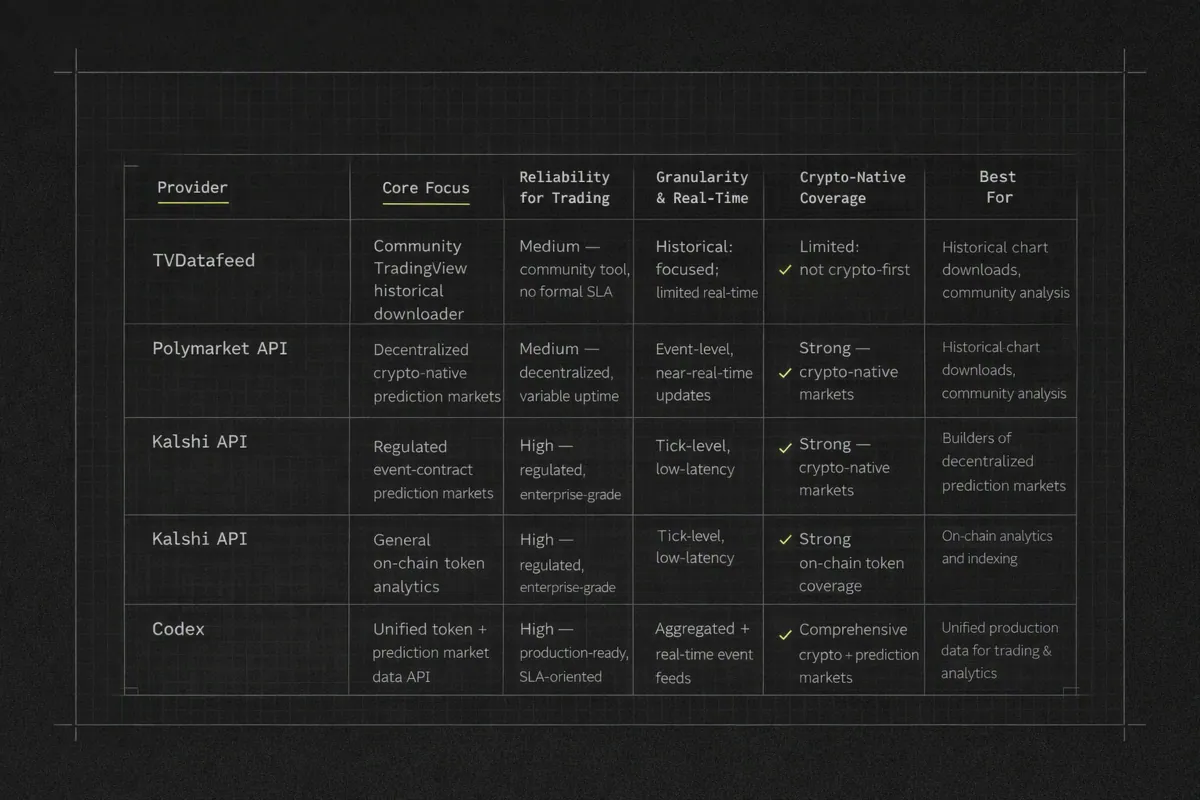
| Provider | Core Focus | Reliability for Trading | Granularity & Real‑Time | Crypto‑Native Coverage | Best For |
|---|---|---|---|---|---|
| TVDatafeed | Community TradingView historical downloader | Community-maintained; not infra‑grade | Up to 5000 bars per timeframe; limited live behavior via forks | Off‑chain price data; no on‑chain prediction markets | Bootstrapping charts, prototypes, light analytics |
| Polymarket API | Decentralized, crypto‑native prediction markets | Strong for live prediction UX; venue‑official | Order books, trades, analytics, real‑time feeds, Chainlink TWAP | Markets fully on‑chain; largest decentralized prediction platform | Crypto prediction UIs, odds comparison, trading terminals |
| Kalshi API | Regulated event contracts and prediction markets | High reliability; clear live vs historical split | Order books, trades, candlesticks, websockets for book/trade/status/fills | Regulated, off‑chain exchange with robust APIs | Regulated prediction apps, compliance‑sensitive dashboards |
| The Graph Token API | General on‑chain token analytics | Reliable for token balances/transfers/prices | Balances, transfers, top holders, OHLC via Uniswap V2 | 60+ chains; token‑centric, not prediction‑specific | On‑chain token analytics dashboards, wallet insights |
| Codex | Unified token + prediction market data | Infrastructure‑grade token data; prediction layer in beta | Sub‑second GraphQL, OHLC, holders, aggregates, subscriptions | 70M+ tokens, 80+ networks, 700M+ wallets; Polymarket + Kalshi schema | High‑traffic trading apps needing one API for tokens + prediction markets |
TVDatafeed: Useful for Charts, Weak for Prediction Markets
TVDatafeed is a community-built TradingView historical data downloader, not an official market-data API.
The repo describes it as a “simple TradingView historical Data Downloader” and notes:
- It can download up to 5000 bars per supported timeframe
- Forks add some live-feed behavior
- Many implementations require TradingView credentials to initialize
Strengths of TVDatafeed
TVDatafeed is helpful when you need:
- Quick historical candles for prototyping chart UIs
- Backtesting data for rough idea validation
- Basic price history without signing contracts or running infra
For early experiments, hackathons, and internal tools, this can be enough.
Limitations for Production Prediction Market Apps
For mission-critical prediction interfaces, TVDatafeed falls short:
- Not venue-native: It doesn’t expose prediction markets, order books, or outcome tokens
- No odds semantics: You get price bars, not “Yes/No at 62% implied probability”
- No real-time websockets: Community forks may add live behavior, but reliability is not guaranteed
- No on‑chain insight: You can’t see wallet-level activity, unique traders, or liquidity onchain
TVDatafeed is best treated as:
- A chart bootstrapping tool, not a full prediction market data provider
- A way to prototype trading UIs, then later swap in more robust APIs
Polymarket API: Crypto‑Native Prediction Markets, On‑Chain First
Polymarket is the world’s largest decentralized prediction market platform, and its API is designed for rich, crypto-native trading UX.
What Polymarket Exposes
Polymarket’s docs describe a comprehensive venue‑native data set:
- Public market data without credentials
- Detailed order book summaries including bids, asks, last trade price, tick size, and minimum order size
- Real-time feeds with 30‑second and 60‑second Chainlink TWAP prices
- Analytics on market activity and liquidity
Each market outcome is tied to an on‑chain token ID, making it easy to:
- Map markets to wallet holdings
- Calculate P&L across outcomes
- Surface portfolio views in crypto-native wallets and dashboards
UX and Architecture Guidance from Polymarket
Polymarket explicitly recommends:
- Using websocket-driven realtime updates, not repeated polling
- Leveraging Goldsky, Dune, Allium for deeper onchain pipelines
For product teams, this signals that:
- Streaming updates are table stakes for modern prediction UIs
- You should separate live trading state from heavy analytics and historical backfills
Best Fit Use Cases for Polymarket
Polymarket is ideal when:
- You’re building crypto-native prediction frontends (DeFi, Web3 social, onchain trading terminals)
- You need live odds, order books, and trade events for market makers and active traders
- You care about onchain composability (connecting markets to wallets, governance, and DeFi protocols)
Compared to TVDatafeed, Polymarket is a complete prediction market API, designed for production.
Kalshi API: Regulated Event Contracts & Robust Market Data
Kalshi focuses on regulated event contracts, positioning itself as a compliance-focused prediction market.
Data and Endpoints
Kalshi’s API is split into live and historical tiers:
- Public market data without API keys for basic discovery
- Websockets for:
- Order book changes
- Trade executions
- Market status updates
- Fill notifications
- Historical endpoints for:
- Trades
- Markets
- Candlesticks
This separation keeps the live API fast and responsive, while historical endpoints serve analytics and backtesting.
Why This Matters for Product Teams
Kalshi’s patterns are practical for architecture:
- Use live endpoints/websockets to power prediction UIs and trading dashboards
- Use historical endpoints for risk, analytics, and reconciliation
Kalshi is compelling if you:
- Need regulated markets for a fintech product targeting mainstream retail
- Care deeply about compliance, auditability, and historical traceability
Compared to TVDatafeed, Kalshi offers a venue-grade prediction API with clear contracts and SLAs.
The Graph Token API: On‑Chain Token Analytics, Not Prediction‑Specific
The Graph’s Token API is a beta, hosted analytics layer focused on token data, not prediction markets.
It’s positioned for use cases where you want data now, without running your own indexer.
What Token API Provides
Across chains like Ethereum, Arbitrum, BSC, Polygon, Optimism, and Base, Token API offers:
- Wallet balances and transfer history
- Top holders and token metadata
- OHLC pricing via Uniswap V2
- Historical snapshots across tokens
The broader Graph ecosystem spans 60+ chains, with subgraphs and Substreams for custom indexing.
Where Token API Fits in Prediction Workflows
While Token API doesn’t model prediction markets directly, it’s useful when you need to:
- Analyze wallet behavior across tokens, including prediction market outcome tokens
- Build token-centric dashboards (TVL-like stats, top holders, transfer flows)
In short:
- Use The Graph Token API as a general-purpose onchain analytics layer
- Pair it with Polymarket/Kalshi APIs for market-specific data
Compared to TVDatafeed, Token API offers onchain context and analytics, but you’ll still need venue APIs for prediction odds and markets.
Codex: Unified Token + Prediction Market Data in One API
Codex is a specialized on‑chain data infrastructure provider designed for trading-grade apps.
It ingests and enriches raw blockchain data across 80+ networks and 700M+ wallets, indexing thousands of transactions per second.
Core Capabilities
Codex exposes an all‑in‑one GraphQL-style API with:
- Real‑time and historical token prices in USD and native units
- Trading‑ready chart data (OHLC, candles, volume)
- Aggregates: liquidity, volume, unique wallets, TVL‑like stats
- Holders and balances across chains
- Scam filtering and token metadata
- Prediction market data (events, markets, trades, trader analytics) across Polymarket and Kalshi (beta)
Codex emphasizes sub‑second latencies, high reliability, and breadth:
- 70M+ tokens
- 80+ networks
- 700M+ wallets
- 16 launchpads
Codex already powers leading apps including Coinbase, TradingView, Uniswap, Magic Eden, Rainbow, MoonPay, Farcaster, pump.fun, and others.
Prediction Market Layer (Beta)
Codex’s prediction endpoints:
- Normalize events and markets across Polymarket and Kalshi under one schema
- Deliver OHLC-style bars and analytics for prediction markets
- Provide subscription equivalents for live streaming
Importantly, Codex is candid that:
- The prediction-market layer is beta
- It may be unreliable for certain edge cases or production-critical workloads
For teams, this means:
- Codex is excellent for rapid integration and multi‑venue coverage
- For the most critical prediction features, you may still want to pair it with direct venue APIs while beta hardens
When Codex Is the Best Choice
Codex is especially strong when you need:
- One normalized API for tokens + prediction markets + wallets
- Trading-grade performance for high‑traffic consumer apps and dashboards
- To avoid building your own indexers, RPC nodes, and ETL pipelines
Use Codex when:
- You’re a CEX, DEX, wallet, NFT marketplace, DeFi dashboard, or social trading app needing both token and prediction data
- You care about latency, uptime, and correctness for trading-adjacent UX
- You want to consolidate vendors and reduce complexity
Compared to TVDatafeed, Codex is an infrastructure-grade solution, not a community script.
Key Criteria: How to Evaluate Prediction Market Data Providers
Before choosing between TVDatafeed and on‑chain prediction market APIs, clarify your requirements across these dimensions.
1. Reliability & Correctness
Ask:
- Is this data source venue-native (Polymarket, Kalshi) or community-maintained (TVDatafeed)?
- Are there SLAs, rate limits, and status pages?
- Does the provider power production apps like Coinbase, TradingView, or Uniswap (Codex)?
For real-money interfaces, venue‑native or infra‑grade sources typically win.
2. Granularity & Real-Time UX
Modern prediction traders expect:
- Live order books
- Incremental updates via websockets/subscriptions, not polling
- Trade events, fills, and status changes
Polymarket and Kalshi both:
- Provide websocket-driven real-time updates
- Stream book changes, trades, and market status
Codex complements this with GraphQL subscriptions and enriched chart data.
TVDatafeed, by contrast:
- Focuses on historical bars up to 5000 per timeframe
- Depends on community forks for any live behavior
3. Crypto‑Native Coverage & On‑Chain Analytics
Consider whether you need:
- Onchain composability (markets as tokens, wallets, DeFi integrations)
- Wallet-level analytics (unique traders, holders, cross-chain behavior)
- Token-level aggregates (liquidity, TVL-like stats, volume)
Here’s how providers compare:
- Polymarket: Crypto-native markets; outcome tokens map cleanly to onchain positions
- Kalshi: Regulated venue; strong for compliance, less focused on onchain assets
- The Graph Token API: Deep token analytics across 60+ chains
- Codex: Unified view across tokens, wallets, prediction markets, and launchpads
- TVDatafeed: Off-chain chart data; no onchain insight
Practical Recommendations: What to Use When
Scenario 1: Prototype Dashboard or Internal Tool
Use:
- TVDatafeed for quick historical price charts
- Optional: Polymarket/Kalshi public endpoints for basic market listings
Why:
- Fastest path to a working UI
- No contracts or heavy infra required
Caveat:
- Don’t treat TVDatafeed as authoritative for production odds or trading decisions
Scenario 2: Crypto‑Native Prediction Frontend (DeFi / Web3)
Use:
- Polymarket API for live markets, order books, and trades
- Codex for unified token prices, wallets, and enriched prediction analytics (with beta caveats)
- Optional: The Graph Token API for deeper wallet/token analytics
Why:
- You need crypto-native semantics and onchain portfolio views
- Traders expect websockets and live odds updates
Scenario 3: Regulated Prediction App or Fintech Product
Use:
- Kalshi API for market data, live websockets, and historical reconciliation
- Codex or The Graph for complementary onchain token analytics if you also support crypto assets
Why:
- Regulatory posture and auditability matter
- You must separate live trading UX from risk and analytics backends
Scenario 4: High‑Traffic Trading App Needing Tokens + Prediction Markets
Use:
- Codex as the primary onchain data layer for tokens, wallets, charts, and aggregates
- Polymarket/Kalshi APIs directly for mission-critical prediction features, especially while Codex prediction data is beta
Why:
- You want one normalized API for most data, plus venue-native feeds where needed
- You care about sub‑second latency, uptime, and correctness across chains and assets
Scenario 5: Analytics Platform or Quant Research Stack
Use:
- Polymarket + Kalshi historical endpoints for volatility, order book dynamics, and event studies
- Codex for cross‑chain token coverage, long‑tail assets, and wallet-level stats
- The Graph Token API for advanced onchain analytics without running your own indexers
Why:
- You need clean, normalized schemas across venues and chains
- You want to avoid building and maintaining custom ETL pipelines for 80+ networks