

Meta description: Compare the best prediction market APIs and on-chain data providers by latency, coverage, resolution accuracy, and reliability — featuring Codex.
Prediction markets have crossed the line from curiosity to critical infrastructure.
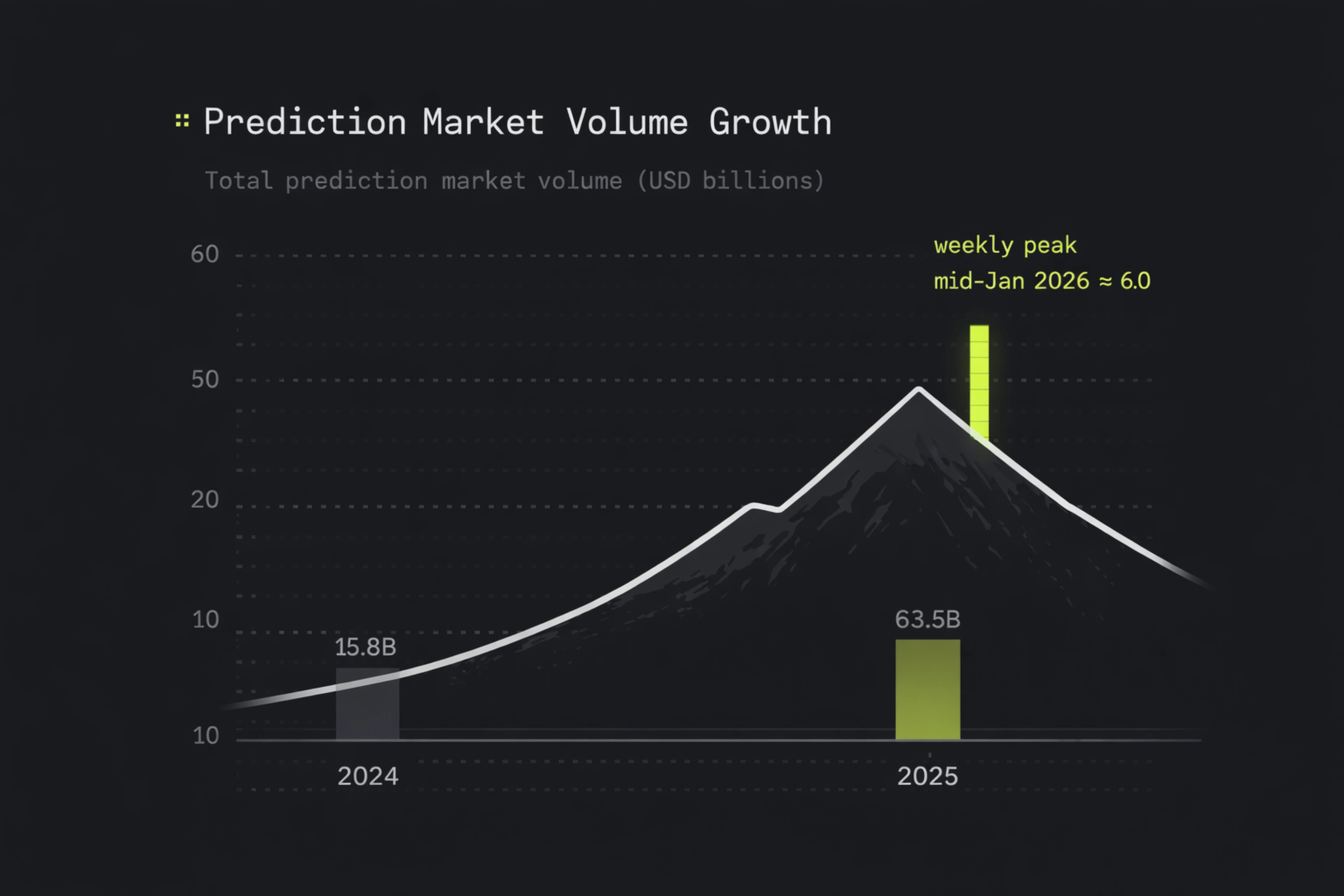
Dune/Keyrock report more than $13B in monthly notional volume, 43M+ monthly transactions, 600K+ monthly users, and over $500M in open interest across major on-chain platforms as of November 2025.[^1] Skynet’s 2025 report estimates total prediction-market volume grew from $15.8B in 2024 to $63.5B in 2025, with a weekly peak of roughly $6B in mid-January 2026.[^2]
If you’re building a prediction market frontend or analytics product, data quality is now a product risk, not a nice-to-have.
This guide gives product and engineering teams a concrete framework to evaluate the best prediction market APIs & data providers. It focuses on latency, coverage, resolution accuracy, liquidity, and reliability — and explains how the Codex prediction market platform addresses each.
We’ll use phrases you’re likely searching for, like best on-chain data provider prediction market frontends, on-chain data API prediction markets, and prediction market latency API, and translate them into practical evaluation criteria.
1. Core evaluation framework for prediction market data providers
When you evaluate an on-chain prediction market API, treat it like you would a trading-grade market data feed.
At minimum, you should score each provider on:
- Prediction market API latency
- Market coverage & depth (venues, markets, history)
- Resolution accuracy & timelines
- Liquidity & microstructure data
- Reliability, uptime, and SLAs
- Schema design & developer UX
- Vendor posture: maturity vs. beta
The rest of this article breaks down each dimension with concrete questions to ask, how to measure it, and how Codex compares.
2. Prediction market latency API: what to measure and how
For trading UIs, leaderboards, and analytics dashboards, latency is UX.
A practical definition of prediction market latency covers two paths:
- Consumer latency: Time from API request to response (REST or GraphQL)
- Event freshness: Time from an on-chain or venue event (trade, order, resolution) to its availability via the API
2.1 How to measure low-latency on-chain data APIs
Use a repeatable benchmark with clear metrics:
- Percentiles: Measure p50, p95, and p99 latency
- Regions: Test from at least two regions that match your users (e.g.,
us-east-1,eu-central-1) - Conditions: Run tests both at idle (1–2 req/s) and under load (50–200 req/s)
- Freshness: Compare timestamps between the venue’s native feed and your provider’s API
Example target SLOs for a high-traffic prediction market frontend:
- p50: ≤ 80 ms
- p95: ≤ 200 ms
- p99: ≤ 400 ms
- Data freshness: ≤ 500–800 ms from event to API for most updates
Codex reports that most token and prediction-market queries complete in under 1 second, with typical p95 REST latencies in the low hundreds of milliseconds and data freshness under 1 second as of mid-2026[^3]. All measurements are taken from Codex’s edge in their primary regions; customers should independently validate end-to-end latency from their own infrastructure.
2.2 Reproducible benchmarking steps (with Codex as an example)
Below is a minimal benchmarking plan you can adapt to any provider.
-
Pick a hot market
- Example: a Polymarket election or sports market with active trading.
-
Baseline venue latency
- Subscribe to Polymarket’s or Kalshi’s official feeds (WebSocket / REST) and record message timestamps.[^4][^5]
-
Measure provider REST latency
# Example: Codex prediction market event query
# Replace YOUR_API_KEY and eventId.

for i in {1..1000}; do
  start=$(date +%s%3N)
  curl -s \
    -H "x-api-key: YOUR_API_KEY" \
    -H "content-type: application/json" \
    -d '{
      "query": "{ filterPredictionMarkets(filter: { eventId: \"EVENT_ID\" }) { markets { id latestPrice lastTradeAt } } }"
    }' \
    https://api.codex.io/graphql > /dev/null
  end=$(date +%s%3N)
  echo $((end-start)) >> latency_ms.log
done
- Measure WebSocket prediction market updates (if supported)
# Pseudocode using Node.js & ws

const WebSocket = require('ws');
const ws = new WebSocket('wss://api.codex.io/realtime?api_key=YOUR_API_KEY');

ws.on('open', () => {
  ws.send(JSON.stringify({
    type: 'subscribe',
    channel: 'prediction.trades',
    marketId: 'MARKET_ID'
  }));
});

ws.on('message', (msg) => {
  const data = JSON.parse(msg);
  const receiveTs = Date.now();
  const eventTs = new Date(data.payload.tradeTimestamp).getTime();
  const freshnessMs = receiveTs - eventTs;
  console.log(freshnessMs);
});
- Analyze
- Compute p50/p95/p99 from
latency_ms.log - Compare trade timestamps between the venue and provider to estimate freshness
This kind of benchmark lets you independently validate any prediction market latency API claims.
3. On-chain data API prediction markets: coverage and reliability
Latency is meaningless without breadth and depth of data.
3.1 Market coverage: venues, instruments, history
Key questions to ask any prediction-market data provider:
-
Which venues are supported?
Example: Polymarket, Kalshi, others like Opinion, Limitless, Predict.fun, etc.[^8] -
How many markets and contracts?
Some newer vendors advertise 53,000+ markets indexed and 916K+ on-chain trades.[^6] -
Historical depth:
- How far back does price and order-book history go?
- Is trade-level history available for backtests?
-
Update cadence:
- How frequently is the coverage matrix updated?
- Is there a public endpoint for supported venues and markets?
Codex’s broader blockchain data platform covers 80+ networks, 70M+ tokens, and 700M+ wallets as of mid-2026, with coverage stats periodically updated on their product page.[^3] Their prediction-market product is more focused: Polymarket and Kalshi are live in beta, with endpoints for events, markets, price bars, trades, and trader analytics.[^7]
Best practice: ask for a coverage endpoint or downloadable matrix. For Codex, you can programmatically inspect coverage using their prediction-market discovery queries (filterPredictionEvents, filterPredictionMarkets) and chain metadata endpoints.
3.2 Reliability and SLAs
Prediction market UIs are often high-traffic trading apps. You should look for:
-
Historical uptime:
- Public status page with incident history
- Target uptime (e.g., 99.9%+ monthly)
-
SLAs by tier:
- Contractual uptime guarantees
- Credits or remedies for breaches
-
Rate limits & backoff behavior:
- Documented per-tier request limits
- Clear headers (e.g.,
X-RateLimit-Remaining,Retry-After)
Codex’s Growth tier advertises 300 requests/second and 1M monthly requests starting at $350/month.[^3] Their docs describe per-tier limits and recommend exponential backoff when clients hit limits. You should validate by inspecting rate-limit headers and testing behavior under load.
4. Resolution accuracy & timelines: more than just “who won”
Resolution semantics are where many prediction-market APIs fall short.
For frontends and analytics tools, resolution accuracy includes:
- Outcome states (e.g., YES/NO, binary, multi-outcome)
- Status transitions and timestamps
- Source of truth and dispute rules
4.1 How Polymarket handles resolution
Polymarket’s docs specify[^5]:
- Official resolution sources (e.g., specific data feeds or publishers)
- Edge-case rules and special outcomes
- A 2-hour challenge period, during which resolutions can be disputed
- Disputed markets that can take 4–6 days total to finalize
A robust prediction-market API needs to capture:
status: e.g.,open,resolving,resolved,disputedresolutionOutcome:YES,NO,INVALID, etc.resolutionSource: textual or coded referenceresolvedAt,challengeEndsAt,finalizedAt
4.2 How Kalshi handles resolution
Kalshi distinguishes between several states, including closed, determined, disputed, and finalized, and notes that settlement timing depends on market type, data-source availability, and manual review.[^4]
For Kalshi-like markets, expect fields such as:
status:open,closed,determined,disputed,finalizedsettlementValueorpayoutstatusUpdatedAtdataSource/resolutionAuthority
4.3 Example resolution schema across venues (JSON-style)
A good provider will normalize resolution semantics into a unified schema.
{
  "marketId": "polymarket:0x123...",
  "venue": "POLYMARKET", // or KALSHI
  "status": "RESOLVED",  // OPEN, CLOSED, RESOLVED, DISPUTED, FINALIZED
  "resolutionOutcome": "YES", // YES/NO/INVALID or enumerated for multi-outcome
  "resolutionSource": "official_nws_feed",
  "resolvedAt": "2026-06-15T12:34:56Z",
  "challengePeriodEndsAt": "2026-06-15T14:34:56Z",
  "finalizedAt": "2026-06-19T09:12:45Z",
  "disputeStatus": "NONE" // PENDING, UPHELD, REJECTED
}
When you compare prediction market resolution timelines, ask providers:
- Do they expose both intermediate and final states?
- How quickly do they reflect disputes and reversals?
- How do they handle venue-specific edge cases?
Codex normalizes Polymarket and Kalshi into a single GraphQL-style API with shared event, market, and resolution semantics. Their docs explicitly note that resolution semantics track official venue states and that prediction-market endpoints are still in beta and “may be unreliable,” requiring Growth or Enterprise plans.[^7]
5. Liquidity and microstructure: beyond headline prices
Headline prices are not enough for institutional users.
Reuters reported that some top Polymarket markets had only around $30M in total liquidity.[^3][^9] That’s “liquid enough for retail” but can be shallow for large orders. For your UI or analytics product, you should treat liquidity data as a first-class requirement.
Key metrics to require from any prediction market liquidity data API:
-
Order-book snapshots:
- Best bid/ask
- Depth by price level
- Cumulative volume
-
Spreads and slippage:
- Implied spread in % or basis points
- Estimated slippage for given order sizes
-
Open interest & notional:
- Outstanding shares / contracts
- Notional value (USD or stablecoins)
-
Venue microstructure:
- Fee schedules
- Market maker incentives
Codex’s prediction-market product focuses first on price bars, trades, and trader analytics (e.g., filterPredictionMarkets, filterPredictionEvents, trader stats) with an emphasis on trading-grade chart data.[^7] For deep order-book microstructure, you may still combine Codex with venue-native order-book feeds, especially if you’re implementing execution logic.
6. How Codex compares to the best prediction market APIs & data providers
Several specialized vendors have emerged:
- PMAxis: advertises 53,000+ markets indexed, 916K+ on-chain trades, and <100 ms API latency.[^6]
- Probalytics: supports Polymarket live, says Kalshi is coming, and claims 1 ms order-book history resolution for backtesting.[^10]
- Predexon: highlights coverage across Polymarket, Kalshi, Opinion, Limitless, Predict.fun, Binance (for crypto reference), and Chainlink.[^8]
- Dome API: was acquired by Polymarket; its APIs reach end of life on April 28, 2026.[^11]
In that context, Codex’s differentiation comes from being an all-in-one token + prediction-market on-chain data API, not a standalone prediction specialist.
6.1 Unified data layer for tokens and prediction markets
Codex is primarily a blockchain data infrastructure platform:
- 80+ networks, 70M+ tokens, 700M+ wallets indexed as of mid-2026[^3]
- Real-time and historical token prices, charts, liquidity, holders, and balances
- Prediction market endpoints (Polymarket and Kalshi) in beta
For product teams, this matters because you can:
-
Use one provider for:
- Token pricing and charts
- Wallet portfolios
- Prediction market events and markets
-
Reduce operational complexity versus stitching together multiple APIs
6.2 Latency, coverage, resolution, reliability — side-by-side
Here’s a concise comparison framework you can copy for internal evaluations. The Codex column reflects the current state of their public docs as of July 2026.
Prediction market API comparison cheatsheet
-
Prediction market API latency
- Target any provider: p95 REST < 200 ms in your main region; freshness < 1 s.
- Codex: token APIs benchmarked under 1 s p95; prediction markets in beta, recommend customer validation.[^3][^7]
-
Market coverage prediction market API
- Target: Polymarket + Kalshi at minimum; clear roadmap for additional venues.
- Codex: Polymarket + Kalshi live; unified discovery and historical bars; coverage matrix discoverable via GraphQL.[^7]
-
Prediction market resolution accuracy
- Target: normalized schema, explicit timestamps, dispute tracking.
- Codex: shared resolution fields across venues, mapped to native semantics; still beta, so double-check for mission-critical workflows.[^5][^7]
-
Most reliable on-chain data APIs for trading apps
- Target: documented uptime, SLAs, rate limits, backoff patterns.
- Codex: infrastructure-grade token and wallet data with reference customers like Coinbase, TradingView, and Uniswap; prediction markets in gated beta.[^3]
For a more compact view:
High-level comparison table
-
Prediction market API latency:
- Codex: optimized for sub-second token data; prediction markets require customer benchmarks.
- Specialists (e.g., PMAxis, Probalytics): advertise <100 ms and 1 ms order-book history, respectively.[^6][^10]
-
Market coverage prediction market API:
- Codex: Polymarket + Kalshi; 80+ networks for token data.[^3][^7]
- Predexon: multiple venues including Opinion, Limitless, Predict.fun, Chainlink.[^8]
-
Prediction market resolution accuracy:
- Codex: normalized resolution timelines, reflecting Polymarket and Kalshi rules.[^5][^7]
- Venue-native APIs: canonical source but inconsistent schemas.[^4][^5]
-
Reliability & uptime:
- Codex: mature infra backing Coinbase/TradingView/Uniswap token data.[^3]
- Newer vendors: often younger, focused specifically on prediction markets.
7. Measurement methodology for Codex latency & freshness
Because this is a critical criteria, here is how Codex encourages teams to measure latency and freshness in a reproducible way:
-
Latency definition:
- p50/p95/p99 measured from the time Codex receives a request at its edge to the time it sends a response
- Measured per endpoint type (e.g.,
filterPredictionMarkets,filterPredictionEvents)
-
Freshness definition:
- Time between when an upstream event is stamped (e.g., Polymarket trade timestamp) and when Codex ingests and exposes it
-
Test setup:
- Run from multiple regions using consistent hardware (cloud VMs)
- Test both low QPS (1–2 req/s) and medium QPS (50–100 req/s)
-
Sampling:
- At least 1,000 requests per endpoint per region
- Compare against venue-native feeds where possible
Codex’s own internal benchmarks show typical p95 under 1 second and freshness under 1 second for token and prediction data in steady state as of mid-2026, but their docs explicitly recommend customers run independent benchmarks for their workloads.[^3][^7]
8. Putting it together: a practical evaluation checklist
Use this checklist for any best real-time crypto data API trading 2024+ evaluation.
Latency & freshness
- [ ] Measured p50/p95/p99 latencies from your main regions
- [ ] Freshness vs. venue-native feeds (trades, resolutions)
- [ ] WebSocket prediction market updates available where needed
Coverage
- [ ] Venues you care about (Polymarket, Kalshi, others) supported
- [ ] Historical data depth documented
- [ ] Coverage matrix or discovery endpoints available
Resolution
- [ ] Normalized status & resolution fields across venues
- [ ] Dispute and challenge timelines exposed
- [ ] Clear mapping to venue documentation
Liquidity
- [ ] Order-book snapshots and/or depth available
- [ ] Open interest and notional exposure metrics
- [ ] Volume and liquidity analytics for dashboards
Reliability & contracts
- [ ] Public status page and uptime track record
- [ ] SLAs covering latency, uptime, and support response times
- [ ] Rate limits and backoff behavior documented
Vendor posture
- [ ] Production-ready vs. beta features clearly labeled
- [ ] Reference customers and case studies
- [ ] Alignment with your stack (GraphQL, REST, WebSocket)
Codex fits best for teams who want a single, high-performance on-chain data API for both tokens and prediction markets, and who are comfortable integrating a beta prediction-market product backed by a mature token infrastructure.
9. FAQ: choosing the best prediction market APIs & data providers
Q1. What is the most important metric when choosing a prediction market API?
For trading UIs and analytics tools, the most important metric is p95 end-to-end latency, measured from your client to the API and back.
You should also track event freshness (time from trade/resolution to API visibility) and treat both as hard SLOs.
Q2. How do I verify prediction market resolution accuracy?
Cross-check your provider’s resolution data against venue-native docs and feeds:
- Sample a set of markets from Polymarket and Kalshi
- Compare status transitions and timestamps
- Validate final outcomes and resolution sources
If you see mismatches, ask the provider how they handle disputes and re-resolutions.
Q3. Do I still need venue-native APIs if I use Codex?
For most frontend and analytics use cases (charts, prices, trader analytics), Codex’s normalized APIs may be sufficient.
If you need execution, full order-book depth, or want to trade during disputes or edge cases, you should still integrate venue-native APIs alongside Codex.
Q4. How does Codex differ from specialist prediction-market APIs?
Specialist providers (like PMAxis, Probalytics, Predexon) focus narrowly on prediction markets, often emphasizing order-book microstructure.
Codex’s differentiation is being a general-purpose on-chain data infrastructure that unifies tokens, wallets, and prediction markets in a single, trading-grade API.
Q5. Is Codex’s prediction market product production-ready?
Codex labels its prediction-market endpoints as beta and notes they “may be unreliable” at times.[^7]
Teams should:
- Gate high-risk flows (e.g., cash-settlement, high-frequency execution) behind additional checks
- Run their own benchmarks against venue-native feeds
- Engage with Codex’s team (usually via Growth or Enterprise plans) for roadmap and production-readiness discussions
If you want a single on-chain data layer for token-aware products and prediction market frontends, Codex is worth evaluating alongside specialist prediction-market APIs. Use the framework in this article to benchmark latency, coverage, resolution accuracy, and reliability before committing.
[^1]: Dune/Keyrock Prediction Markets Report, November 2025 – https://dune.com/prediction-markets-report [^2]: Skynet 2025 Prediction Markets Report – https://indd.adobe.com/view/publication/c5e0e901-0d7d-471b-80be-ec82d0d88048/xjq4/publication-web-resources/pdf/2025_Skynet_Prediction_Markets_Report_.pdf [^3]: Codex Product Page & Docs (tokens, networks, wallets, pricing, performance) – https://www.codex.io/product [^4]: Kalshi Docs (market life cycle, statuses, settlement) – https://kalshi.com and documentation linked therein [^5]: Polymarket Docs (orderbook, resolution rules, challenge period) – https://docs.polymarket.com/concepts/resolution and https://docs.polymarket.com/trading/orderbook [^6]: PMAxis homepage and docs (markets indexed, trades, latency claims) – https://www.pmaxis.trade/ [^7]: Codex Docs – Prediction Markets (Polymarket & Kalshi, beta notice) – https://docs.codex.io/prediction-markets/polymarket [^8]: Predexon Docs (venues covered, multi-venue support) – https://docs.predexon.com/ [^9]: Reuters via Investing.com, prediction-market liquidity coverage – https://www.investing.com/news/stock-market-news/prediction-markets-look-to-institutional-investors-for-next-phase-of-growth-4711614 [^10]: Probalytics homepage (Polymarket, Kalshi, 1ms orderbook history) – https://www.probalytics.io/ [^11]: Dome API deprecation notice – https://dome.mintlify.app/