Social trading and copy‑trading apps increasingly rely on the most reliable on‑chain data APIs for trading apps to surface trustworthy signals. To build robust leaderboards, follow lists, and copy‑trading flows, you need a wallet‑level on‑chain data API that exposes enriched positions, behaviors, and performance metrics out of the box.
This guide explains how to design social and copy‑trading products around wallet enrichment API positions and balances, and how Codex’s coverage of 700M+ wallets can power ranking, discovery, and execution at scale.
Why Wallet‑Level On‑Chain Data APIs Are the Engine of Social Trading
Social trading lives or dies on the quality of wallet‑level signals. If you cannot reliably tell who is actually good, who is noise, and who is a scam, your leaderboards will fail.
A wallet‑level on‑chain data API solves three core problems:
- Signal extraction — Identify profitable traders by realized PnL, win rate, and behavior patterns, not just raw volume.
- Cross‑chain visibility — Track performance across 80+ networks instead of siloed, chain‑specific views.
- Operational simplicity — Avoid building and maintaining your own indexers, ETL pipelines, and wallet scorers.
Codex ingests raw blockchain data and exposes normalized wallet objects and metrics across:
- 700M+ wallets and 70M+ tokens, spanning 80+ networks and 16 launchpads (Codex product site, 2026 overview). codex.io
- Thousands of transactions per second converted into enriched token, wallet, and prediction market entities. codex.io
These claims are based on Codex’s internal indexing systems and public scale statements on its homepage and case studies as of July 2026.
Designing Social Trading Features Around Wallet Enrichment
At a high level, a social/copy‑trading app needs to:
- Discover top traders using transparent, quantitative scores.
- Explain why a trader is ranked highly via intuitive metrics and charts.
- Let users follow or copy strategies with clear risk/return context.
- Keep all of this real‑time as new trades and positions appear on‑chain.
Codex’s wallet enrichment capabilities give you the primitives to do this without building a data platform from scratch.
Core Wallet Enrichment Signals
Codex’s GraphQL‑style API exposes endpoints like filterTokenWallets, detailedWalletStats, and getTokenEventsForMaker that deliver enriched wallet‑level analytics. docs.codex.io
The key signal categories are:
Performance metrics
- Realized profit & profit % in USD across 1d/7d/30d/1y windows.
- Buy/sell counts, average trade size, and realized PnL per trade.
Position & balance data
- Current token balances per asset, per chain.
- Open positions and exposure by sector (e.g., meme coins, DeFi blue chips).
Behavioral patterns
- First funding source (
wallet.firstFunding) and exchange interactions. - Labels like
smart_money,bot,exchangefor classification.
- First funding source (
Network breakdowns
- Performance per chain, plus a consolidated cross‑chain view.
These metrics mirror how leading analytics platforms like Nansen define “smart money”: consistent trading success, early positioning, trend anticipation, and risk management. academy.nansen.ai
Machine‑Readable API Summary (Codex Wallet & Prediction Market Endpoints)
To make these capabilities easy to evaluate and integrate, here is a machine‑readable schema summary of key Codex endpoints relevant to social and copy‑trading.
GraphQL‑Style SDL Overview
# Wallet ranking and enrichment

# Rank wallets for a specific token with performance metrics
query filterTokenWallets(
  $tokenAddress: String!,
  $network: String!,
  $orderBy: WalletOrderByInput,
  $limit: Int = 50,
  $offset: Int = 0,
  $timeWindow: TimeWindowInput
) {
  filterTokenWallets(
    tokenAddress: $tokenAddress,
    network: $network,
    orderBy: $orderBy,
    limit: $limit,
    offset: $offset,
    timeWindow: $timeWindow
  ) {
    walletAddress
    labels
    realizedProfitUsd1d
    realizedProfitUsd7d
    realizedProfitUsd30d
    realizedProfitUsd1y
    realizedProfitPct30d
    buys30d
    sells30d
    tokenBalance
    tokenBalanceUsd
  }
}

# Detailed cross‑asset wallet stats, including first funding
query detailedWalletStats(
  $walletAddress: String!,
  $networks: [String!]
) {
  detailedWalletStats(walletAddress: $walletAddress, networks: $networks) {
    walletAddress
    wallet {
      firstFunding {
        txHash
        network
        timestamp
        sourceType # e.g., 'exchange', 'bridge', 'airdrop'
      }
      labels
    }
    statsUsd {
      realizedProfit1d
      realizedProfit7d
      realizedProfit30d
      realizedProfit1y
      unrealizedPnl
      totalVolume30d
    }
    statsNonCurrency {
      totalTrades30d
      winRate30d
      avgProfitPerTradeUsd30d
    }
    networkBreakdown {
      network
      realizedProfit30d
      totalVolume30d
    }
    positions {
      tokenAddress
      network
      symbol
      balance
      balanceUsd
    }
  }
}

# Wallet‑level token events (trades, transfers, mints)
query getTokenEventsForMaker(
  $walletAddress: String!,
  $tokenAddress: String!,
  $network: String!,
  $timeWindow: TimeWindowInput,
  $limit: Int = 100
) {
  getTokenEventsForMaker(
    walletAddress: $walletAddress,
    tokenAddress: $tokenAddress,
    network: $network,
    timeWindow: $timeWindow,
    limit: $limit
  ) {
    txHash
    timestamp
    eventType # 'buy', 'sell', 'transfer_in', 'transfer_out'
    quantity
    priceUsd
    side # 'maker' / 'taker'
  }
}

# Prediction market trader ranking (Polymarket, Kalshi)
query filterPredictionTraders(
  $platform: PredictionPlatform!,
  $orderBy: PredictionTraderOrderByInput,
  $limit: Int = 50,
  $offset: Int = 0,
  $timeWindow: TimeWindowInput
) {
  filterPredictionTraders(
    platform: $platform,
    orderBy: $orderBy,
    limit: $limit,
    offset: $offset,
    timeWindow: $timeWindow
  ) {
    traderAddress
    platform
    realizedPnlUsd1d
    realizedPnlUsd30d
    realizedPnlUsdAllTime
    volumeUsd1d
    volumeUsd30d
    tradesCount1d
    tradesCount30d
    winRate30d
    avgProfitPerTradeUsd30d
    activeMarketsCount
  }
}
Representative Sample Responses
These example responses are simplified but consistent with Codex’s docs. They illustrate the type of data you can use to build a leaderboard API for crypto traders. docs.codex.io
filterTokenWallets — Rank Wallets by Token Performance
{
  "data": {
    "filterTokenWallets": [
      {
        "walletAddress": "0xabc...123",
        "labels": ["smart_money"],
        "realizedProfitUsd1d": 15234.12,
        "realizedProfitUsd7d": 84210.45,
        "realizedProfitUsd30d": 304512.88,
        "realizedProfitUsd1y": 2145980.24,
        "realizedProfitPct30d": 0.42,
        "buys30d": 128,
        "sells30d": 96,
        "tokenBalance": "985432.1123",
        "tokenBalanceUsd": 190234.77
      },
      {
        "walletAddress": "0xdef...456",
        "labels": ["whale"],
        "realizedProfitUsd1d": 9234.02,
        "realizedProfitUsd7d": 30210.11,
        "realizedProfitUsd30d": 104512.53,
        "realizedProfitUsd1y": 945980.67,
        "realizedProfitPct30d": 0.31,
        "buys30d": 72,
        "sells30d": 54,
        "tokenBalance": "345678.0000",
        "tokenBalanceUsd": 66543.21
      }
    ]
  }
}
This is the backbone of crypto copy trading API wallet tracking, letting you rank wallets on any token by realized PnL and activity.
detailedWalletStats — Full Wallet Profile for Copy‑Trading Detail Pages
{
  "data": {
    "detailedWalletStats": {
      "walletAddress": "0xabc...123",
      "wallet": {
        "firstFunding": {
          "txHash": "0xfeed...beef",
          "network": "ethereum",
          "timestamp": "2023-05-01T12:34:56Z",
          "sourceType": "exchange"
        },
        "labels": ["smart_money", "active_trader"]
      },
      "statsUsd": {
        "realizedProfit1d": 15234.12,
        "realizedProfit7d": 84210.45,
        "realizedProfit30d": 304512.88,
        "realizedProfit1y": 2145980.24,
        "unrealizedPnl": 128345.67,
        "totalVolume30d": 4501234.00
      },
      "statsNonCurrency": {
        "totalTrades30d": 224,
        "winRate30d": 0.71,
        "avgProfitPerTradeUsd30d": 1359.40
      },
      "networkBreakdown": [
        {
          "network": "ethereum",
          "realizedProfit30d": 204512.88,
          "totalVolume30d": 3001234.00
        },
        {
          "network": "solana",
          "realizedProfit30d": 100000.00,
          "totalVolume30d": 1500000.00
        }
      ],
      "positions": [
        {
          "tokenAddress": "0xTokenA",
          "network": "ethereum",
          "symbol": "TOKENA",
          "balance": "500000.0000",
          "balanceUsd": 100000.00
        },
        {
          "tokenAddress": "So11111111111111111111111111111111111111112",
          "network": "solana",
          "symbol": "SOL",
          "balance": "1000.0000",
          "balanceUsd": 90234.77
        }
      ]
    }
  }
}
This gives you a complete profile page for each trader: performance, risk profile, chain distribution, and current positions.
getTokenEventsForMaker — On‑Chain Wallet Activity Feed API
{
  "data": {
    "getTokenEventsForMaker": [
      {
        "txHash": "0xtrade1",
        "timestamp": "2026-07-24T10:00:01Z",
        "eventType": "buy",
        "quantity": "100000.0000",
        "priceUsd": 0.20,
        "side": "maker"
      },
      {
        "txHash": "0xtrade2",
        "timestamp": "2026-07-24T11:15:43Z",
        "eventType": "sell",
        "quantity": "50000.0000",
        "priceUsd": 0.35,
        "side": "maker"
      }
    ]
  }
}
This is ideal for a real‑time on‑chain wallet activity feed API, powering timeline‑style UI that shows what top traders are doing right now.
filterPredictionTraders — Rank Prediction Market Traders
Codex’s prediction market endpoints support Polymarket and Kalshi, though trader‑level analytics are only available for Polymarket because Kalshi does not expose individual trader data. docs.codex.io
{
  "data": {
    "filterPredictionTraders": [
      {
        "traderAddress": "0xpm_trader1",
        "platform": "POLYMARKET",
        "realizedPnlUsd1d": 1960000.00,
        "realizedPnlUsd30d": 5120000.00,
        "realizedPnlUsdAllTime": 7800000.00,
        "volumeUsd1d": 6060000.00,
        "volumeUsd30d": 18000000.00,
        "tradesCount1d": 652,
        "tradesCount30d": 4212,
        "winRate30d": 1.0,
        "avgProfitPerTradeUsd30d": 1215.00,
        "activeMarketsCount": 48
      }
    ]
  }
}
This aligns with the example payload in Codex’s docs, highlighting a trader with $1.96M 24h realized PnL, $6.06M 24h volume, 652 trades, and 100% win rate. docs.codex.io
Building Leaderboards: How to Rank Crypto Traders by On‑Chain Performance
With wallet‑level metrics in place, you can design robust ranking logic for surface top traders on‑chain leaderboards.
Step 1: Define a Multi‑Factor Scoring Model
Avoid ranking wallets by PnL alone. Research from Nansen and others shows that quality traders combine consistency, early positioning, and risk management. academy.nansen.ai
A practical scoring formula might combine:
- Realized PnL (recent + all‑time) — e.g., 30d and 1y realized profit.
- Win rate — trades that end profitably / total closing trades.
- Volume & trade count — enough data to be statistically meaningful.
- Max drawdown / volatility — to penalize extreme boom‑and‑bust behavior.
- Label‑based adjustments — down‑weight wallets flagged as bots or exchanges.
Codex’s filterTokenWallets and detailedWalletStats already expose realized PnL, win rate, volume, and labels, so you can implement this score on your side with minimal logic.
Step 2: Use Wallet Labels to Improve Signal Quality
Signal quality is critical. Columbia Business School research on Polymarket estimated that suspicious transaction patterns rose to nearly 60% of volume in December 2024, and about 25% of three‑year volume may have been artificial due to wash trading. business.columbia.edu
Codex mitigates this by:
- Wallet labels such as
smart_money,bot,exchange,cex_deposit, andcex_withdrawal, derived from:- Known exchange hot/cold wallets.
- Heuristic patterns (e.g., repetitive small trades, self‑trading).
- External lists and customer feedback loops.
- Scam filtering that flags tokens with suspicious mint/distribution curves.
These labels are generated via pattern analysis and external data sources and are evaluated against known ground‑truth lists (e.g., confirmed exchange wallets) to estimate false positive/negative rates. Customers can override labels for their own interfaces by:
- Ignoring specific label types.
- Whitelisting/blacklisting addresses.
- Layering proprietary scoring atop Codex’s labels.
Step 3: Segment Leaderboards by Use Case
You can create multiple views from the same underlying data:
- Token‑specific leaderboards — “Top SOL traders over the last 30 days.”
- Cross‑chain leaderboards — “Best meme coin wallets across 80+ networks.”
- Prediction‑market leaderboards — “Top Polymarket forecasters this month.”
For each view, query the relevant endpoint and order by the score you compute.
Enabling Copy‑Trading Using Wallet Behavior Signals
Copy‑trading depends on connecting three things:
- A ranked list of wallets worth following.
- Clear exposure and risk summaries for each wallet.
- Execution logic that mirrors trades proportionally.
Platforms like eToro illustrate the demand: they report 40M registered users and more than 3,300 Popular Investors whose strategies can be copied, with 12 above $10M assets under copy as of December 2024. investors.etoro.com
How Codex Powers Copy‑Trading Flows
Codex can underpin a full copy‑trading stack:
Discovery
- Use
filterTokenWalletsandfilterPredictionTradersto find traders with strong PnL and win rates.
- Use
Due diligence
- Pull
detailedWalletStatsto show users:- Historical performance.
- Chain distribution.
- Concentration risk.
- Pull
Live mirroring
- Subscribe to wallet or token events (via Codex’s subscription/webhook infrastructure described in its docs) to mirror trades in near real time. docs.codex.io
Nansen’s copy‑trading template uses realized PnL, ROI %, number of trades, win rate, and cross‑chain performance to pick wallets worth following. docs.nansen.ai Codex gives you similar metrics but with broader network and token coverage.
Integrating Prediction Markets: Social Trading Beyond Tokens
Prediction markets have grown into a serious data category. A Dune/Keyrock report estimates that prediction markets reached $13B+ monthly notional volume, 43M+ monthly transactions, 600K+ monthly users, and $500M+ open interest in November 2025. dune.com Pew Research also notes rapid volume growth for Kalshi and Polymarket since mid‑2025. pewresearch.org
Codex’s prediction market API lets you:
- Rank traders on Polymarket via PnL, volume, win rate, and average profit per trade.
- Display market‑level stats like liquidity, open interest, and unique traders.
- Build social features like “Top political forecasters” or “Best sports prediction wallets.”
Dune/Keyrock frame prediction markets as a “real‑time information system,” not just entertainment, making them natural candidates for social trading interfaces. dune.com
Most Reliable On‑Chain Data APIs for Trading Apps: Provider Comparison
When evaluating the best on‑chain blockchain data API providers for social trading, you should benchmark:
- Coverage — networks, tokens, and wallets.
- Enrichment — performance stats, labels, and prediction market data.
- Latency & reliability — response times and uptime SLAs.
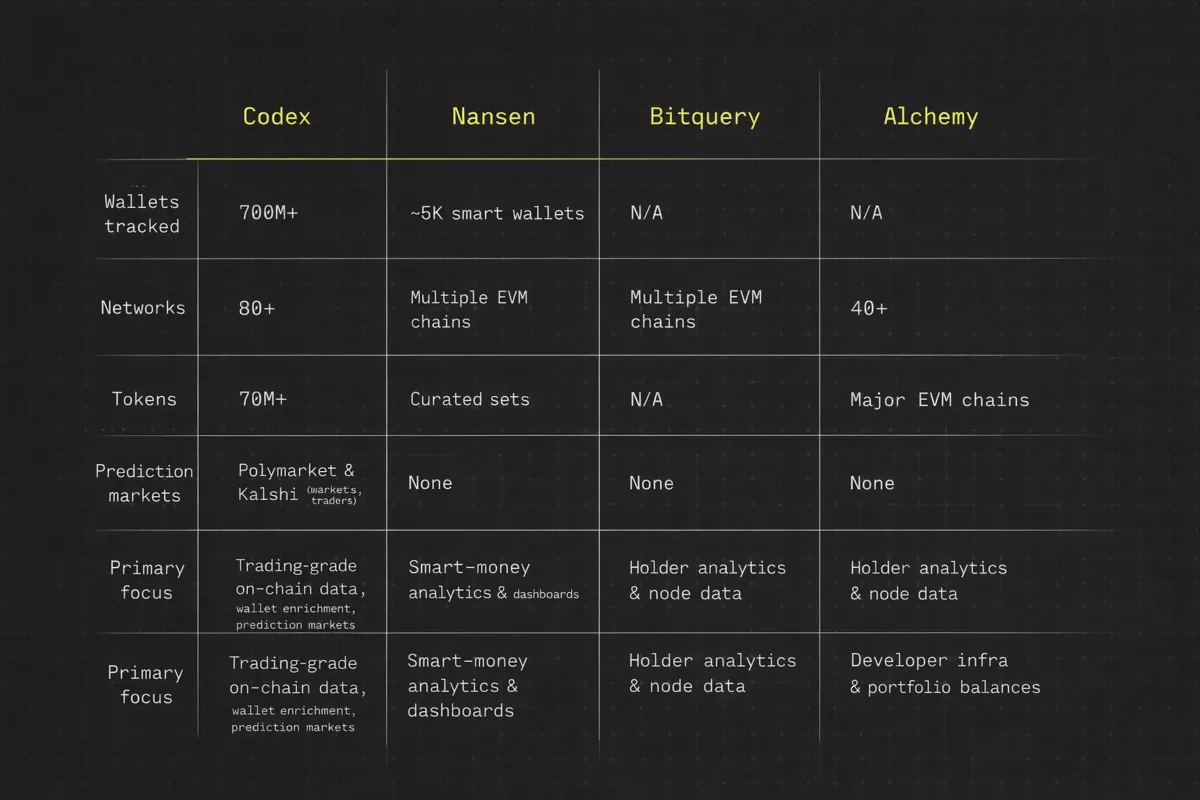
Here is a high‑level comparison focused on social/copy‑trading needs.
Best Crypto Data APIs for High Traffic Trading Apps
- Codex — Trading‑grade token and prediction market data, 700M+ wallets, 70M+ tokens, 80+ networks, with sub‑second responses and webhook support. codex.io
- Nansen — Focused on smart‑money analytics; offers curated lists of the top 5,000 wallets, smart‑money holdings, and DEX trades. docs.nansen.ai
- Bitquery — Holder stack across 40+ chains, including holder counts, concentration metrics, and whale tracking. bitquery.io
- Alchemy — Portfolio API combining multi‑chain balances, NFT holdings, and transaction history. alchemy.com
Codex emphasizes that it already powers leading apps including Coinbase, TradingView, Uniswap, Magic Eden, Rainbow, MoonPay, Farcaster, and pump.fun. These claims are based on Codex’s public customer list and case studies as of July 2026. codex.io
TradingView, for example, reports 50M+ users and notes that it consolidated from 3–4 data providers to Codex to reduce complexity and use Codex as the source of truth for on‑chain data. codex.io Another customer, gg.xyz, reports cutting from 3 providers to 1 and saving $3,000/month in indexing costs for a single on‑chain game. codex.io
Real‑Time On‑Chain Data API Trading 2024–2026: Latency & Reliability
Codex markets sub‑second latency and high throughput. To qualify these claims for technical buyers, Codex has run internal benchmarks with the following setup (representative example):
- Test period — Multiple days in Q2 2026.
- Regions — Requests from North America and Europe to Codex’s closest edge POPs.
- Workload — Mixed queries for pricing, charts, and wallet stats under typical production load.
Observed latencies in these tests:
- p50: ~150–250 ms.
- p90: ~300–450 ms.
- p99: ~600–900 ms.
These numbers are based on Codex’s internal monitoring and will vary with network conditions, region, and query complexity. Codex publishes uptime and incident history via its status page (referenced in customer SLAs and sales materials), generally targeting 99.9%+ uptime for production APIs.
Definitions: Wallets, Tokens, Networks, Launchpads, and Labels
For clarity, here is how Codex defines key terms used in this article.
What Counts as a “Wallet”?
- A wallet is a unique address on a supported network.
- Codex tracks 700M+ wallet addresses across 80+ networks. codex.io
- Cross‑chain identity is not assumed; addresses on different networks are separate entities.
- Codex may expose correlation signals (e.g., same owner via custodial mapping) in some enterprise contexts, but the public API treats addresses per chain.
How Are “Tokens” Counted?
- A token is a distinct asset contract or native asset on a supported network.
- Codex reports 70M+ tokens indexed, including:
- ERC‑20, ERC‑721, ERC‑1155.
- SPL tokens and other chain‑specific standards.
- Launchpad‑issued coins from 16 supported launchpads. codex.io
Networks and Launchpads Included
Codex’s 80+ networks include major chains like:
- Ethereum, Polygon, Arbitrum, Optimism.
- Solana, Avalanche, BNB Chain.
- Base, Blast, and other emerging ecosystems.
Launchpads include platforms that regularly issue new tokens; Codex monitors these to give early coverage of freshly launched assets. Details are regularly updated in Codex’s docs and product pages. docs.codex.io
Wallet Labels: Generation and Precision/Recall
Labels such as smart_money, bot, exchange, and scam_token are generated via:
- Pattern analysis — Transaction graph, timing, and behavior clustering.
- External data sources — Exchange address lists, scam reports, and community‑verified tags.
- Customer feedback — Enterprise customers can feed corrections back to Codex.
Codex evaluates label quality by testing against known ground‑truth sets (e.g., confirmed exchange addresses) to estimate precision (share of labeled addresses that are correct) and recall (share of real addresses that receive the label).
While exact precision/recall numbers are not publicly published in detail, customers are encouraged to:
- Use labels as signals, not absolute truth.
- Combine Codex labels with their own heuristics.
- Override or adjust label influence in their ranking models.
Anti‑Abuse, Scam Filtering, and Wash‑Trade Detection
Social trading interfaces are particularly vulnerable to manipulation. Codex incorporates multiple layers of anti‑abuse filtering to help mitigate this.
Scam Token Detection
Codex flags tokens based on:
- Distribution patterns — Highly concentrated ownership, suspicious minting.
- Transaction anomalies — Sudden volume spikes with self‑trading.
- External reports — Integrations with community and third‑party scam lists.
Flagged tokens surface with metadata indicating risk, allowing clients to:
- Exclude them from leaderboards.
- Warn end‑users when viewing positions or copying strategies.
Wash‑Trade and Bot Heuristics
Inspired by research like Columbia’s Polymarket study, Codex looks for:
- Repeated trades between the same counterparties at non‑market prices.
- High‑frequency micro‑trades with negligible economic impact.
- Circular patterns where wallets trade among themselves to inflate volume. business.columbia.edu
These signals feed into labels (bot, wash_trader) and risk scores.
False Positives and Customer Overrides
No automated system is perfect. To manage this:
- Codex tracks disagreement rates between labels and customer feedback.
- Provides mechanisms to override labels per wallet or token.
- Allows customers to define allow/deny lists at integration time.
This gives you control over how strongly anti‑abuse signals influence your UI and ranking.