Overview: Codex Agent SDK vs CoinGecko API
If you’re running a high‑traffic trading app, wallet, or analytics product, your data layer is not just “another API” — it’s core infrastructure.
This comparison breaks down Codex Agent SDK and CoinGecko’s REST API across:
- Performance and latency
- Historical depth and charting
- Multi‑chain token and wallet coverage
- Agent‑friendly integration paths
- Migration strategies for teams upgrading to a trading‑grade on‑chain data layer
It’s written for product, engineering, and data leads evaluating the best on‑chain data APIs for trading apps and planning a move from CoinGecko to infrastructure like Codex.
For deeper benchmarks and agent examples, see the related pillar guide: “Codex vs CoinGecko Performance Pillar: Agent SDK and Trading‑Grade Benchmarks.”
At a Glance: Who Each Platform Is For
CoinGecko API
- Best for: Market‑wide crypto price discovery, CEX tickers, global stats, conventional portfolio apps.
- Data focus: Aggregated crypto market data (CEX + some on‑chain), coins by ID, broad REST endpoints.
- Delivery: REST + WebSocket + webhooks, with SDKs and AI integration docs.
- Strengths: Long historical horizon for market charts, rich CEX/derivatives surfaces.
Codex Agent SDK + GraphQL API
- Best for: Trading‑grade on‑chain data powering exchanges, pro charting, wallets, bots, and prediction market frontends.
- Data focus: On‑chain tokens and prediction markets, wallet‑scale indexing, trading events, OHLCV.
- Delivery: Single GraphQL supergraph with queries, subscriptions, webhooks, TS SDK, and agent Skills/MCP.
- Strengths: Sub‑second latency, multi‑object queries in one round trip, 70M+ tokens and 700M+ wallets indexed.
If your core UX is trading on on‑chain tokens and pools, Codex behaves more like a real‑time data layer than a classic REST aggregator.
Core Architectural Difference: Polling REST vs Unified GraphQL + Streaming
The biggest shift when moving from CoinGecko to Codex is how you integrate.
CoinGecko: Endpoint‑Per‑Resource, Polling by Default
- REST surface with separate endpoints for prices, markets, charts, etc.
- Typical integration pattern:
- Cron / scheduler hits endpoints every N seconds.
- Cache layer deduplicates data for frontends.
- Even for on‑chain DEX data, you’re pulling individual resources from a 200+ network, 1,800+ DEX, 39M+ token index.
Codex: One GraphQL Supergraph, Streaming First
- Single GraphQL endpoint across 80+ networks and 70M+ tokens.
- You can fetch in one request:
- Token metadata
- Current USD/native prices
- OHLCV candle data
- Holders and balances
- Recent trades or prediction market events
- Real‑time delivery via:
- Subscriptions for live charts and trades
- Webhooks for push‑based updates
- Codex Agent SDK and Skills for AI agents
For modern trading UX, this matters: fewer round trips, less glue code, and much lower latency from chain to UI.
Performance & Latency: Trading‑Grade vs Cache‑Bound
When teams ask for the best real‑time crypto data API for trading in 2024, they’re usually talking about three things:
- Response time (latency)
- Data freshness
- How aggressively endpoints are cached
Codex: Sub‑Second Latency, Fast Indexing
Codex’s own benchmarks highlight trading‑grade performance:
filterTokensresponses: typically 60–150 ms.- New tokens: searchable in ~2–5 seconds after launch.
- Wallet balances: updated after finalization in ~1.8 seconds on average.
- Token bars (OHLCV): resolutions down to 1 second with live updates via subscriptions.
Design choices that help:
- Separate ultra‑lean endpoints like
getTokenPricesfor fast price lookups. - Heavier analytics (holders, advanced aggregates) available but not mixed into the hot path.
For bots, trading terminals, and high‑traffic consumer apps, this is what “trading‑grade” looks like.
CoinGecko: Cache Windows and Historical Priority
CoinGecko’s docs emphasize cache‑backed historical endpoints:
- Market chart endpoint caching:
- 30 seconds for 1‑day ranges.
- 30 minutes for 2–90 day ranges.
- 12 hours for ranges above 90 days.
- Daily bars:
- The last completed UTC day appears at 00:35 UTC.
- Cache expires at 00:40 UTC.
This design is ideal for:
- Analytics tools pulling long history at moderate frequency.
- Portfolio apps where minute‑level latency is acceptable.
It’s less suited to:
- Tick‑sensitive trading UIs.
- Bots reacting to on‑chain events in near‑real time.
Historical Depth: Long Horizon vs High‑Resolution Trading Bars
Both platforms offer historical data, but with different trade‑offs.
CoinGecko Historical Data
- Market chart data:
- 5‑minute granularity from 9 Feb 2018.
- Hourly data from 30 Jan 2018.
- Plan constraints:
- Basic: historical data limited to the past 2 years.
- Analyst+: access to full historical range.
If your primary question is “how did this coin behave over the last 5+ years across centralized markets?”, CoinGecko is strong.
Codex Token Bars & Event History
Codex focuses on trading‑style event history:
- Resolutions for
getTokenBars:- 1S, 5S, 15S, 30S, 1, 5, 15, 30, 60, 240, 720, 1D, 7D.
- Notes:
- Sub‑minute resolutions are fully updated for the last 24 hours due to data volume.
- Aggressive indexing of on‑chain trades and liquidity changes.
This makes Codex ideal for:
- Real‑time token charting widgets.
- Short‑term trading analytics (last minutes/hours/days).
- Precision backtesting on on‑chain execution behavior.
For global CEX‑oriented historical analytics, CoinGecko still plays a complementary role.
Coverage: Networks, Tokens, Wallets
Coverage is where Codex’s on‑chain focus diverges from CoinGecko’s broader market scope.
Network Coverage
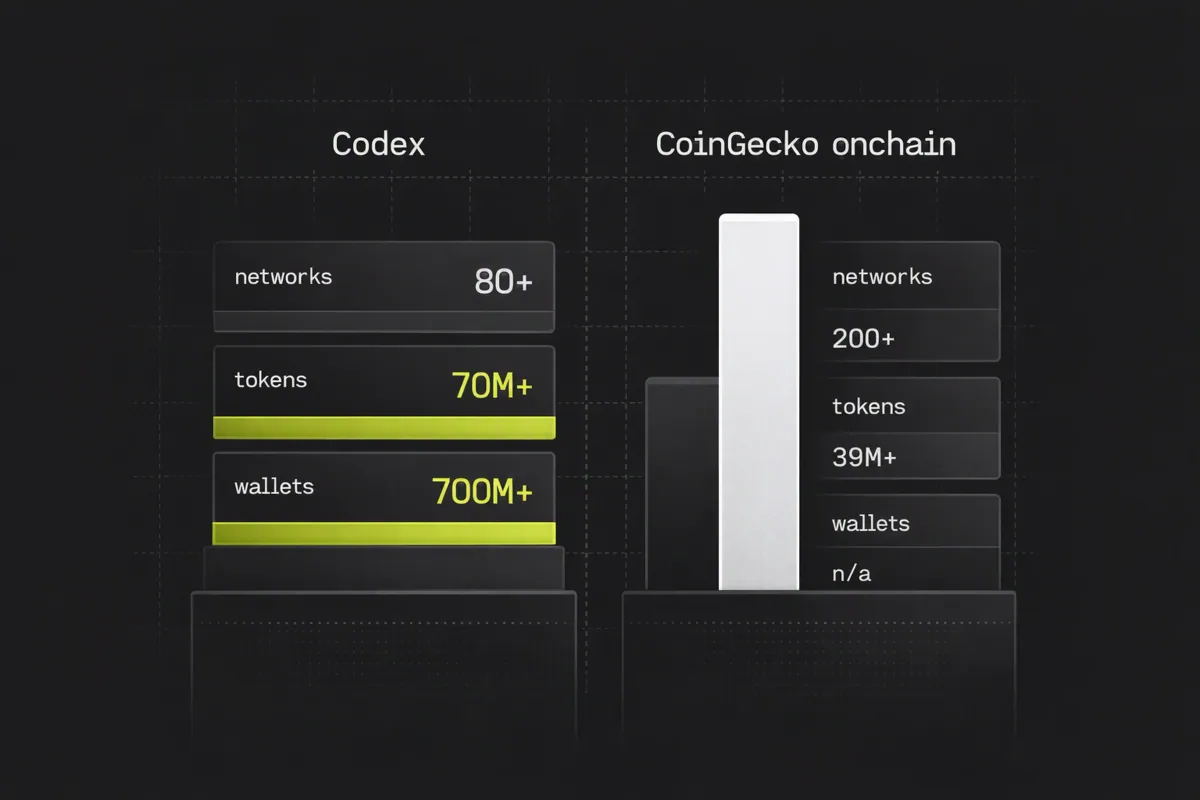
- Codex: 80+ networks indexed.
- CoinGecko onchain: 200+ blockchain networks across 1,800+ DEXes.
CoinGecko onchain touches more networks at a DEX aggregation layer, while Codex focuses on a depth of indexing and enrichment across a curated but broad set of chains.
Token Coverage
- Codex: 70M+ tokens.
- CoinGecko onchain: 39M+ tokens.
Codex’s long‑tail token support — including launchpad assets and newer chain ecosystems — is designed for teams that can’t afford gaps in token discovery.
Wallet Coverage
- Codex: 700M+ wallets indexed across chains.
- CoinGecko: docs emphasize pools/tokens/DEXes, not wallet‑scale indexing at this magnitude.
Wallet‑level indexing enables:
- Cross‑chain portfolio views.
- Holder distributions and concentration metrics.
- Trader analytics for prediction markets.
This depth is a major differentiator for wallets, social trading apps, and trader analytics tools.
Agent‑Friendly Integration: Codex Agent SDK vs CoinGecko SDKs
AI‑native integration is now a feature, not an afterthought. Both platforms acknowledge this, but with different emphases.
CoinGecko: REST‑First with SDKs & AI Docs
- Official TypeScript and Python SDKs.
- REST, WebSocket, and webhook delivery.
- AI integration docs designed for copilots and assistants.
This works well if your agents are:
- Reading coin metadata and market stats.
- Pulling global price feeds and rankings.
Codex: Agent‑Grade On‑Chain Data Layer
Codex’s Agent SDK and ecosystem are tailored to trading agents:
- TypeScript SDK over the GraphQL supergraph.
- Codex Skills: packaged capabilities agents can call directly.
- Docs MCP: tool for agents to navigate API docs and schema.
- MPP pay‑per‑request: documented at $0.001/request, ideal for usage‑based agent workloads.
This allows agents to:
- Query live token prices, chart data, and liquidity in one call.
- Listen to on‑chain events via subscriptions (e.g., trades, mints, burns).
- Access prediction market endpoints for events, markets, and trader stats.
For teams building AI trading copilots, agentic research tools, or auto‑hedging bots, Codex’s agent‑grade design is a meaningful advantage.
Rate Limits & Production Suitability
CoinGecko Keyless API: Good for Prototyping, Not Production
CoinGecko’s docs explicitly warn:
- Keyless API is not suitable for:
- Production workloads
- Scheduled polling
- High‑frequency updates
- Typical usage caps:
- ~10–30 calls/min for CoinGecko endpoints.
- ~10 calls/min for GeckoTerminal endpoints.
For production you need a Pro plan with explicit request credits and per‑minute limits.
Codex: Infra‑Grade Assumption
Codex positions itself as production‑grade from day one:
- Built to support customers like Coinbase, TradingView, Uniswap, Magic Eden, Rainbow, MoonPay, and more.
- Focus on sub‑second latencies and high throughput for:
- Trading terminals
- Wallets with millions of users
- High‑traffic consumer apps
If your workload looks like a live trading interface, Codex’s performance posture and pricing (including MPP for agents) align better with infra‑grade needs.
Decision Framework: When to Choose Codex vs CoinGecko
Use the following criteria to decide whether Codex, CoinGecko, or both belong in your stack.
1. Your Primary Data: On‑Chain vs Market‑Wide
- Choose CoinGecko when:
- You care about CEX prices, derivatives, NFTs, global market stats.
- Your app is more about market discovery than on‑chain trading.
- Choose Codex when:
- Your core data is on‑chain tokens, pools, wallets, and prediction markets.
- You need contract‑address‑based queries with normalized metadata and prices.
2. Latency Requirements
- If <1s latency and streaming are critical:
- Codex’s GraphQL + subscriptions + tuned endpoints are a better fit.
- If you can tolerate cache windows of 30s–12h:
- CoinGecko’s historical ranges are more than sufficient.
3. Historical Use Case
- Long‑horizon, cross‑market analytics (2018 onward, CEX‑heavy):
- Lean on CoinGecko.
- High‑resolution, short‑term on‑chain trading analytics:
- Use Codex token bars and event history.
4. Agent & Automation Strategy
- Basic AI integration pulling coin info and charts:
- CoinGecko SDKs are fine.
- Sophisticated trading agents, bots, and agentic dashboards:
- Codex Agent SDK + Skills + MPP provide more suitable primitives.
5. Multi‑Chain Coverage & Long‑Tail Tokens
- Need maximum chain count at the DEX aggregation layer:
- CoinGecko onchain’s 200+ networks is attractive.
- Need long‑tail token and wallet coverage for trading‑grade UX:
- Codex’s 70M+ tokens and 700M+ wallets are compelling.
Migration Strategy: From CoinGecko to Codex as Your On‑Chain Data Layer
Codex is explicit in its docs: it is not a drop‑in replacement for all CoinGecko surfaces.
However, for on‑chain token data and contract‑address queries, Codex is a close fit and often an upgrade.
Step 1: Map Your Current CoinGecko Usage
List your current endpoints and categorize them:
- On‑chain:
- DEX prices by contract address
- Pool and token metadata
- On‑chain volume/liquidity metrics
- Off‑chain / global:
- CEX tickers
- Derivatives and futures
- Global market cap / dominance stats
- NFT floors
Only the on‑chain category is in scope for direct Codex replacement.
Step 2: Identify Equivalent Codex Queries
Use Codex’s migration and API docs to map:
- Token prices →
getTokenPrices - Candles & charts →
getTokenBars - Token discovery →
filterTokens - Holders & balances → holder/balance queries
- Prediction markets →
filterPredictionEvents,filterPredictionMarkets, trader stats
Codex’s GraphQL structure lets you compose these into one query rather than multiple REST calls.
Step 3: Re‑Architect for Streaming Instead of Polling
Replace cron‑based polling with:
- Subscriptions for:
- Live token prices and candles
- Real‑time trades or liquidity events
- Webhooks for:
- Threshold‑based alerts
- Balance changes or position updates
This reduces:
- API call volume
- Cache complexity
- Latency between on‑chain events and visible UI changes
Step 4: Introduce Codex Agent SDK for Automation
For workloads where AI agents are involved:
- Integrate the Codex TS Agent SDK.
- Configure Codex Skills that represent key workflows:
- “Fetch on‑chain token price & liquidity”
- “Stream token trades for the last 15 minutes”
- “Query prediction market odds for event X”
- Use MPP $0.001/request for cost‑controlled experimentation.
This lets agents tap into Codex as a first‑class trading‑grade data layer instead of juggling multiple REST endpoints.
Step 5: Keep CoinGecko Where It Still Adds Value
Most mature teams don’t fully abandon CoinGecko. Instead, they:
- Use Codex for on‑chain, trading‑grade paths.
- Keep CoinGecko Pro for:
- CEX price references
- Global market metrics
- Some NFT and derivative surfaces.
The net result is a hybrid stack where Codex is the on‑chain source of truth, and CoinGecko provides complementary macro context.
Comparison Table: Codex Agent SDK vs CoinGecko API
| Criteria | Codex Agent SDK & GraphQL API | CoinGecko REST API & SDKs |
|---|---|---|
| Core focus | Trading‑grade on‑chain token + prediction market data | Broad crypto market data (CEX + some on‑chain) |
| Architecture | Single GraphQL supergraph, queries + subscriptions + webhooks | Multiple REST endpoints, plus WebSocket/webhooks |
| Networks | 80+ networks | 200+ onchain networks, 1,800+ DEXes |
| Tokens | 70M+ tokens | 39M+ tokens onchain |
| Wallets | 700M+ wallets indexed | No comparable wallet‑scale index documented |
| Latency | ~60–150 ms token queries; balances ~1.8 s post‑finalization | Cache windows 30s–12h depending on range |
| Historical depth | High‑resolution bars down to 1S, full short‑term event history | 5‑minute data from 2018, long‑horizon market charts |
| Agent integration | TS SDK, Codex Skills, Docs MCP, MPP at $0.001/request | TS/Python SDKs, AI integration guides |
| Ideal use cases | Pro trading apps, wallets, prediction market frontends, bots | Market discovery, portfolio tracking, research dashboards |