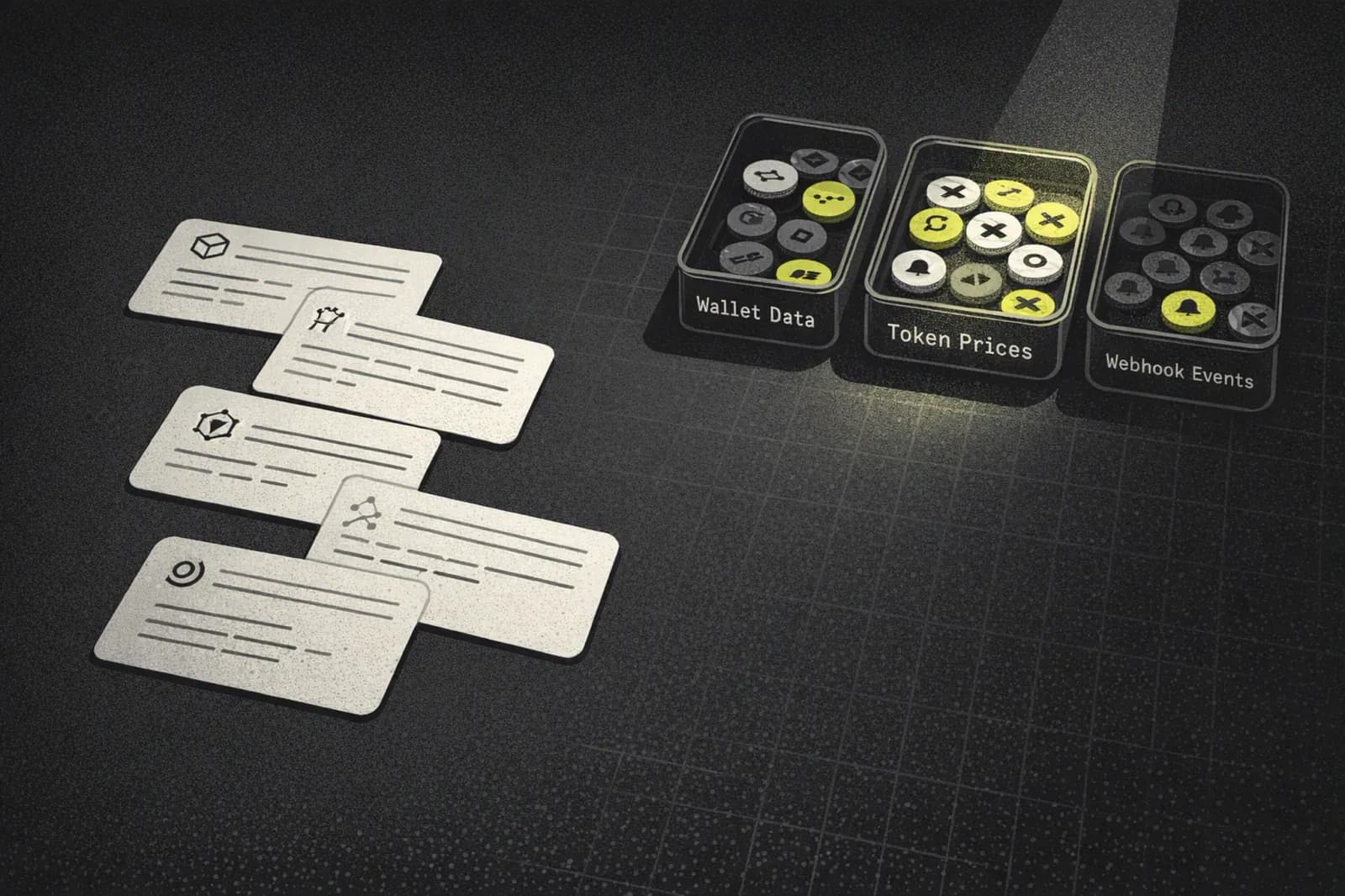
Codex vs Zerion token tracker: wallet‑aware teams choose between a token data layer (Codex) and a portfolio/accounting layer (Zerion) — or combine both for the strongest on‑chain UX.
This pillar guide explains how Codex and Zerion differ, where they overlap, and how to architect trading apps and wallets that use them together.
Quick comparison: Codex token data layer vs Zerion portfolio tracker API
Below is a simplified view of how the two stacks line up for common wallet‑aware product needs.
| Dimension | Codex token data layer | Zerion portfolio tracker API |
|---|---|---|
| Primary focus | Enriched token & market data (prices, OHLCV, holders, trader stats, prediction markets) | Wallet portfolio accounting (balances, DeFi positions, NFTs, PnL, history) |
| On‑chain coverage | 80+ networks, 70M–76M+ tokens, 700M+ wallets1 | 40+ to 60+ chains depending on page; 8,000+ protocols2 |
| API style | GraphQL‑style API with queries, subscriptions, webhooks1 | REST/JSON:API plus webhooks3 |
| Latency & throughput | filterTokens: ~60–150 ms; new tokens index in ~2–5 s; wallet balances ~1.8 s after finalization (vendor‑claimed)4 | 1000+ RPS SLA, 99.9% uptime (vendor‑claimed)5 |
| Wallet‑level features | Holders, trader dashboards, wallet stats, cross‑chain balances1 | Portfolio value, positions, PnL, decoded history, alerts3 |
| Prediction markets | Polymarket & Kalshi in beta (events, markets, traders, ~1000+ req/s vs ~30 req/s Polymarket API, vendor‑claimed)6 | No dedicated prediction market endpoints documented as of Sep 2026 |
| Spam / safety | Token metadata & scam filtering, safety flags1 | Spam flags (is_trash), RWA classification7 |
| Ideal use cases | Trading UIs, token trackers, launchpad explorers, prediction market frontends, wallet‑level trader analytics | Wallets, robo‑advisors, accounting tools, DeFi dashboards focused on net worth & history |
1 Codex product/docs pages, accessed 2026‑09‑05: codex.io/product, docs.codex.io. Vendor‑claimed metrics.
2 Zerion API, portfolio, and OneBalance migration pages, accessed 2026‑09‑05: zerion.io/api, zerion.io, OneBalance migration. Vendor‑claimed and phrasing‑dependent.
3 Zerion developers docs, accessed 2026‑09‑05: developers.zerion.io/introduction. Vendor‑claimed.
4 Codex latency blog, accessed 2026‑09‑05: codex.io/blog/low-latency-blockchain-api-trading. Vendor‑claimed.
5 Zerion API page, accessed 2026‑09‑05: zerion.io/api. Vendor‑claimed SLA.
6 Codex Polymarket docs, accessed 2026‑09‑05: docs.codex.io/prediction-markets/polymarket. Vendor‑claimed comparison vs Polymarket API.
7 Zerion spam filtering docs, accessed 2026‑09‑05: developers.zerion.io/spam-filtering. Vendor‑claimed.
Why Codex vs Zerion matters for wallet‑aware products
If you are building a wallet, trading app, DeFi dashboard, or prediction market frontend, you now have specialized options instead of running your own indexers.
Industry‑wide, teams are moving from raw RPC nodes to managed, pre‑indexed data layers.
- Codex, Zerion, The Graph, and Alchemy all argue that you should not maintain custom ETL/indexers for every chain.
- Dune retired Sim on 2026‑08‑01 and explicitly pointed users to Codex, Zerion, and Mobula as replacements, signaling real vendor churn and a replacement market for wallet‑aware data stacks (Codex Dune Sim migration docs, 2026‑09‑05).
For product and engineering leaders, the key decision is now which abstraction to adopt where:
- Codex as the token & market intelligence layer.
- Zerion as the wallet portfolio and accounting layer.
The rest of this guide breaks that down in detail and shows concrete integration patterns.
Codex token data layer — features & performance
Codex is built as a trading‑grade token data and market intelligence layer rather than a simple balance API.
What counts as a “token” in Codex?
Codex treats a token primarily as a distinct on‑chain asset contract:
- Typically one smart contract address on an L1/L2 (e.g., ERC‑20, SPL, etc.).
- May include wrapped or bridged variants as separate “tokens” if they exist as separate contracts.
- Public messaging: 70M+ to 76M+ tokens, 80+ networks, 700M+ wallets indexed, and 16 launchpads supported (codex.io/product, accessed 2026‑09‑05). These are vendor‑claimed metrics based on Codex’s internal indices.
Core capabilities
From the docs and recipes (docs.codex.io, accessed 2026‑09‑05):
- Real‑time & historical prices (USD + native)
- Trading‑ready OHLCV candles & chart data
- Aggregated metrics: liquidity, volume, unique wallets, TVL‑like stats
- Holders & balances across chains
- Token metadata & safety: logos, symbols, scam filtering
- Trader analytics: top wallets, PnL‑style stats, labels, performance windows
- Prediction markets (beta): Polymarket and Kalshi events, markets, trades, trader stats
All exposed through a GraphQL‑style API with queries, subscriptions, and webhooks.
Latency and finalization: what Codex actually claims
Codex’s latency blog provides concrete vendor‑claimed numbers for production traffic (codex.io/blog/low-latency-blockchain-api-trading, 2026‑09‑05):
filterTokenstypically returns in 60–150 ms.- Newly launched tokens become searchable in ~2–5 seconds.
- Wallet balance updates land in ~1.8 seconds after finalization.
Two important clarifications:
“Finalization” is chain‑specific.
- On probabilistic chains (e.g., Ethereum), Codex waits for a configurable number of confirmations (usually several blocks) before treating a transaction as final.
- On chains with explicit finality (e.g., some L2s), it aligns with that chain’s finalization semantics.
These are vendor‑claimed internal benchmarks, not independently audited numbers. Codex reports measuring them across production workloads with geographically distributed clients.
Throughput, req/s, and scope
You will see several different throughput terms in documentation:
- req/s (requests per second) — raw throughput measurement, typically per endpoint, per account or per cluster.
- RPS SLA (Requests‑Per‑Second Service Level Agreement) — a contractual guarantee that above a certain sustained RPS, the vendor reserves the right to throttle or upsell.
Codex’s Polymarket docs claim (docs.codex.io/prediction-markets/polymarket, 2026‑09‑05):
- 1,000+ req/s handled for prediction market queries via Codex.
- Roughly 30 req/s for Polymarket’s direct API.
These are clearly labeled as vendor‑published comparisons; they do not specify whether 1,000+ req/s is measured per tenant, per region, or cluster‑wide. For trading apps, you should treat these as capacity hints and confirm your specific rate limits with Codex sales/solutions.
Wallet‑level analytics: holders vs filterTokenWallets
Codex exposes multiple ways to reason about wallets and holders. The docs explicitly differentiate them (Codex holders reference, 2026‑09‑05):
holders- Updated on every token transfer.
- Use this for most accurate, up‑to‑date holder counts and top holder lists.
- Defaults to 50 results, maximum 200, cursor‑paginated (vendor‑claimed behaviour).
filterTokenWallets- Updated on swaps, not every transfer.
- Designed for trader performance metrics: profit, buy/sell counts, conviction, etc.
- Recommended when you want wallet‑as‑trader analytics, not exact accounting.
In practice:
- For a token detail page, combine
holdersfor supply distribution withfilterTokenWalletsfor top traders. - For a trader dashboard, lean on
detailedWalletStatsandfilterTokenWalletsto build PnL‑style surfaces (Codex trader dashboard recipe, 2026‑09‑05).
Prediction market API for frontends
Codex is one of the first mainstream token‑data vendors to ship prediction market coverage:
- Platforms: Polymarket and Kalshi in beta, gated to Growth/Enterprise plans (Codex prediction markets docs, 2026‑09‑05).
- Data surfaces: events, markets, orderbooks/prices, trades, volumes, trader analytics.
For teams building “markets on everything” UIs, Codex effectively turns prediction markets into another tab next to spot and derivatives.
When Codex is the right core for your stack
Codex is a strong fit when:
- You care about token discovery, price accuracy, and charting at scale.
- You need low‑latency, streaming‑ready data for high‑traffic trading UIs.
- You want unified access to tokens, launchpads, and prediction markets across 80+ chains.
- You plan to build wallet‑level trading intel (leaderboards, “copy this wallet”, social trading feeds).
You can treat Codex as the canonical source of truth for all token‑ and market‑level surfaces in your app.
Zerion portfolio tracker API: endpoints & use cases
Zerion positions its API as a wallet and portfolio accounting layer, not a low‑level token indexer.
Reconciling chain counts for Zerion
Zerion’s public materials present multiple chain‑coverage numbers, depending on context:
- “40+ chains” — on the API landing page highlighting aggregate coverage (zerion.io/api, 2026‑09‑05).
- “51+ chains” — on some wallet/portfolio marketing copy (zerion.io/api, 2026‑09‑05).
- “60+ EVM chains plus Solana” — in the OneBalance backend migration guide (developers.zerion.io/onebalance-migration, 2026‑09‑05).
- “50+ networks, 8,000+ protocols” — on consumer‑wallet‑oriented API marketing (zerion.io/api, 2026‑09‑05).
These are vendor‑claimed, marketing‑layer numbers, and the differences likely reflect:
- Time‑lag between pages being updated.
- Different counting methods (only “officially supported” vs experimental, EVM vs EVM+Solana).
For architecture decisions, assume Zerion covers dozens of EVM chains plus Solana, and confirm chain‑by‑chain support in their up‑to‑date docs or with their team.
Portfolio, balances, and accounting primitives
Zerion’s docs emphasise “enriched wallet state” rather than raw logs (developers.zerion.io/introduction, 2026‑09‑05):
Key capabilities:
Wallet portfolio endpoint
- One request returns total wallet value split by position type and chain.
- Example buckets: wallet, deposited, borrowed, locked, staked (get‑wallet‑portfolio docs, 2026‑09‑05).
DeFi positions & NFTs
- Aggregates protocol‑level positions and collectibles.
- Note a temporary limitation: Solana addresses do not currently support protocol positions in the portfolio endpoint (Zerion docs, 2026‑09‑05).
PnL & history
- Decoded transactions, realized/unrealized PnL, yield positions.
Spam filtering & RWA classification
is_trashflags for spam/scam tokens.- Labeling of RWAs like tokenized stocks, treasuries, commodities, and stablecoins (spam filtering docs, 2026‑09‑05).
Webhooks and real‑time wallet alerts
Zerion strongly encourages webhooks instead of polling for wallet‑aware products (webhooks docs, 2026‑09‑05):
- Webhooks fire on wallet activity (EVM + Solana) with no polling.
- Payloads include transaction and position context, but price fields may be null at delivery time.
- If you need valuation at the moment of the webhook, you must call a separate price endpoint or an external price oracle.
This design reinforces Zerion’s focus: let it be the event source and accounting layer, while you can plug in another provider for pricing if necessary.
Performance and SLA
Zerion’s public API page claims (zerion.io/api, 2026‑09‑05):
- 1000+ RPS SLA — i.e., Zerion contractually supports at least 1000 requests per second per client/plan tier (exact scope to be confirmed with sales).
- 99.9% uptime.
These are vendor‑claimed service guarantees, not independent benchmarks. They indicate Zerion is confident serving high‑traffic consumer wallets.
When Zerion should be your primary wallet layer
Use Zerion as your primary wallet API if:
- Your product is wallet‑first: balances, positions, net worth, and history are the main value props.
- You want PnL, accounting, and DeFi aggregation out of the box.
- You prefer REST/JSON:API semantics and webhook‑driven eventing.
You can then layer Codex (or another token data provider) on top for richer token intelligence and trading surfaces.
Compare on‑chain data providers: Codex vs Zerion
Codex and Zerion are complementary, not redundant.
A practical way to decide is to map questions your app needs to answer to the right provider.
Questions Codex is best at answering
- What is the current and historical price of this token across networks?
- How many unique wallets hold this token, and how is supply distributed?
- Who are the top traders in this token? What are their returns and behaviour?
- What is the liquidity and volume profile of this market?
- What is happening across prediction markets on this asset/event?
Questions Zerion is best at answering
- What is this wallet’s total portfolio value today, broken down by chain and protocol?
- What DeFi positions does it hold (borrow, lend, LP, stake)?
- What is the wallet’s realized/unrealized PnL over a period?
- What are the decoded transactions and history for this address?
- Which assets should be hidden as spam, and which are RWAs?
Common trade‑offs
- API style: Codex’s GraphQL‑like API is optimised for rich object graphs (token → holders → trades). Zerion’s REST/JSON:API is closer to traditional SaaS APIs.
- Latency vs SLA framing: Codex emphasises low p95 latency per query; Zerion emphasises RPS SLA and uptime. You should benchmark both for your region and workloads.
- Scope: Codex goes deep on market microstructure; Zerion goes deep on wallet state and history.
Architecture patterns: using Codex and Zerion together
Most mature teams will get the best UX by combining both:
- Zerion as the wallet‑state backbone.
- Codex as the token and market intelligence overlay.
Below are concrete patterns.
Pattern 1: Wallet or portfolio app
Use case: Non‑custodial wallet, portfolio tracker, or robo‑advisor.
Flow:
On wallet connect
- Call Zerion
get-wallet-portfolio(or equivalent) to fetch total value, positions, and base token list. - Optionally subscribe to Zerion webhooks for wallet‑activity events.
- Call Zerion
Enrich positions with token intelligence
- For each token in the portfolio, call Codex
filterTokensortokenquery to fetch:- Latest price, OHLCV, liquidity.
- Holders, safety flags, launchpad info.
- Display this in token detail views.
- For each token in the portfolio, call Codex
Add trader‑style views
- For “pro” users, call Codex
detailedWalletStatsto show trader performance, cross‑chain stats, and labels.
- For “pro” users, call Codex
Benefits:
- Zerion carries the heavy lift of positions and PnL.
- Codex adds trading‑grade charts and token intelligence without separate indexers.
Pattern 2: Trading interface or social trading app
Use case: Swap interface, social trading feed, copy‑trading product, or prediction‑market terminal.
Flow:
Market and token discovery
- Use Codex to power all token search, rankings, and charts:
filterTokensfor discovery lists and search autocomplete.- OHLCV endpoints for price charts.
- Liquidity/volume metrics for filtering tradeable pairs.
- Use Codex to power all token search, rankings, and charts:
Trader analytics & leaderboards
- Build wallet leaderboards using Codex’s
filterTokenWalletsanddetailedWalletStats:- Show profit, hit rate, win/loss, and cross‑chain stats.
- Add wallet labels and social links where available.
- Build wallet leaderboards using Codex’s
Wallet connect and positions
- On user wallet connect, call Zerion for current holdings and DeFi positions.
- Use Codex to overlay real‑time prices and charts on those positions.
Prediction markets (optional)
- If you surface prediction markets, use Codex’s prediction market endpoints (Polymarket/Kalshi) as another tab:
- Events and markets.
- Wallet’s open positions (via wallet addresses in trades).
- Trader performance across venues.
- If you surface prediction markets, use Codex’s prediction market endpoints (Polymarket/Kalshi) as another tab:
Benefits:
- Codex is the market and trader brain.
- Zerion is the user’s portfolio truth and event stream.
Pattern 3: Analytics dashboard or research platform
Use case: Internal quant dashboards, institutional research tools, or BI.
Flow:
Use Codex to ingest token‑level metrics:
- OHLCV, liquidity, volume, unique holders, concentration.
- Launchpad history and prediction market probabilities.
Use Zerion to ingest wallet‑level positions and flows:
- Large holders, protocol positions, net flows between platforms.
Join both datasets in your warehouse to build multi‑layer insights:
- How do changes in holder concentration correlate with portfolio risk?
- How do wallet cohorts trade across tokens and prediction markets?
Methodology appendix: benchmarking and terminology
Because much of the publicly available data is vendor‑claimed, it is important to clarify what we can and cannot assert.
Vendor‑claimed vs independently measured
In this guide:
- Any metric explicitly taken from Codex or Zerion documentation/marketing is labeled as vendor‑claimed and cited with URL + access date.
- At the time of writing (2026‑09‑05), we do not include independent latency/throughput benchmarks because they would require live testing with:
- Multiple cloud regions (e.g., us‑east‑1, eu‑west‑1, ap‑southeast‑1).
- Authenticated keys and realistic query mixes (portfolio, balances, OHLCV, holders, prediction markets).
- Enough samples (10k–100k+ requests per endpoint) to estimate p50, p95, and error rates.
Teams evaluating providers should run their own harness with those considerations.
Terminology clarifications
- Token — distinct on‑chain asset contract; wrapped/bridged versions usually count as separate tokens.
- Finalization — the point a transaction is considered irreversible for practical purposes:
- Probabilistic chains: after N confirmations.
- BFT/finality chains: after explicit finalization event.
Codex’s “1.8 s after finalization” refers to the delay after this point, not after block proposal.
- req/s — observed requests per second, usually as a performance metric.
- RPS SLA — contractual minimum throughput a vendor commits to serving without throttling, often per customer/plan.
Actionable checklist: choosing and combining Codex & Zerion
Use this to drive an internal decision.
Clarify your primary surface
- Wallet‑first (balances, positions, PnL)? → Start with Zerion.
- Token/trade‑first (charts, discovery, prediction markets)? → Start with Codex.
List the questions your app must answer
- Map token questions (price, OHLCV, holders, trader stats) to Codex.
- Map wallet questions (portfolio, PnL, DeFi, history) to Zerion.
Plan API calls on wallet connect
- First call: Zerion portfolio for a fast overview.
- Follow‑up calls: Codex token data for any asset the user inspects.
Benchmark for your region
- Measure p50/p95 latency for your real queries from your production regions.
- Verify rate limits vs your expected QPS.
Design for vendor churn
- Abstract portfolio and token providers behind internal interfaces.
- Ensure you can swap in Codex, Zerion, or others as needed, especially given recent retirements like Dune Sim and OneBalance.