Building a trading interface or wallet is no longer just about talking to a node.
If you’re a product or engineering leader shipping high‑traffic, trading‑adjacent apps, your on‑chain data API is effectively part of your matching engine and UX. Latency, correctness, and uptime directly translate into PnL, trust, and user retention.
This guide walks through how to evaluate blockchain data APIs specifically for trading‑grade workloads — with concrete latency and reliability benchmarks from the market and how Codex is architected for these demands.
Why “trading‑grade” blockchain data is different
Most node APIs and generic blockchain data services are built for:
- Explorers
- Analytics dashboards
- Periodic reporting
Trading‑grade apps have very different requirements:
- Sub‑second round trips from UI → backend → data API → UI
- Streaming or near‑real‑time updates for prices, candles, balances, and orderbook‑like views
- Consistency across networks and assets, including long‑tail tokens
- Predictable behavior under peak load (token launches, airdrops, market crashes)
If your data layer can’t keep up, you see:
- Stale prices and candles
- Desynced balances vs chain reality
- Frozen charts during volatility
- Incorrect aggregates (liquidity, volume, holders)
That’s the bar you should evaluate every blockchain data API against.
The 4 non‑negotiables: what to evaluate in a blockchain data API
When you’re selecting a provider for trading, wallets, or consumer apps, focus on four core dimensions:
- Latency & freshness
- Reliability & uptime SLAs
- Scale & behavior under peak load
- Data model & trading‑readiness
Let’s break each down with concrete benchmarks.
1. Latency & freshness: how fast is “fast enough”?
For trading interfaces, every 100ms matters. You need to evaluate both:
- API response latency (how fast you get a response), and
- Data freshness (how quickly new on‑chain events appear in your queries)
What “good” looks like (benchmarks)
Real numbers from current providers:
- Codex
filterTokensresponses typically 60–150ms- New tokens searchable in ~2–5 seconds
- Wallet balances updated after finalization in ~1.8s on average
- QuickNode Core API
- Claims sub‑50ms latency on its core API
- Goldsky Mirror
- Advertises <1s latency for streams and sub‑second processing
- Covalent
- Markets sub‑second indexing across 100+ chains
- Bitquery WebSocket
- Described as sub‑second latency for streams
For trading‑grade frontends, practical targets are:
- HTTP/GraphQL requests: p95 under 150–200ms
- WebSockets/streams: updates within <1s of chain finalization
- New asset discovery (tokens/markets): visible within a few seconds
Anything slower starts to show up as laggy charts, delayed balances, and out‑of‑sync UIs.
How Codex approaches low latency
Codex’s pipeline is designed around trading workloads:
- Ingests raw chain events across 80+ networks
- Normalizes them into tokens, trades, wallets, markets
- Precomputes OHLCV, holders, aggregates
- Serves everything via an all‑in‑one GraphQL‑style API
- Uses caching and streaming updates to keep response times in the 60–150ms range for key queries
Because Candles, prices, and aggregates are precomputed and updated in near real time, you avoid expensive on‑the‑fly aggregations that blow up latency during volatility.
How to evaluate latency in practice
Actionable steps for your team:
Benchmark p50/p95/p99
- Measure latency for your actual queries (candles, portfolio, balances) from your production regions.
- Use realistic payloads (e.g., 50–100 tokens per request).
Test under load
- Run load tests at your expected throughput (e.g., 200–300 RPS) during a burst.
- Watch how latency degrades as you approach limits.
Check freshness
- Measure how long it takes for:
- A new token launch to appear in search.
- A balance change to reflect in wallet views.
- A new trade to show in candles/volume.
- Measure how long it takes for:
Validate WebSocket behavior
- Subscribe to 50–100 symbols.
- Track update delays vs on‑chain timestamps.
You want predictable, documented latency and transparent freshness guarantees, not just “fast” in marketing copy.
2. Reliability & uptime SLAs: can you trust it during chaos?
A trading app is only as reliable as its data layer. Evaluate:
- Historical uptime
- SLA guarantees
- Status page transparency
- Incident handling and communication
Market benchmarks
From public docs and marketing:
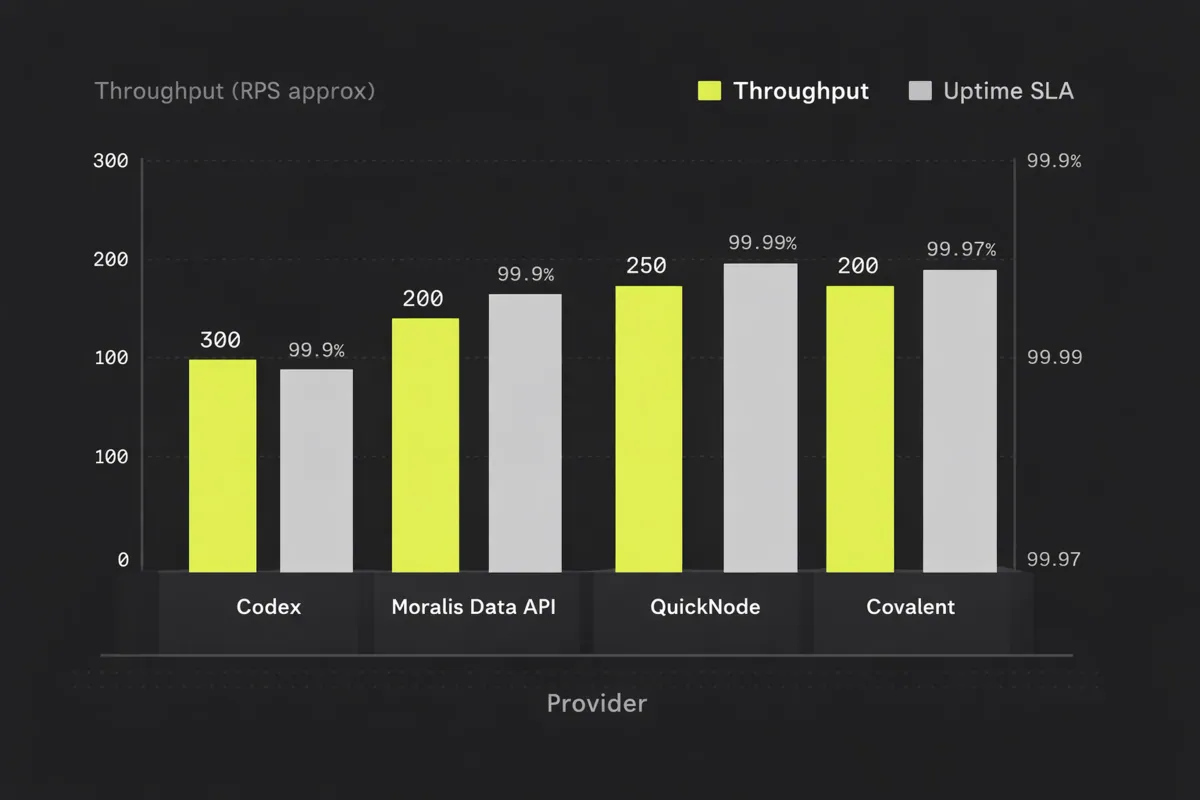
- QuickNode: advertises 99.99% uptime SLA for its core API
- Covalent: cites 99.97% uptime and 1B+ API calls served
- Moralis: offers 99.9% uptime SLA for RPC nodes
Codex distinguishes itself with detailed operational transparency:
- Public status page with real incidents, not just green check marks
- Example incidents:
- June 8, 2026: token data processing delay of ~1–2 minutes due to Kafka producer timeouts
- June 25, 2026: Base network outage causing downstream delays
- Ongoing note on Robinhood Wallet balance delay due to upstream RPC latency
This kind of detail is a strong signal that a provider treats reliability as an engineering problem, not a marketing line.
Case study: TradingView’s reliability requirements
TradingView migrated its on‑chain data to Codex after using 3–4 providers, including The Graph. Outcomes reported:
- 15 seconds faster responses on on‑chain data
- 2M additional tokens indexed
- 200+ engineering hours saved
- 99.9% WebSocket uptime cited in the case study
Their product leadership emphasized that generic indexing tools were not designed for financial‑data quality, particularly around wicks, bot attacks, and latency during spikes.
What to demand in an SLA
For trading‑grade use cases, look for:
- Clear uptime guarantees (99.9%+ with credits for missed targets)
- Defined incident response times and severity levels
- Documented RTO/RPO for core systems
- Real‑time status page with incident history and postmortems
If an API provider can’t show you a status page with actual historical incidents and clear SLAs, you should assume you will be the monitoring system.
3. Scale & behavior under peak load: can it survive your biggest day?
The moment you most need your data provider — a token launch, a volatility spike, a major news event — is when many providers break.
You need to understand:
- Throughput limits (RPS, concurrent connections)
- Burst behavior
- Rate‑limit policies
- Graceful degradation mechanisms
Throughput benchmarks across providers
Examples from public docs:
- Codex (Growth‑tier guidance)
- ~300 RPS
- ~300 concurrent WebSocket connections
- ~1M requests/month
- Practical starting point: ~100 tokens per WebSocket connection
- Moralis Data API
- 40 req/s (Free/Starter)
- 80 req/s (Pro)
- 200 req/s (Business)
- Dune API (SQL‑centric, not real‑time)
- 40 rpm on Free high‑limit endpoints
- 200 rpm on Plus
- 1000+ rpm on Enterprise
Other providers like Goldsky, QuickNode, Covalent, and Bitquery emphasize streaming scale, but numbers are often gated behind sales conversations.
Here’s how some of these claims compare at a glance.
What to test for peak conditions
Your evaluation shouldn’t stop at “can I make a request?” — it should mirror your worst day in production.
Run experiments that answer:
How does p95 latency change as you approach rate limits?
- Does it slowly degrade, or does it fall off a cliff at 80–90% of quota?
What happens when you exceed limits?
- Do you get clear 429s with retry‑after headers?
- Does the provider silently drop WebSocket messages?
How do streaming updates behave at scale?
- Can you safely subscribe to 100+ assets per connection?
- Does the provider recommend sharding subscriptions?
Does the provider have real experience with high‑traffic apps?
- Codex, for example, powers Coinbase, TradingView, Uniswap, Magic Eden, Rainbow, MoonPay, Farcaster, pump.fun, and others.
- That’s evidence of hardened behavior under serious traffic.
You want a provider that actively designs for bursty, trading‑style workloads, not one that just lifts general‑purpose rate limits.
4. Data model & trading‑readiness: are you getting price ticks or raw logs?
Many “blockchain data APIs” simply wrap raw logs or basic transaction lists. That’s not enough for trading‑grade UX.
You should look for a provider that turns raw chain events into enriched, normalized trading objects that you can consume directly.
Trading‑ready primitives you should expect
At minimum, your API should expose:
- Real‑time and historical prices
- Spot in USD and native
- Bid/ask or mid where relevant
- Trading‑ready charts
- OHLC candles
- Volume overlays
- Configurable intervals (1m, 5m, 1h, 1d…)
- Aggregated metrics
- Liquidity and volume per token / pool
- Unique wallets and holder counts
- TVL‑like stats per asset or protocol
- Wallet & holder views
- Cross‑chain balances
- Holder distribution
- Metadata & safety
- Token metadata and logos
- Scam filtering
- Launchpad context (which launchpad, when, etc.)
Codex does this enrichment up front and serves it via a single GraphQL schema, instead of pushing this burden onto your team.
Why unified schemas matter
If you stitch together multiple providers for:
- Prices
- Charts
- Wallet balances
- NFTs
- Prediction markets
…you introduce:
- Conflicting data models (e.g., different token identifiers, decimal handling)
- Latency and reliability differences between vendors
- Complexity in your error handling and retry logic
A single, unified schema reduces:
- Time to build new features
- Operational surface area
- Edge cases during outages
Codex’s point of view is explicit: “we index the chain so you don’t have to.” Your team focuses on product logic, not ETL.
5. Prediction market data: a new evaluation category
If your app touches prediction markets — Polymarket front‑ends, Kalshi analytics, social trading, or risk dashboards — you have an extra dimension: market‑specific analytics.
Most generic blockchain APIs don’t understand prediction market semantics at all.
What a prediction market API should provide
Look for capabilities like:
- Events & markets
- Query events, markets, and outcomes
- Filter by category, resolution time, or platform
- Trades & order flow
- Historical and real‑time trades
- Market depth / liquidity indicators
- Trader analytics
- PnL per trader
- Position sizing
- Leaderboards / ranking signals
Codex is one of the first platforms to treat this as a first‑class product:
- Dedicated endpoints for events, markets, trades, and trader stats
- Coverage across Polymarket and Kalshi
- Exposes windowed stats and ranked discovery signals
- Currently marked as beta, with docs clearly flagging potential unreliability
If prediction markets are core to your roadmap, you should evaluate providers on this axis specifically — not assume an RPC or generic data service can be adapted.
6. How Codex is optimized for high‑traffic trading interfaces
Synthesizing the above, Codex is architected explicitly as a trading‑grade on‑chain data layer.
Key design choices relevant for product and engineering leaders:
Performance‑first architecture
- Sub‑second ingestion from 80+ networks and 700M+ wallets
- Trading views and charts precomputed, not assembled ad hoc
- Typical
filterTokenslatency: 60–150ms
Scale and concurrency built‑in
- Growth plans targeting ~300 RPS and 300 concurrent WebSockets
- Practical guidance of ~100 tokens per WebSocket connection
- Used as a single source of truth by TradingView, Coinbase, Uniswap, Magic Eden, Rainbow, MoonPay, and others
Enriched data model
- 70M+ tokens indexed (with some docs citing 75M+) and 80+ networks
- Real‑time prices, OHLCV, liquidity metrics, holders, balances, scam filtering
- Unified schema across tokens, wallets, launchpads, and prediction markets
Operational maturity
- Public status page with detailed incident logs
- Production‑hardened across tier‑1 partners
- Beta flagging for newer surfaces like prediction markets
For teams who don’t want to build and maintain:
- Multi‑chain indexers
- Kafka pipelines and OLAP warehouses
- ETL jobs for OHLC, liquidity, and holders
…Codex effectively acts as the drop‑in data plane behind trading‑grade applications.
7. A practical evaluation checklist for your team
Here’s a condensed checklist your product/engineering leads can use when comparing blockchain data APIs for trading‑grade apps.
Latency & freshness
- [ ] p95 HTTP latency under 150–200ms for key queries
- [ ] WebSocket updates within <1s of on‑chain finalization
- [ ] New tokens indexed and searchable in <5s
- [ ] Documented freshness metrics in public docs
Reliability & uptime
- [ ] Public status page with real incident history
- [ ] Clear uptime SLA (99.9%+) and credits
- [ ] Defined incident response and communication process
- [ ] Evidence of stability with high‑traffic customers
Scale & peak behavior
- [ ] Published RPS and concurrency limits (e.g., Codex ~300 RPS, 300 connections)
- [ ] Load‑tested behavior near and above rate limits
- [ ] Predictable error codes and retry semantics
- [ ] Guidance on subscription fan‑out (tokens per WebSocket)
Data model & coverage
- [ ] Trading‑ready primitives (prices, OHLCV, volume, liquidity, holders)
- [ ] Cross‑chain wallet and balance views
- [ ] Long‑tail token and launchpad coverage
- [ ] Scam filtering and metadata
Prediction markets (if relevant)
- [ ] Events, markets, outcomes, and trades exposed as first‑class objects
- [ ] Trader analytics and ranking signals
- [ ] Latency comparable to token data
- [ ] Clear beta/GA status and reliability expectations
If a provider scores poorly on more than one of these dimensions, it will likely show up as data incidents in production.