Overview: Why Onchain Data Breaks as You Scale
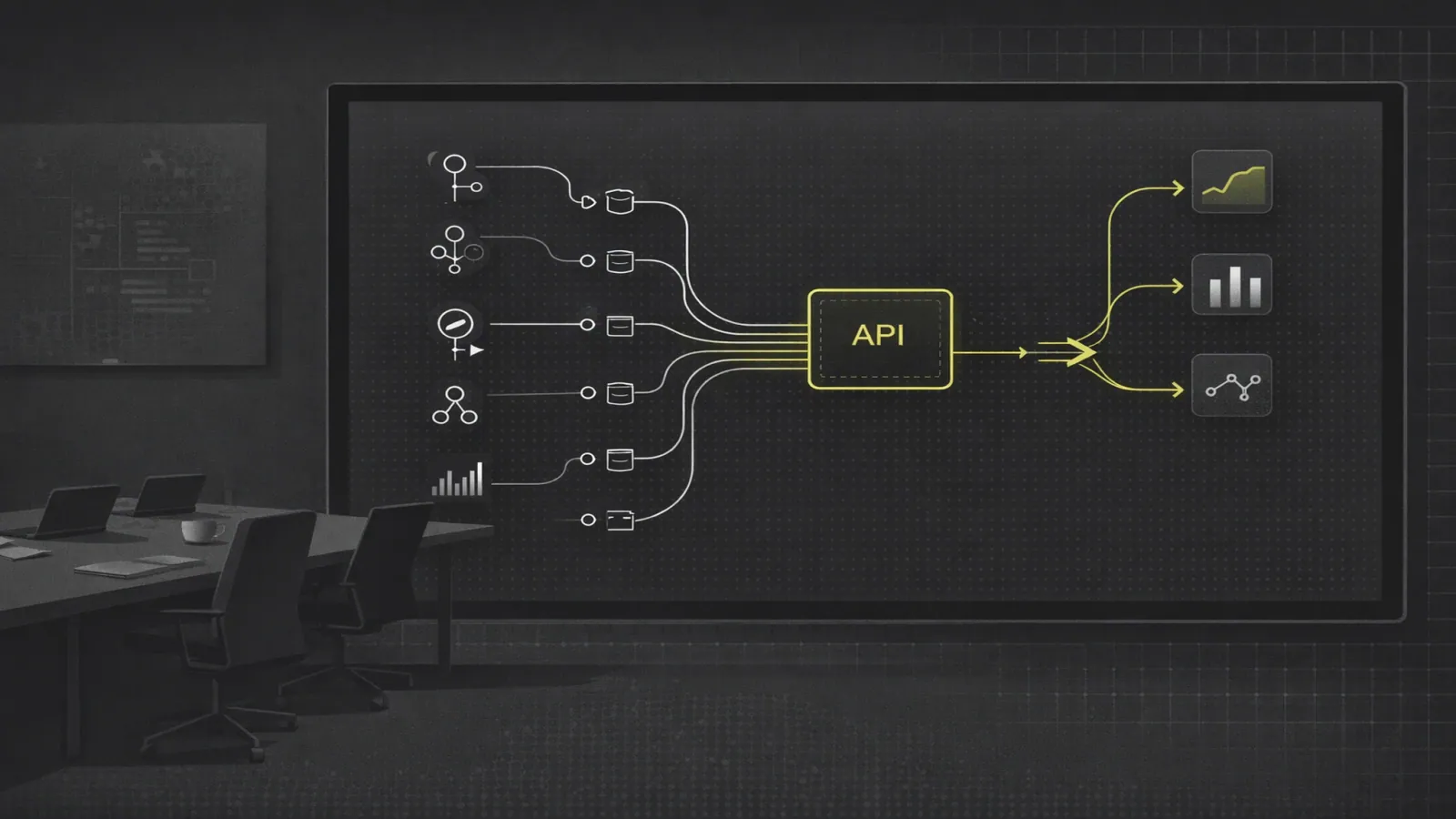
Most crypto products don’t fail because they can’t hit an RPC endpoint. They fail because their data layer can’t keep up once they have real users.
As you move from an MVP to millions of users, the hard problems are:
- Turning raw chain events into trading-ready, queryable data
- Handling multi-chain expansion without rewriting your backend
- Surviving API throttling and rate limits
- Managing cold-start latency, backfills, and reorgs
- Serving real-time charts, prices, and prediction markets with sub-second freshness
This guide gives founders, CTOs, and heads of product a practical framework for scaling onchain data from prototype to production. We’ll map each stage to the key decisions, pitfalls, and where a platform like Codex fits.
The Three Stages of Scaling Onchain Data
To keep things concrete, we’ll use a simple three-stage model:
- MVP / Prototype – Single chain, low traffic, fast iteration
- Product-Market Fit – Multi-chain, tens to hundreds of thousands of users
- Scale-Up / Millions of Users – Global traffic, trading-grade expectations
At each stage, we’ll cover:
- Data requirements
- Typical failure modes
- Infrastructure choices
- How Codex helps you skip years of infra work
Stage 1: MVP / Prototype – Ship Fast, Don’t Paint Yourself Into a Corner
At MVP, your goals are simple:
- Validate your core UX
- Integrate one or two chains
- Support basic balances, prices, and charts
Many teams start with:
- Direct RPC calls (Alchemy, QuickNode, etc.)
- One-off ETL scripts into a database
- Free or low-tier price APIs
What Works at This Stage
For a prototype, this is fine. You might only need:
- Latest token prices in USD
- Simple 24h charts
- Basic wallet balances
- A single prediction market integration
You can often ship this in days, not weeks. But the decisions you make here will either accelerate or block you later.
Early Pitfalls to Avoid
Even at MVP, avoid these anti-patterns:
- Schema per chain – Writing custom indexing logic for each chain (e.g., “we have a special table just for Base”) makes multi-chain expansion painful.
- Tight coupling to a single RPC provider – Hardcoding RPC URLs throughout your codebase instead of abstracting a data layer.
- No plan for historical data – Building features that rely on full history (e.g., PnL, advanced analytics) but only storing recent blocks.
How Codex Fits at MVP
Using Codex at MVP is about future-proofing while still moving fast.
With Codex, you can:
- Get real-time and historical token prices via a single GraphQL-style API
- Pull chart-ready OHLC and candles without building aggregations
- Query holders and balances across chains without custom indexers
- Start experimenting with prediction market endpoints (markets, events, trades)
Codex already indexes 70M+ tokens, 700M+ wallets, and 80+ networks. Even if you only use one chain today, you’re building on an API that’s designed for multi-chain from day one.
MVP takeaway: You don’t need complex infra yet, but you do want a data provider that won’t break when you add your second chain or your first 10,000 users.
Stage 2: Product-Market Fit – Handling Growth, Throttling, and Chain Expansion
Once you hit PMF, the game changes.
You’re likely dealing with:
- Tens to hundreds of thousands of users
- Multiple chains and launchpads
- Complex features: portfolios, PnL, advanced charts, social feeds, prediction markets
This is where most DIY data pipelines start to crack.
Pitfall 1: API Throttling and Rate Limits
As traffic grows, rate limits become product constraints.
- QuickNode documents examples like 250 requests per second / 1,000 rpm / 10,000 rpd and returns HTTP 429 when you exceed limits.
- Nodit uses CU/s throughput tiers with 429 errors and
Retry-Afterheaders. - Many price APIs cap requests per second and historical lookbacks on lower tiers.
If your UI relies on naive polling:
- You’ll hit throttling during traffic spikes
- Your charts and balances will lag or fail
- You’ll waste engineering time tuning per-provider limits
Mitigation strategies:
- Move from raw polling to streaming or pre-aggregated data
- Use a provider that offers trading-grade chart + price feeds out of the box
- Centralize on one data schema instead of stitching multiple APIs
How Codex helps:
- Provides trading-ready charts (OHLC, candles, volume) with sub-second freshness
- Normalizes data across 80+ networks, so you call one API instead of many
- Powers 500M+ API requests/month for apps like Defined, demonstrating it can handle sustained load
Pitfall 2: Cold-Start Latency and Backfills
Cold starts are brutal for trading and portfolio UX.
Typical causes:
- Spinning up indexing jobs per new token/market
- Backfilling historical data every time you add a new feature
- Inefficient queries that scan raw logs instead of pre-indexed data
The result:
- Slow initial loads for portfolios and dashboards
- Missing historical data for long-tail tokens and new launchpads
- Frequent reindexing when something goes wrong
Industry context:
- The Graph’s Substreams claims up to 72,000% faster processing than traditional RPC-based approaches by streaming pre-processed data.
- Bitquery advertises sub-500ms streams and shows GraphQL/WebSocket responses around 312ms.
The direction is clear: high-traffic apps need pre-indexed, streaming-friendly data, not DIY backfills.
How Codex helps:
- Codex continuously ingests thousands of transactions per second across 80+ networks
- It exposes normalized, enriched objects (tokens, trades, wallets) instead of raw logs
- You get historical and real-time data in one API, so features like PnL and advanced charting work without separate backfill jobs
Pitfall 3: Chain Expansion and Fragmented Schemas
Multi-chain is no longer optional.
- Codex supports 80+ networks
- The Graph supports 60+ networks
- Alchemy supports 100+ chains
- Moralis supports 30+ chains, Nodit 50+, Bitquery 40+
Users expect your app to “just work” across:
- Major L1s and L2s
- Popular launchpads (Codex supports 16 launchpads)
- Long-tail and newly launched tokens
If each chain requires a custom indexer and schema, you’ll quickly:
- Blow up your infra costs (e.g., one Codex case study cites $3,000/month just to index a single game)
- Fragment your analytics and metrics across systems
- Slow down every new chain integration by weeks or months
How Codex helps:
- One GraphQL-style API for tokens, holders, charts, and prediction markets
- Unified schemas across 80+ networks and 70M+ tokens
- Built-in scam filtering and token metadata for safer user experiences
PMF takeaway: At this stage, you need to treat your data layer as core product infrastructure. A provider like Codex lets your team focus on UX and features instead of indexers and ETL.
Stage 3: Millions of Users – Trading-Grade, Real-Time, and Prediction-Market Ready
At scale, you’re competing with the UX of top apps like Coinbase and TradingView. Your users expect:
- Sub-second updates for balances and charts
- Zero visible downtime
- Consistent pricing and liquidity metrics across devices and regions
- Prediction markets and onchain events that feel as responsive as centralized products
Latency Is a Systems Problem
Latency at this stage is not about a single slow node.
Alchemy notes that latency comes from:
- Request-path overhead
- Network hops and routing
- Traffic spikes and load balancing
- Node lag and workload bottlenecks
- Incomplete measurement and blind spots
Modern infra benchmarks:
- Alchemy: sub-50ms average response times and 99.99% uptime across 100+ chains
- The Graph: 1.27 trillion queries served, 75,000+ projects, 50+ indexers
- Bitquery: streams with sub-500ms latencies
To compete, your data provider must be engineered as infrastructure, not a side project.
Real-World Scale: What Codex Delivers
Codex is already the data layer behind:
- TradingView, with 50M+ users
- Coinbase, Uniswap, Magic Eden, Rainbow, MoonPay, and others
In public case studies, Codex reports:
- TradingView integration: 15-second response time reduction, 200+ hours of developer time saved, and 99.9% uptime on WebSocket connections
- Defined: 500M API requests/month, 250,000+ monthly users, 10,000+ Telegram channels served
- Sudoswap: $50,000+ annual AWS savings, 60% faster app load times, 1,000+ developer hours saved
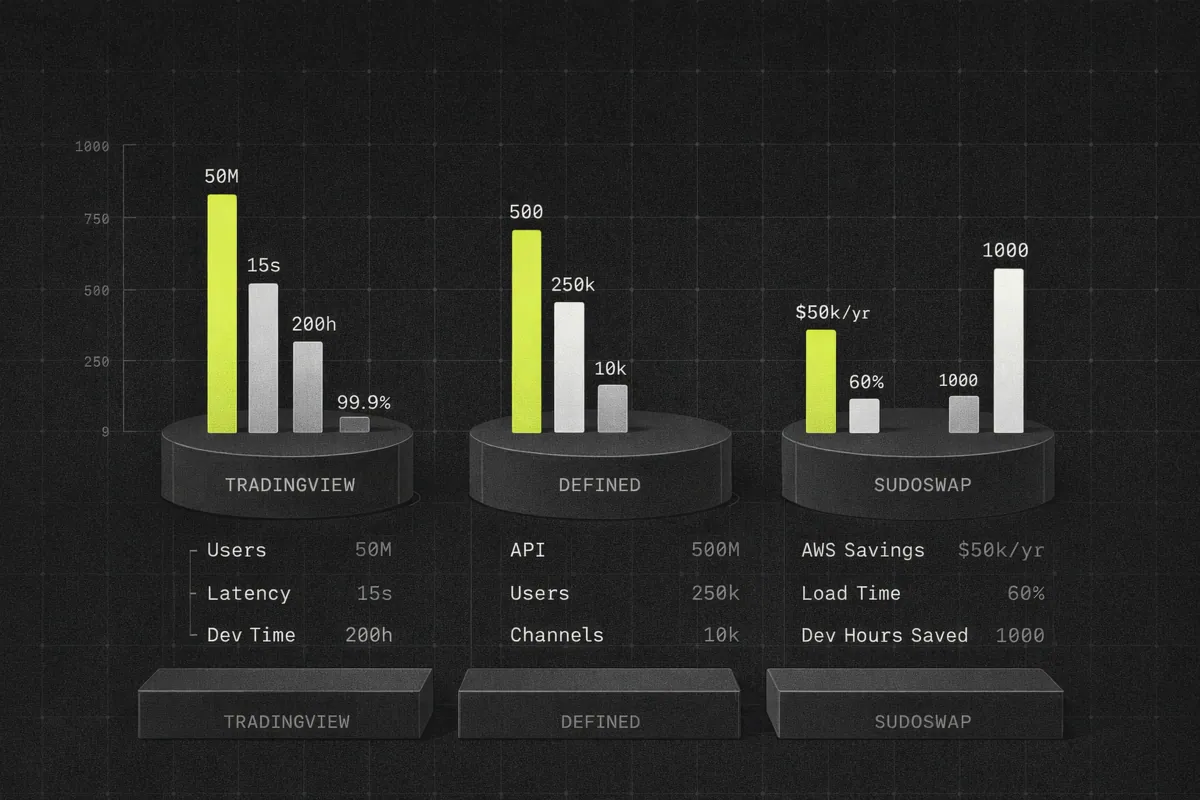
These are the kinds of numbers you should benchmark against when choosing a data provider.
Prediction Markets: A New Data-Intensive Vertical
Prediction markets add an extra layer of complexity:
- Events and markets have lifecycles (open, trading, resolved)
- Frontends need live volume, odds, and order book-like behavior
- APIs must support pagination, filtering, and real-time updates
Recent signals:
- Polymarket added a live-volume endpoint and adjusted list limits to support responsive frontends
- Alchemy’s Polymarket case study highlights ~100ms global latency and zero downtime during the 2024 U.S. elections
Codex leans into this space with dedicated prediction-market endpoints:
filterPredictionEventsfilterPredictionMarkets- Trader analytics and trade histories
This gives you trading-grade prediction market data and token data in one API, instead of stitching multiple specialized providers.
Scale-up takeaway: At millions of users, any fragility in your data layer becomes a visible UX problem. Codex’s focus on speed, reliability, and unified coverage reduces the risk surface dramatically.
A Practical Framework: Planning Your Data Infrastructure
Here’s a concise framework you can use to plan your data stack from day one.
1. Define Your Data UX
Start from the user:
- Do users expect trading-terminal-grade charts?
- Are you showing portfolio PnL across chains?
- Will you support prediction markets or options-like products?
Map each major feature to:
- Data types (tokens, wallets, markets, NFTs)
- Latency requirements (real-time vs near-real-time vs batch)
- Historical depth (intraday vs multi-year)
2. Choose a Primary Onchain Data Provider
Your default should be one unified, high-performance API. Glue-code between multiple providers should be the exception, not the rule.
When evaluating providers, compare:
- Coverage: networks, tokens, wallets, launchpads, prediction markets
- Latency & uptime: look for sub-second responses and 99.9%+ uptime
- Data model: raw logs vs enriched, normalized objects
- Reference customers: are they powering TradingView-level or Coinbase-level apps?
Codex positions itself as the trading-grade onchain data layer, with:
- 70M+ tokens, 700M+ wallets, 80+ networks
- Real-time prices, charts, aggregates, holders, balances
- Integrated prediction-market data in a single API
3. Design for Multi-Chain From Day One
Even if you only launch on one chain:
- Use chain-agnostic schemas in your internal services
- Avoid hardcoding chain logic deep in your application
- Ensure your provider supports the next 3–5 chains you’re likely to add
Codex’s unified schema across 80+ networks makes this significantly easier.
4. Plan for Throttling and Concurrency
Assume your traffic will spike.
- Implement backoff and retry handling for 429 responses
- Prefer pre-aggregated, streaming-friendly endpoints over raw logs polling
- Monitor request rates and latency per endpoint
With Codex, you can lean on their experience handling hundreds of millions of monthly requests for existing customers.
5. Outsource ETL, Indexing, and Reorg Handling
Running your own indexers, RPCs, and ETL pipelines across 80+ networks is not a competitive advantage.
- Offload indexing and enrichment to a dedicated infra provider
- Use normalized objects (tokens, trades, markets) instead of maintaining raw event parsers
- Let your engineers focus on product and differentiation, not low-level infra
Codex’s core promise is literally: “We index the chain so you don’t have to.”
When Should You Migrate to Codex?
You don’t need to refactor your entire stack on day one. Many teams adopt Codex incrementally.
Common triggers:
- You’re hitting rate limits or 429s during peak times
- You’re spending $3,000+/month on homegrown indexing for a single game or product
- Your team is maintaining multiple indexers and schemas across chains
- Product initiatives are blocked by missing data (e.g., holders, liquidity, prediction markets)
Incremental adoption patterns:
- Start with pricing and charts – Swap your chart data provider with Codex for better coverage and latency.
- Add wallet and holders data – Switch from DIY ETL to Codex endpoints.
- Layer in prediction-market data – Use Codex’s dedicated endpoints for events, markets, and trader analytics.
Over time, you consolidate more of your data stack into a single, trading-grade API.
Final Thoughts
Scaling from MVP to millions of users in crypto is less about clever smart contracts and more about rock-solid data infrastructure.
By:
- Defining your data UX early
- Choosing a unified, multi-chain data provider
- Designing for throttling, latency, and chain expansion
- Offloading indexing and ETL to a platform like Codex
You give your team the freedom to focus on what actually differentiates your product.
Codex’s message is simple: “We index the chain so you don’t have to.” If you’re serious about building high-traffic, trading-grade crypto products, that’s a foundation worth considering.