Why Token‑Aware Fintech Is Harder Than It Looks
If you’re building a wallet, exchange, portfolio tracker, or prediction market front‑end, you must treat token data as first‑class.
Prices, charts, balances, liquidity, and even prediction market odds are now core UX, not “nice to haves.”
Yet many teams still start with the assumption: “We’ll just run a node and write some queries.” In practice, that quickly turns into a multi‑month ETL, indexing, and enrichment project.
This guide breaks down:
- Why rolling your own on‑chain data pipeline is expensive and complex
- The hidden operational and reliability risks of DIY indexing
- How to build a token‑aware fintech app using Codex’s trading‑grade data APIs instead
- Concrete steps to integrate token and prediction market data without touching raw chain logs
The Real Cost of Building Your Own Blockchain Data Pipeline
It’s not just a node; it’s an ETL and reorg problem
Public blockchains are optimized for writes and verification, not for rich, ad‑hoc reads.
AWS notes that retrieving specific blockchain info often means scanning blocks sequentially, then running complex ETL across disparate sources and expensive storage.
The Graph’s docs put it plainly:
- Blockchains have no relational structure
- There is no native query language
- Historical reads often require archive nodes and custom indexing
In other words, to answer basic product questions like:
- “What’s the historical OHLCV for this token?”
- “How many unique wallets traded this asset last week?”
- “Which addresses hold at least $10k of this token across chains?”
…you end up building:
- Custom indexers per chain
- A schema for enriched token, trade, and wallet entities
- Backfill jobs and reorg‑aware ETL
Node operations alone can blow your infra budget
Even before indexing, node operations are non‑trivial.
Ethereum.org says running your own node is challenging, consuming engineering time, storage, and bandwidth. Storage for full‑archive nodes is measured in terabytes, not gigabytes.
Key data points:
- Geth estimates an Ethereum archive node needs roughly 2 TB for flat state history and up to 6.5 TB+ with historical trie data
- Hash‑based archive sync can exceed 20 TB during sync and take months
- Google Cloud prices Ethereum archive nodes around $2.74/hour (~$2,000.20/month)
And that’s one chain.
As soon as you add more networks (Solana, Base, Polygon, Arbitrum, etc.), the cost and operational burden multiply.
Schema drift, reorgs, and maintenance
Once you have nodes and raw data, you still need to:
- Design schemas for tokens, swaps, transfers, predictions, and wallets
- Handle chain reorgs (rollbacks) correctly, re‑indexing affected history
- Rerun backfills whenever your ETL logic or schema changes
- Keep up with new protocols, launchpads, and bridges that introduce fresh data models
AWS explicitly warns that blockchain data prep is similar to other big data problems, but with more complicated ETL and more frequent backfills.
Every time a protocol changes an event signature or you add a new venue, you’re back in migration land.
Opportunity cost: months of engineering vs. product velocity
For trading‑adjacent apps, latency, correctness, and uptime are non‑negotiable.
But every engineer you assign to indexers and ETL is not shipping:
- New portfolio views and P&L features
- Smarter alerts and risk dashboards
- Better prediction market experiences
- Mobile UX improvements and on‑ramp integrations
Teams at Series A+ and enterprise scale routinely spend months to get a “good enough” on‑chain data stack.
That’s the gap Codex is designed to close.
Why Most Teams Shouldn’t Build Their Own On‑Chain ETL
Data quality and latency requirements are higher for fintech and trading
If you’re building high‑traffic trading apps or consumer fintech experiences, you care about:
- Sub‑second latency for price updates
- Clean, normalized data across 80+ networks
- Accurate OHLCV for charting and analytics
- Consistent token metadata, including scam filtering
DIY pipelines often fall short on one or more of these:
- Latency spikes when backfills or batch jobs run
- Long‑tail tokens lack reliable prices or metadata
- Prediction market data arrives out of sync with token data
For trading and prediction market front‑ends, that translates directly into:
- Missed trades
- Poor risk visibility
- Broken charts or empty portfolios
Multi‑vendor setups increase failure points
Many teams try to patch over these issues by stitching together multiple providers:
- Node‑as‑a‑service for raw RPC
- A separate analytics API for token prices
- Custom scripts for wallet balances
- ETL into their own data warehouse
This increases:
- Complexity: more integration code to maintain
- Latency variance: each provider has different performance characteristics
- Failure modes: more APIs that can rate‑limit, degrade, or change formats
A single, unified on‑chain data layer is simply easier to reason about and scale.
Meet Codex: Trading‑Grade On‑Chain Data Without the Pipeline Headache
Codex positions itself as the fastest and most reliable blockchain data API for token and prediction market data.
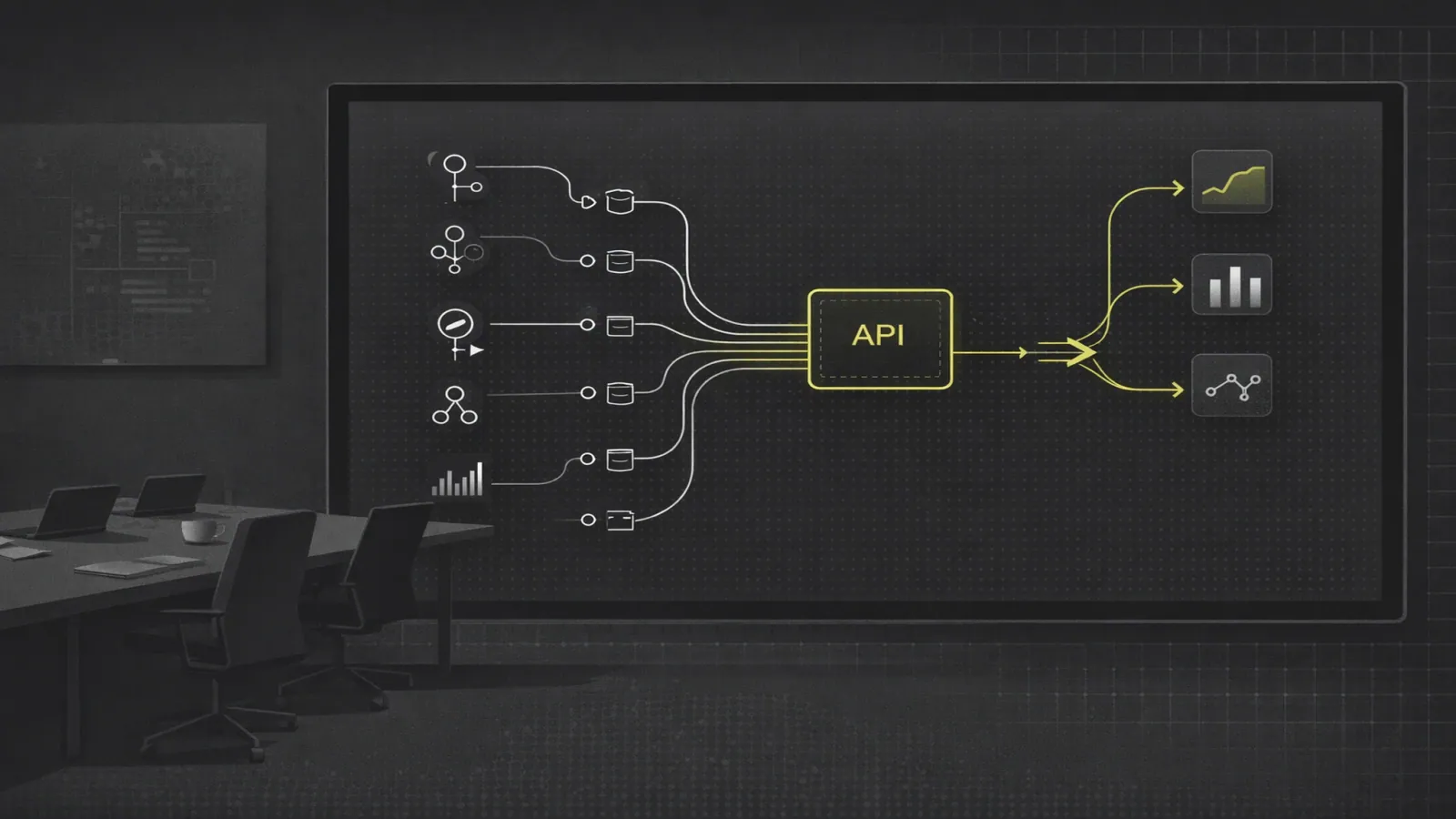
Instead of building ETL, indexers, and enrichment in‑house, you plug into one GraphQL‑style API that already handles:
- Ingestion and enrichment across 80+ networks
- Coverage of 70M+ tokens and 700M+ wallets
- Indexing of thousands of transactions per second
- Unified APIs for tokens, wallets, launchpads, and prediction markets
Codex already powers leading apps including:
- Coinbase
- TradingView
- Uniswap
- Magic Eden
- Rainbow
- MoonPay
- Farcaster
- pump.fun
For product and engineering teams, that’s strong social proof that the data is production‑grade.
What You Get Out of the Box With Codex
1. Token data: prices, charts, and metadata
Codex exposes trading‑ready token data in one API:
- Real‑time and historical token prices in USD and native units
- Trading‑ready chart data: OHLC, candles, volume
- Aggregated metrics: liquidity, volume, unique wallets, TVL‑like stats
- Token metadata and scam filtering
- Launchpad‑aware token discovery across 16+ launchpads
This is ideal for:
- Exchanges and DEX front‑ends needing the best crypto data APIs for high‑traffic trading apps
- Wallets that require a token metadata enrichment API with price and risk indicators
- On‑chain analytics dashboards that use real‑time token transfer indexing APIs for user portfolios
2. Wallet‑level analytics and balances
Codex’s wallet endpoints give you:
- Balances across chains and tokens
- Wallet‑level transaction history
- Cross‑chain views across 700M+ wallets
That means you can build:
- A single portfolio view across multiple networks
- On‑chain analytics for wallets (e.g., net flows, positions, and realized/unrealized P&L)
- Risk and compliance tooling that needs accurate holdings in near real time
3. Prediction market data (Polymarket & Kalshi)
Prediction markets are rapidly becoming mainstream.
Dune’s data shows combined Polymarket + Kalshi volume reaching $26.6B, and Kalshi reports 800% growth in institutional volume in six months.
Codex provides dedicated prediction market APIs currently in beta for Growth and Enterprise plans, covering:
- Events and markets via
filterPredictionEventsandfilterPredictionMarkets - Trades and trader analytics (performance, exposure, behavior)
This is particularly powerful for:
- Best on‑chain data provider for prediction market front‑ends
- Trading terminals that want to show prediction markets alongside spot/perps
- Research tools and social trading apps that visualize crowd sentiment and odds
How to Build a Token‑Aware Fintech App Without Running ETL
Let’s walk through a practical architecture for a token‑aware fintech product using Codex.
Step 1: Stop at the RPC layer; don’t go deeper
You may still want a node‑as‑a‑service (for transactions or smart contract interactions), but you do not need to:
- Run archive nodes
- Build indexers per chain
- Design complex ETL pipelines for token/market data
Instead, treat RPC purely as transaction execution.
For everything data‑related, you call Codex.
Step 2: Use Codex as your single on‑chain data layer
Codex’s GraphQL‑style API becomes your source of truth for on‑chain data.
Core integration patterns:
- Server‑side data fetching: Your backend queries Codex for prices, OHLCV, balances, and prediction markets, then caches responses for your front‑end.
- Streaming and live updates: Use Codex’s live subscriptions for real‑time token prices and chart data in trading UIs.
- Aggregates for analytics: Pull liquidity, volume, and unique wallet metrics to power dashboards.
Key benefit:
- One high‑performance API replaces a patchwork of indexers, warehouses, and homegrown enrichment scripts.
Step 3: Wire token data into every core product surface
To build a genuinely token‑aware fintech app, integrate Codex across:
Portfolio views
- Use balances + prices for total value and per‑asset P&L
- Add liquidity and volume metrics to show how “tradeable” a position is
Trading and swap screens
- Power charts with OHLCV data
- Show real‑time prices with sub‑second latency
Notifications and alerts
- Trigger alerts off price moves, volume spikes, or wallet activity
Risk and compliance views
- Monitor large token holders and concentration via holders endpoints
This is where “token‑aware” becomes tangible for end users.
Step 4: Add prediction markets as a first‑class data source
If you’re building prediction market front‑ends, trading terminals, or research tools, treat prediction markets like another asset class.
With Codex’s prediction market API:
- Discover events and markets with normalized schemas
- Pull odds, liquidity, and volume per market
- Analyze trader behavior: who is consistently profitable, how concentrated is the flow, etc.
You can:
- Overlay prediction market odds on fundamental and macro dashboards
- Offer side‑by‑side views of token prices vs. market probabilities
- Give users portfolios that include both tokens and prediction market positions
Step 5: Scale without touching infra
As you grow, Codex scales with you:
- Add new chains by configuration, not infra builds
- Expand from prices to holders, from tokens to prediction markets, without new ETL
- Rely on Codex’s sub‑second latency and high uptime, proven with apps like Coinbase and TradingView
This is the core of Codex’s value proposition: “We index the chain so you don’t have to.”
On‑Chain Indexing Services vs. Build Your Own: A Practical Comparison
Here’s how a Codex‑based approach compares to a DIY pipeline for token‑aware apps.
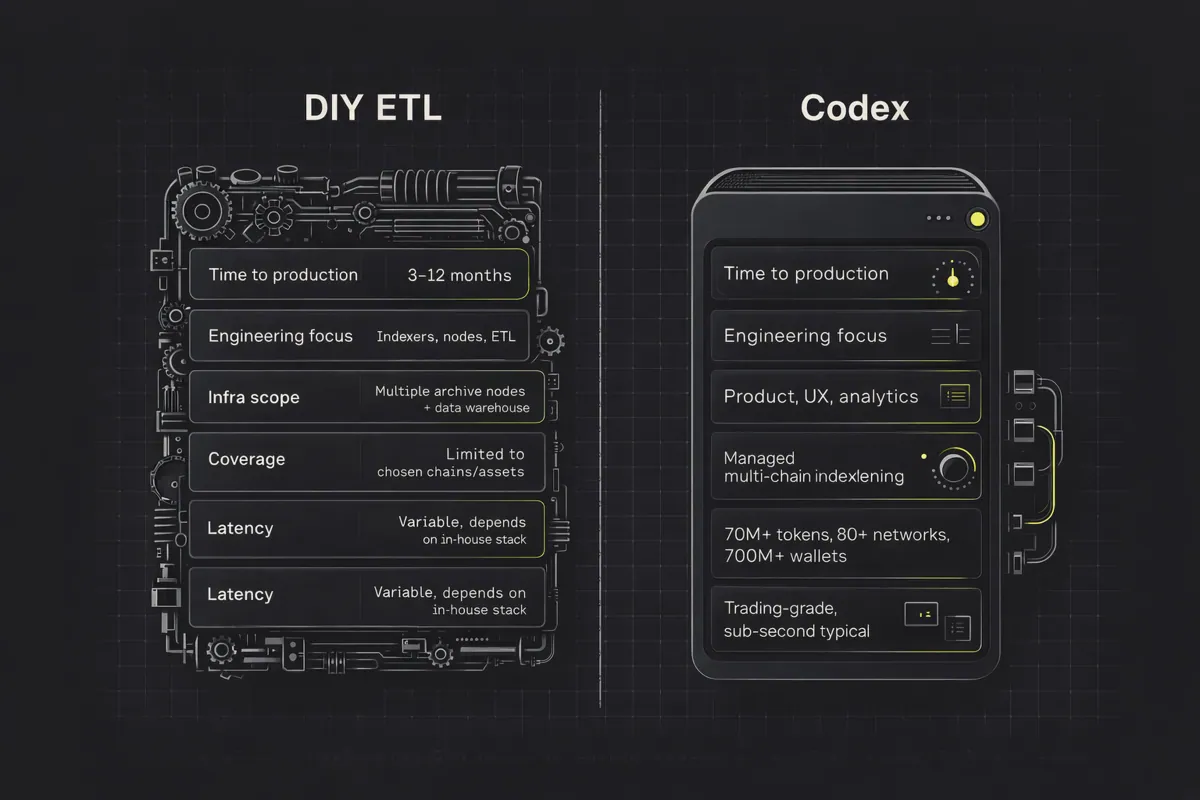
DIY pipeline
You are responsible for:
- Running nodes (or paying cloud providers per chain)
- Designing ETL and schemas for tokens, trades, wallets, and predictions
- Handling reorgs, backfills, and schema migrations
- Normalizing long‑tail token metadata and prices
- Stitching multiple data sources to cover all chains and launchpads
Typical outcomes:
- 3–12 months of engineering before reliable production data
- Ongoing infra and DevOps burden
- Inconsistent data quality across chains and assets
Codex‑powered pipeline
Codex handles:
- Multi‑chain indexing and enrichment across 80+ networks
- Token and wallet normalization for 70M+ tokens and 700M+ wallets
- Prediction market indexing across Polymarket and Kalshi
- Performance tuning for trading‑grade latency and uptime
You focus on:
- Product UX and features
- Analytics models and risk logic
- Business logic and growth
Typical outcomes:
- Weeks (or days) from idea to production
- Vendor consolidation: one scalable blockchain data API for wallets and exchanges
- Higher reliability and performance versus homegrown stacks
Action Plan: How to Adopt Codex in Your Stack
For Heads of Product, CTOs, and lead engineers, here’s a concrete rollout plan.
1. Start with a single feature
Pick a high‑impact surface:
- Token price and charting for your trading UI
- Cross‑chain balances for your wallet
- Prediction market discovery for a new product line
Integrate Codex for that feature only.
Benchmark:
- Latency vs. your existing setup
- Coverage (long‑tail tokens, launchpads, prediction markets)
- Data quality and correctness
2. Expand to wallet analytics and holders
Once comfortable, extend integration to:
- Wallet balances and transaction history
- Holders data and concentration metrics
Use this to:
- Improve portfolio UX
- Enhance risk/compliance tooling
- Drive better personalization and recommendations
3. Consolidate around Codex as your primary data layer
Phase out:
- Ad‑hoc ETL scripts
- Homegrown indexers where Codex offers equivalent endpoints
- Redundant data providers (price feeds, chart vendors) that Codex can replace
Aim for:
- One on‑chain analytics API for wallets, exchanges, and prediction apps
- Simple, well‑documented integration points
4. Negotiate for scale and enterprise needs
For high‑traffic consumer apps, work with Codex on:
- SLAs for on‑chain data API uptime and reliability
- Usage‑based pricing appropriate for 4–6 figure annual contracts
- Roadmap alignment around new chains, launchpads, and prediction market venues