
Overview: Choosing the Best Crypto Data APIs for Trading Apps
If you’re building a trading app, wallet, or crypto analytics product, your data API choice will define your UX, reliability, and roadmap.
This guide breaks down the best general‑purpose crypto data APIs—with a focus on:
- CoinGecko API
- CoinMarketCap API
- Token Metrics (signals vs data API)
Then we explain when these feeds aren’t enough and why trading‑grade apps increasingly rely on enriched on‑chain providers like Codex for sub‑second charts, holders, prediction markets, and cross‑chain wallets.
What Counts as a “Crypto Data API” Today?
Most teams evaluating “best crypto data APIs for trading apps” are looking for three layers:
- Market data
- Prices, OHLC candles, volume, order books
- Market cap, circulating supply, listings
- On‑chain data
- DEX prices, liquidity, pools
- Wallet balances, transfers, holders
- Derived analytics
- Aggregated liquidity, unique wallets, TVL‑like metrics
- Prediction market events, odds, trader stats
CoinGecko and CoinMarketCap sit strongly in layer 1, with growing support in layer 2.
Trading‑grade apps that care about latency, correctness, and deep on‑chain analytics often need layer 2 and 3 in one unified, enriched API.
CoinGecko API: Coverage, Market Cap, and On‑Chain Data
CoinGecko positions itself as the world’s largest independent crypto data aggregator for market data and basic on‑chain analytics.1
Core Coverage
According to its API docs (accessed 2026‑09‑02), CoinGecko exposes roughly:
- ~18,000+ coins and tokens2
- 1,500+ exchanges3
- REST, WebSocket, and Webhook interfaces4
- A separate on‑chain DEX layer covering:
- 200+ blockchain networks
- 1,800+ DEXes
- 39M+ tokens5
This makes CoinGecko one of the best general‑purpose market‑data + on‑chain hybrid APIs for:
- Price feeds for listed assets
- Exchange and market overviews
- On‑chain token, pool, and trade data on DEXs
How CoinGecko Calculates Market Cap (e.g., ADA Market Cap)
CoinGecko is unusually explicit about market cap methodology:
- Market cap is price × circulating supply.6
- Bridged/wrapped tokens are excluded from global market cap to avoid double counting.7
- Historical circulating‑supply charts are available from 22 June 2019 onward.7
For example, for Cardano (ADA):
- CoinGecko states ADA price is computed via a volume‑weighted average across 124 exchanges and 444 markets.8
- ADA market cap = ADA price × ADA circulating supply.
API example (ADA market cap via CoinGecko):
- Endpoint:
GET /coins/{id}(e.g.,/coins/cardano) - Relevant fields:
market_data.current_price.usdmarket_data.circulating_supplymarket_data.market_cap.usd
This gives you both price and market cap directly, plus the underlying circulating supply for verification.
CoinGecko API Pricing
CoinGecko uses credits and rate limits (requests per minute) as its primary constraints.9
As of 2026‑09‑02, public pricing shows:
- Demo (Free)
- 10,000 calls/month
- 100 requests/minute
- Basic
- From $29/month billed yearly or $35/month billed monthly
- 100,000 credits/month
- 300 requests/minute
- ~2 years of historical data
- Analyst
- From $103.20/month billed yearly or $129/month billed monthly
- 500,000 credits/month
- 500 requests/minute
- ~10 years of historical data
- Lite
- From $399.20/month billed yearly or $499/month billed monthly
- 2,000,000 credits/month
- 500 requests/minute
- ~10 years of history
- Enterprise
- Custom pricing
- Advertised 99.9% uptime SLA9
Trade‑offs for product teams:
- The Demo/keyless public API is ideal for prototyping.
- Serious apps quickly need Analyst or Lite for:
- Higher monthly volume
- Long historical chart backfills
- SLAs and support
Coverage Gaps and Limitations
Even with strong coverage, CoinGecko remains market‑data‑first:
- On‑chain DEX layer is powerful but not a full wallet/indexing stack.
- Limited direct support for:
- Detailed wallet balances across chains
- Holder breakdowns, transfers, internal PnL
- Prediction market analytics
- Delisted coins are excluded by default from
/coins/list, though historical data remains accessible on higher tiers.10
For high‑frequency trading apps that need:
- Sub‑second streaming charts
- Cross‑chain wallet views
- Holder distributions and liquidity analytics
CoinGecko often becomes one layer in a broader stack rather than the sole source of truth.
CoinMarketCap API: Broad Commercial Surface and Rate Limits
CoinMarketCap markets itself as the industry authority and “most trusted cryptocurrency market data API” for wallets, exchanges, and analytics.11
Core Coverage
As of its public API pages (accessed 2026‑09‑02), CoinMarketCap reports:
- 50M+ tokens tracked12
- 941+ exchanges12
- 72+ API endpoints for quotes, listings, market data, DEX data, indices, and global metrics12
- ~1B API calls monthly across its ecosystem12
Like CoinGecko, it’s primarily a market‑data product, with growing on‑chain/Dex support.
How CoinMarketCap Exposes Market Cap (e.g., ADA Market Cap)
CoinMarketCap surfaces market cap, circulating supply, total supply, and max supply together on each asset page.13
Methodology is less prominently documented than CoinGecko’s, but its quote endpoints expose:
market_capcirculating_supply
which is sufficient for downstream verification.
API example (ADA market cap via CoinMarketCap):
- Endpoint:
GET /v1/cryptocurrency/quotes/latest?symbol=ADA - Relevant fields:
data.ADA.quote.USD.pricedata.ADA.circulating_supplydata.ADA.quote.USD.market_cap
You can recompute ADA market cap as price × circulating_supply for consistency checks.
CoinMarketCap API Pricing
CoinMarketCap uses credits and per‑minute throttling as the main constraints.1415
Public pricing (accessed 2026‑09‑02):
- Free / Public API
- Keyless entry point for prototyping
- Lower quotas and fewer endpoints
- Builder
- $29/month
- 150,000 credits/month
- ~3 years of historical data
- Startup
- $79/month
- 450,000 credits/month
- All‑time history
- Growth
- $299/month
- 2,000,000 credits/month
- Professional
- $699/month
- 5,000,000 credits/month
- Enterprise
- Custom pricing
- Enterprise SLAs and support
CoinMarketCap API Rate Limits
Rate limiting is per 60‑second window, and 429 responses indicate throttling.15
- Each tier has a defined RPM (requests per minute) cap.
- Limits reset every 60 seconds.
- Exceeding limits returns HTTP 429—you must back off or upgrade.
This makes CoinMarketCap attractive for:
- Portfolio tracking apps
- Research tools needing historical quotes
- Consumer wallets with moderate traffic
But for real‑time crypto data API for high‑frequency trading, RPM‑style throttling and credit models can be a bottleneck.
CoinGecko vs CoinMarketCap API Comparison
This section provides a quick CoinGecko vs CoinMarketCap API comparison for teams deciding between them.
Side‑by‑Side Summary
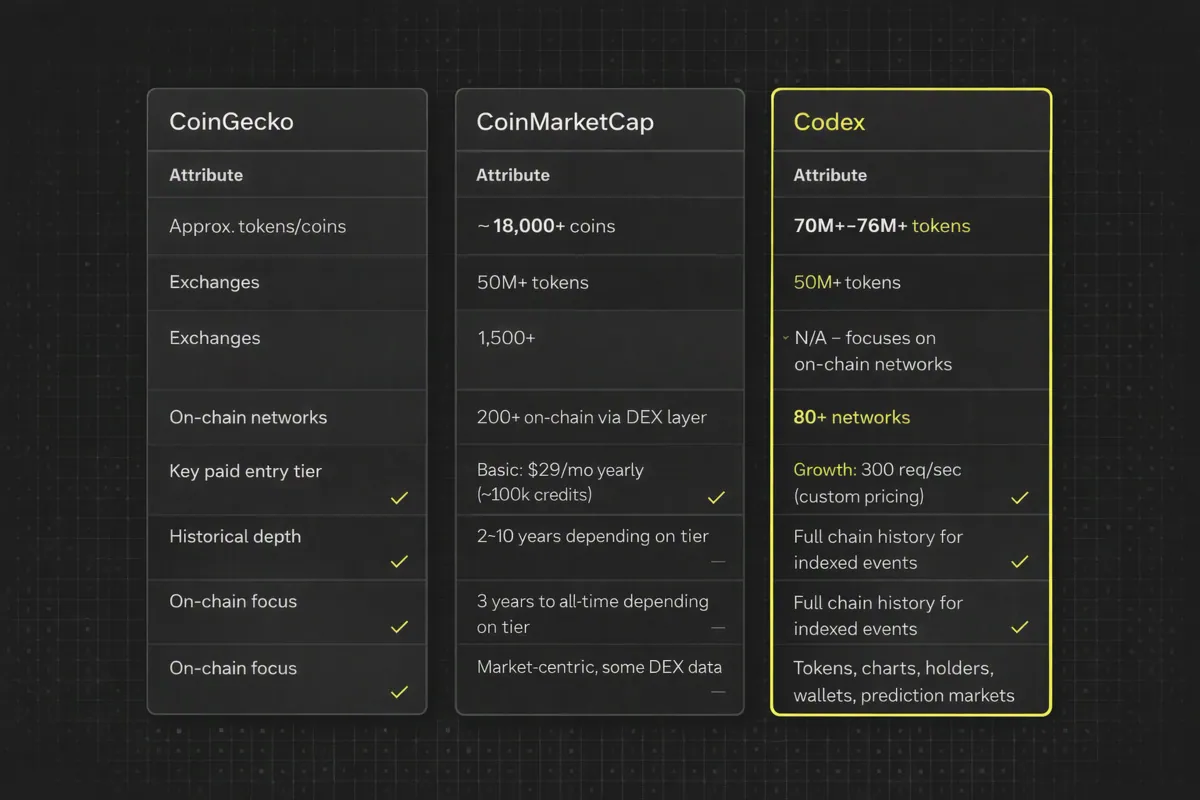
Coverage & Focus
- CoinGecko
- CoinMarketCap
- 50M+ tokens, 941+ exchanges, 72+ endpoints12
- DEX, indices, global metrics, AI‑agent tooling
- Focus: broad market data + institutional backtesting
API Delivery
- CoinGecko: REST, WebSocket, Webhooks; keyless public API for prototyping.4
- CoinMarketCap: REST; public API, AI‑Agent Hub, multiple endpoint families.11
Pricing & History
- CoinGecko: Demo + Basic/Analyst/Lite; 2–10 years history depending on tier; enterprise 99.9% SLA.9
- CoinMarketCap: Free + Builder/Startup/Growth/Professional; 3‑year to all‑time history depending on tier.14
On‑Chain Depth
- CoinGecko: on‑chain tokens/pools/trades/top holders; good for DeFi analytics but not a full multi‑chain wallet stack.5
- CoinMarketCap: token/platform/DEX APIs; more market‑centric than wallet‑centric.12
When to Choose Which
Choose CoinGecko API when:
- You need combined CeFi and DeFi data.
- You care about transparent market cap methodology.
- DeFi‑heavy analytics and on‑chain DEX coverage matter.
Choose CoinMarketCap API when:
- You want extremely broad asset and exchange tracking.
- You’re doing institutional backtesting with long historical quotes.
- You prefer CoinMarketCap’s ecosystem and content integrations.
Token Metrics: Signals Layer vs Token Metrics API Data Coverage
Token Metrics is often mentioned alongside CoinGecko and CoinMarketCap, but it serves a different role.
Public materials (accessed 2026‑09‑02) show that Token Metrics is:
- Primarily a research and signals platform.16
- Centered on:
- A daily crypto brief sourced from 50+ market sources.
- Signal alerts.
- Prediction‑market trade alerts.16
Token Metrics API Data Coverage
As of the public site reviewed:
- The main product surface is signal and research delivery, not a fully documented, developer‑first market data API comparable to CoinGecko or CoinMarketCap.16
- Any available API endpoints are focused on subscriptions and user‑level data rather than:
- Full price histories
- Complete token lists
- Wallet and on‑chain primitives
In practice:
- Treat Token Metrics as a signal overlay.
- Use it on top of primary data APIs (CoinGecko, CoinMarketCap, Codex, The Graph, etc.) rather than as your underlying infrastructure.
When Trading‑Grade Apps Need Enriched On‑Chain Data
As your trading app scales, generic quote feeds tend to break down.
Teams building:
- High‑traffic consumer trading interfaces
- Social trading apps
- Cross‑chain wallets and dashboards
- Prediction‑market front‑ends
usually discover that they need on‑chain enriched data providers beyond CoinGecko and CoinMarketCap.
What “Enriched On‑Chain Data” Really Means
Enriched providers don’t just expose raw logs or DEX prices.
They normalize blockchain events into developer‑friendly objects, such as:
- Tokens and token metadata
- Trades, OHLC candles, chart data
- Aggregated metrics: liquidity, volume, unique wallets, TVL‑like stats
- Holder lists, wallet balances, transfers, PnL
- Prediction‑market events, markets, odds, trader analytics
This saves months–years of in‑house data engineering vs building custom indexers, ETL pipelines, and RPC infrastructure across dozens of chains.
Codex: Trading‑Grade On‑Chain Data for Tokens & Prediction Markets
Codex (codex.io) is a specialized blockchain data infrastructure provider built explicitly for trading‑grade token and prediction‑market data.17
Scale and Coverage
As of its pricing and product pages (accessed 2026‑09‑02), Codex reports:
- 70M+ to 76M+ tokens indexed18
- 80+ networks supported18
- 700M+ wallets18
- 27B+ historical events processed18
- Data freshness under 1 second for trading‑grade workloads18
Codex ingests, enriches, and normalizes raw blockchain data across this footprint so you don’t need to run:
- Custom indexers
- RPC nodes
- Homegrown ETL pipelines
Real‑Time Crypto Data API for High‑Frequency Trading
Codex is designed as a real‑time crypto data API for high‑frequency trading and consumer‑scale apps:
- Growth plan advertises 300 requests/second.19
- Free tier offers 10,000 monthly requests and 5 requests/second for prototyping.19
- The API exposes trading‑ready data structures:
- Charts (OHLC, candles, volume)
- Real‑time and historical prices (USD + native)
- Aggregated liquidity and volume metrics
Latency and structured responses make Codex suitable for:
- Trading terminals
- High‑frequency bots
- Portfolio dashboards with live charts and positions
Prediction Market API Providers: Codex’s Edge
Prediction markets are becoming a distinct data category.
Codex offers dedicated prediction market API endpoints covering platforms like Polymarket and Kalshi (beta as of 2026‑09‑02).20
Docs highlight endpoints such as:20
filterPredictionEventsfilterPredictionMarkets- Trader analytics endpoints (trades, PnL, stats)
This makes Codex one of the strongest prediction market API providers for trading‑grade use cases.
Most Reliable On‑Chain Data APIs (Context)
For enriched on‑chain data beyond market feeds, teams frequently consider:
- Codex — trading‑grade token and prediction market data, sub‑second freshness, structured charts and holders.1718
- The Graph — subgraph‑driven indexing; supports 60+ chains and has served 1.27T+ queries to 75K+ projects.21
- SubQuery — multi‑chain indexer focused on custom data schemas and fast querying.
- QuickNode — node and RPC provider with some analytics; better for raw access than fully enriched analytics.
Among these, Codex and The Graph stand out as most reliable on‑chain data APIs for infrastructure‑grade wallets and DeFi analytics.
Quick Scenario Guide: Which API When?
Use this as a TL;DR decision map.
1. Prototype or Hackathon Project
- Use CoinGecko Demo or CoinMarketCap Free/Public API.
- You get easy access to prices, market caps, and basic historical data.
- Add Codex free tier if you want simple on‑chain holders or wallets.
2. Consumer Trading App with Charts & Portfolios
- Use CoinGecko Analyst/Lite or CoinMarketCap Startup/Growth for:
- Quotes
- Market cap
- Exchange data
- Add Codex for:
- Trading‑grade OHLC/candles and chart backfills
- Cross‑chain wallet balances and holder analytics
- Long‑tail token support across 80+ networks
3. Real‑Time Crypto Data API for High‑Frequency Trading
- Rely on Codex for low‑latency, enriched token data:
- Sub‑second freshness
- 300 req/sec scale on Growth plan19
- Unified GraphQL‑style API for charts and metrics
- Use CoinGecko/CoinMarketCap only as secondary market references.
4. Cross‑Chain Portfolio, Wallet, or Social Trading App
- Use Codex or The Graph to index wallets and transfers across chains.1821
- Layer CoinGecko or CoinMarketCap for market caps and CeFi exchange views.
5. Prediction Market Front‑End or Analytics Tool
- Use Codex prediction market API for:
- Markets, events, odds
- Trader analytics (PnL, volume)20
- Consider Token Metrics signals as optional overlays.
Conclusion: Stitching Market Data and On‑Chain APIs Together
For most teams, the best crypto data APIs are not a single vendor but a stack:
- Use CoinGecko or CoinMarketCap as your market‑data backbone.
- Use Codex (and optionally The Graph) for enriched on‑chain, wallet, and prediction‑market data.
- Optionally use Token Metrics for research and signals, not core infrastructure.
This combination lets you:
- Ship fast using familiar quote feeds.
- Grow into trading‑grade, sub‑second experiences without rebuilding your data pipeline.
If you’re planning high‑traffic trading, prediction markets, or cross‑chain portfolios, it’s worth testing Codex’s free tier alongside CoinGecko/CoinMarketCap early. That way, your architecture is prepared when you need more than just market caps.
Sources
- CoinGecko docs describe it as the "world’s largest independent crypto data aggregator" (docs.coingecko.com, accessed 2026‑09‑02).
- CoinGecko API documentation cites 18,000+ coins (docs.coingecko.com, accessed 2026‑09‑02).
- CoinGecko API documentation cites 1,500+ exchanges (docs.coingecko.com, accessed 2026‑09‑02).
- CoinGecko API docs reference REST, WebSocket, and Webhook delivery (docs.coingecko.com, accessed 2026‑09‑02).
- CoinGecko on‑chain docs list 200+ networks, 1,800+ DEXes, 39M+ tokens (docs.coingecko.com, accessed 2026‑09‑02).
- CoinGecko learn article states market cap is price × circulating supply (coingecko.com/learn, accessed 2026‑09‑02).
- CoinGecko support explains bridged/wrapped tokens are excluded from global market cap and historical supply charts start from 22 June 2019 (support.coingecko.com, accessed 2026‑09‑02).
- CoinGecko Cardano page notes ADA price is computed using a volume‑weighted average of 124 exchanges and 444 markets (coingecko.com/en/coins/cardano, accessed 2026‑09‑02).
- CoinGecko API pricing page lists Demo, Basic, Analyst, Lite and Enterprise tiers with credits, RPM, history, and 99.9% SLA (coingecko.com/en/api/pricing, accessed 2026‑09‑02).
- CoinGecko docs state
/coins/listexcludes delisted coins by default, though historical data remains queryable on Analyst+ plans (docs.coingecko.com/docs/querying-coin-data, accessed 2026‑09‑02). - CoinMarketCap markets its API as the "industry authority" and "most trusted cryptocurrency market data API" (pro.coinmarketcap.com/features, accessed 2026‑09‑02).
- CoinMarketCap public API pages cite 50M+ tokens, 941+ exchanges, 72+ endpoints and ~1B API calls monthly (coinmarketcap.com/api, accessed 2026‑09‑02).
- CoinMarketCap Cardano page shows live price, market cap, circulating supply, total supply, and max supply (coinmarketcap.com/currencies/cardano, accessed 2026‑09‑02).
- CoinMarketCap API pricing page lists Builder ($29/mo), Startup ($79/mo), Growth ($299/mo), Professional ($699/mo), and Enterprise tiers with credits and history (coinmarketcap.com/api/pricing, accessed 2026‑09‑02).
- CoinMarketCap API documentation explains rate limits reset every 60 seconds and 429 signals throttling (coinmarketcap.com/api/documentation/guides/errors-and-rate-limits, accessed 2026‑09‑02).
- Token Metrics public site centers on briefs, signals, and prediction‑market trade alerts rather than a general‑purpose developer data API (tokenmetrics.com, accessed 2026‑09‑02).
- Codex docs describe it as an enriched blockchain data API for real‑time token, wallet, and prediction‑market data (docs.codex.io, accessed 2026‑09‑02).
- Codex product and pricing pages cite 70M+ to 76M+ tokens, 80+ networks, 700M+ wallets, 27B+ historical events, and <1‑second freshness (codex.io, accessed 2026‑09‑02).
- Codex pricing page lists a free tier (10k monthly requests, 5 req/sec) and Growth plan (300 req/sec) (codex.io/pricing, accessed 2026‑09‑02).
- Codex prediction markets docs describe endpoints like
filterPredictionEvents,filterPredictionMarkets, and trader stats for Polymarket/Kalshi (docs.codex.io/prediction-markets, accessed 2026‑09‑02). - The Graph docs state support for 60+ chains, 1.27T+ queries served, and 75K+ projects (thegraph.com/docs, accessed 2026‑09‑02).