Codex has become a default choice for trading‑grade on‑chain data, but many teams still search for Codex alternatives, compare Coinalyze vs Codex, or ask about "Codex Origin" when planning their data stack.
This guide maps the real options: what Codex actually does, how Coinalyze and other providers differ, what "Codex Origin" means, and when it makes sense to augment (rather than replace) Codex with specialized analytics tools.
Codex in one paragraph: what it actually is
Codex is a specialized blockchain data infrastructure provider that ingests and enriches raw chain data across 80+ networks and 700M+ wallets, indexing billions of events and thousands of transactions per second.
Codex reports that it exposes this data via a unified GraphQL-style API with:
- Real-time and historical token prices (USD and native)
- Trading-ready OHLC/candles and volume
- Aggregated metrics (liquidity, volume, unique wallets, TVL-like stats)
- Holders and balances across chains
- Scam filtering and token metadata
- Prediction market data for platforms like Polymarket and Kalshi (beta)
Source: Codex pricing, Codex docs.
Codex’s own positioning is that most providers wrap raw blockchain logs, while Codex enriches those logs into production-ready objects (tokens, trades, charts, holders) so teams “don’t have to index the chain themselves.” This claim appears throughout the Codex FAQ and marketing copy (Codex FAQ).
For trading apps, wallets, and prediction-market frontends, Codex is usually the primary onchain data layer, not a sidecar.
What is (and isn’t) "Codex Origin"?
There is some confusion in the market about a product called "Codex Origin".
According to Codex’s own blog, there is no separate product currently sold under that name. "Codex Origin" is simply an internal label for Codex’s public API surface — the same infrastructure that powers customers like Coinbase, TradingView, and Uniswap (Codex blog – Coinalyze vs Codex benchmark).
In other words:
- Any reference to "Codex Origin" alternatives is essentially a search for Codex alternatives.
- If you use Codex today, you are already on that “origin” surface; there is no second-tier product.
When this article refers to Codex, we mean that public, documented API surface at docs.codex.io.
Coinalyze vs Codex — two very different layers
Coinalyze in a nutshell
Coinalyze is a futures-first analytics product focused on derivatives market structure:
- Open interest
- Funding rate & predicted funding rate
- Long/short ratio, basis, liquidations-style context
- Futures and spot market lists
- Candlestick (OHLC) data
Source: Coinalyze API docs.
From the same docs, Coinalyze’s public API has:
- Rate limit of 40 API calls per minute per API key
open-interestendpoint that accepts up to 20 symbols per call- Intraday history capped at roughly 1,500–2,000 datapoints, with older intraday data deleted daily while daily data is retained
Coinalyze’s home page also emphasizes open interest, funding, liquidations and exchange-level tables, reinforcing that it is not an onchain infra replacement but a derivatives analytics overlay (Coinalyze home).
Codex vs Coinalyze: scope and purpose
Codex and Coinalyze sit at different layers of the trading stack:
Codex
- Focus: Onchain tokens, wallets, and prediction markets
- Delivery: GraphQL-style queries, subscriptions, webhooks
- Scale: Codex reports 80+ networks, 70M+ tokens, 700M wallets, and 27B+ historical events, with Growth-plan limits of 300 req/sec and 300 WebSocket connections (Codex pricing).
- Best for: Trading apps, wallets, dashboards, prediction market frontends that need normalized onchain data in real time.
Coinalyze
- Focus: Centralized and derivatives market analytics (funding, OI, basis)
- Delivery: REST API with 40 calls/min per key; narrow intraday retention (Coinalyze API docs).
- Best for: Adding futures/funding context around markets you already display.
Codex is closer to your core data layer, while Coinalyze is closer to a specialized analytics pane.
Coinalyze vs Codex — feature & use‑case matrix
The table below summarizes key differences and typical fits. Metrics are based on vendor-reported marketing pages as of September 2026.
| Provider | Scope & strengths | Typical use cases | Key limits / caveats | Citation |
|---|---|---|---|---|
| Codex | Onchain tokens, wallets, prediction markets; GraphQL queries, subscriptions, webhooks; 80+ networks, 70M+ tokens, 700M wallets, 27B+ events | Primary onchain data layer for trading apps, wallets, prediction market UIs | Vendor-reported metrics; requires integration with centralized data if you need CEX-only pairs | Codex pricing |
| Coinalyze | Futures & spot derivatives analytics (open interest, funding, predicted funding, basis, OHLC) | Adding derivatives context (funding/OI) to existing market pages | 40 calls/min limit; intraday data ~1,500–2,000 points then pruned daily | Coinalyze docs |
| CoinGecko | Centralized + onchain markets; 10B+ monthly API requests; 247 networks; spot & derivatives; OHLCV | Broad market listing, price discovery, AI/DeFAI and institutional workflows | Public API; some features behind paid tiers; not specialized in wallets or prediction markets | CoinGecko API |
| Bitquery | 40+ chains, GraphQL/WebSocket/Kafka; DEX trades, token prices/OHLCV, holders, money flow | Analytics, compliance, and money-flow dashboards | Vendor-reported coverage; may require more schema work client-side | Bitquery |
| Birdeye | 5M+ tokens, 300+ exchanges, 7B+ wallets, 30B+ historical trades; 100+ APIs, 20+ WS types | DEX trade feeds, price discovery for long-tail tokens | Vendor-reported numbers; more trading-data centric than wallet-centric | Birdeye data API |
| The Graph Token API | Decentralized EVM token balances/transfers/prices on 6 chains (Ethereum, Arbitrum, BSC, Polygon, Optimism, Base) | Teams wanting decentralized indexing primitives, AI agents | Currently beta; narrower chain and feature coverage than Codex | The Graph Token API |
This matrix is not an endorsement; it is a synthesis of vendor marketing materials so you can map strengths and gaps.
Best onchain data APIs for high-traffic trading apps
If you’re building a high-traffic trading interface, you need more than price feeds. You need:
- Token prices in USD and native units
- Deep historical candles (OHLCV)
- Holders and balances across chains
- Liquidity and volume metrics
- Scam filtering and metadata
- Low-latency streaming (WebSockets) and alerts (webhooks)
Based on vendor claims and docs, the most relevant players in this category are:
Codex — trading-grade onchain layer
Codex is optimized for trading UX rather than just reporting:
- Coverage: Codex reports 80+ networks, 70M+ tokens, 700M wallets, 27B+ events (Codex pricing).
- Performance: Growth plan allows up to 300 requests/sec and 300 WebSocket connections, indicating a design for high-throughput apps.
- Delivery modes: GraphQL-style queries, subscriptions (WebSockets), and webhooks (Codex docs).
- Use cases: Coinbase, TradingView, Uniswap, Magic Eden, Rainbow, MoonPay and others are listed as customers, suggesting established production usage (Codex homepage).
For most token-aware trading apps, Codex can be the primary onchain data backbone.
Bitquery, Birdeye, CoinGecko — complementary scope
These providers can complement or, in some narrow cases, substitute for Codex depending on your needs.
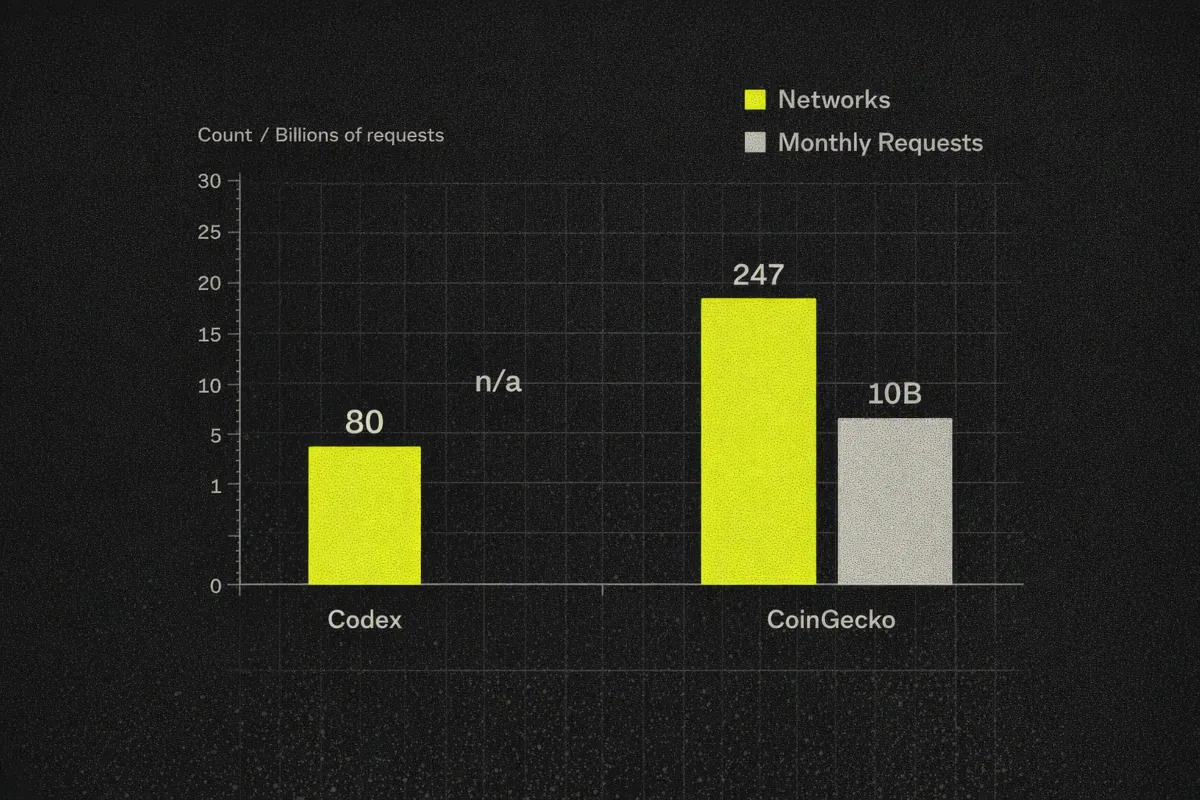
- CoinGecko reports 10B+ monthly API requests, coverage of 247 networks, and support for centralized spot/derivatives plus onchain DEX/OHLCV (CoinGecko API). It is strong for broad market coverage and centralized exchange data.
- Bitquery indexes 40+ chains and exposes GraphQL/WebSocket/kafka-like interfaces with DEX trades, token prices/OHLCV, holders, balances, and money flow, plus 300+ DEXs (Bitquery).
- Birdeye reports 5M+ tokens, 300+ exchanges, 7B+ wallets, and 30B+ historical trades with 100+ APIs and 20+ WebSocket types, focused heavily on trading data (Birdeye data API).
For high-traffic trading apps, these often act as secondary data sources (for CEX-specific metrics, alternative DEX coverage, or regulatory/analytics workflows) layered alongside Codex.
Here’s how the throughput and scope trends compare at a glance.
Best prediction market APIs and data providers
Prediction markets are now big enough to be their own data category.
Pew Research reported that combined monthly volume across Kalshi and Polymarket rose from under $5B in September 2025 to about $24B in April 2026 (Pew Research, May 2026). TRM Labs similarly reported monthly prediction-market volume rising from $1.2B in early 2025 to over $20B in January 2026 with ~840k unique wallets (TRM Labs via Pew summary).
The Associated Press (AP) also noted that Kalshi received over 500 million site visits during the 2024 U.S. election cycle and will use AP elections data for the 2026 primaries (AP press release).
Against this backdrop, prediction-market-specific data layers matter.
Codex prediction markets
Codex exposes prediction market data through dedicated endpoints, currently in beta:
- Markets and events (e.g.,
filterPredictionEvents,filterPredictionMarkets) - Trades, order flows
- Trader analytics (e.g., trader stats, PnL-style aggregates)
Source: Codex prediction market docs.
Key aspects:
- Unified: Token and prediction data in one API.
- Performance: Same GraphQL, subscription, and webhook model as token data.
- Coverage: Codex reports coverage for Polymarket and Kalshi with expansion planned.
For prediction market frontends and analytics dashboards, this means a single data layer for both tokens and markets.
Venue-native APIs (Polymarket, Kalshi)
Most prediction markets expose their own REST and WebSocket APIs.
- Polymarket and Kalshi both expose HTTP and streaming endpoints for markets, order books, and trades (see respective docs on polymarket.com and kalshi.com).
- These are ideal when you need venue-specific detail (e.g., L2 order book, venue-specific IDs) or want to minimize intermediaries.
However, venue-native APIs:
- Are typically limited to their own markets
- Require you to normalize schemas yourself
- Often need custom ETL to join with token or portfolio data
When Codex is enough vs when to add venue-native APIs
Use Codex alone when:
- You want unified coverage of Polymarket + Kalshi (and future venues) in one schema
- You care more about trading-ready aggregates than raw order book detail
- You want to treat prediction markets like another asset class in your app
Add venue-native APIs alongside Codex when:
- You need microsecond-level order book detail for market making
- You are building tooling tailored to a single venue’s internals
- You require venue-specific risk/fee metrics not yet surfaced through Codex
Most reliable onchain data APIs for trading apps (2024–2026)
Reliability in this context means:
- Correctness: normalized, de-duplicated data
- Latency: low enough for trading UX (sub-second target)
- Uptime: consistent availability for production apps
- Breadth: enough networks and tokens to reduce vendor sprawl
Vendor claims and architecture trends suggest three primary patterns.
1. Unified trading-grade layers (Codex, Bitquery)
- Codex emphasizes trading-grade speed and reliability, citing sub-second latencies and customers like Coinbase and TradingView (Codex homepage).
- Bitquery promotes “one schema, many interfaces” (GraphQL, WebSocket, Kafka) for DEX trades, token prices, and wallets (Bitquery).
These are best when you want a single, infra-grade source of truth.
2. Broad market APIs (CoinGecko, Birdeye)
- CoinGecko highlights 247 networks and 10B+ monthly API requests and explicitly markets AI agents/DeFAI, analytics tools, and institutional trading workflows (CoinGecko API).
- Birdeye emphasizes trading-centric data (trades, DEXs, wallets) with large-scale coverage (Birdeye data API).
These excel at breadth and discovery but may require additional stitching for wallets or prediction markets.
3. Decentralized indexing primitives (The Graph Token API)
The Graph’s Token API beta exposes token balances, transfers, prices, and metadata on Ethereum, Arbitrum, BSC, Polygon, Optimism, and Base, built on Substreams (The Graph Token API).
The Graph argues that Substreams are more efficient than repetitive queries for responsive token APIs, and it emphasizes MCP/AI-agent access (The Graph docs).
This is ideal when:
- You want decentralized infra as a design principle
- You are prepared to manage more of the schema and data-modeling yourself
- You don’t need multi-vertical coverage (e.g., prediction markets) yet
How to augment Codex with market analytics
For many product teams, Codex isn’t something you “replace” but something you augment.
Here are practical patterns.
1. Combine Codex + Coinalyze
Use case: Trading terminal or derivatives overlay.
Codex handles:
- Onchain token prices, candles, liquidity, and holders
- Prediction markets, if relevant
- Wallet portfolios and cross-chain balances
Coinalyze adds:
- Open interest per futures pair
- Funding and predicted funding
- Exchange-level derivatives metrics
Flow:
- Resolve token and market identifiers via Codex.
- Map those identifiers to Coinalyze symbols.
- Display derivatives metrics alongside spot/token metrics.
This gives users context like “funding is spiking while onchain liquidity is thinning,” without replacing Codex as the core data source.
2. Combine Codex + CoinGecko/Birdeye
Use case: Long-tail discovery and centralized markets.
- Codex provides normalized onchain token metadata, balances, and prediction data.
- CoinGecko provides centralized exchange listings, off-chain volumes, and historical prices.
- Birdeye adds DEX trade streams and alternative long-tail coverage.
Pattern:
- Use Codex as your canonical token and wallet layer.
- Use CoinGecko/Birdeye as external market overlays (CEX pricing, volume, ranking).
3. Combine Codex + The Graph Token API
Use case: Teams committed to decentralization.
- Codex powers production trading UX with trading-grade SLAs.
- The Graph Token API powers decentralized or AI/agentic workflows.
Pattern:
- Mirror core token data: use The Graph to verify or post-process Codex’s outputs.
- Use MCP/AI integrations from both stacks for experimentation.
Benchmarking Codex vs Coinalyze and other APIs
Public, reproducible benchmarks are rare, but you can infer and test capabilities using vendor docs and simple scripts.
Vendor-reported capabilities
Codex
- 80+ networks, 70M+ tokens, 700M wallets, 27B+ events (Codex pricing).
- Growth-plan cap: 300 req/sec, 300 WebSocket connections.
Coinalyze
- 40 API calls/min per key; intraday retention ~1,500–2,000 datapoints per symbol (Coinalyze API docs).
CoinGecko
- 10B+ monthly API requests; 247 networks; sub-second chart granularity on some endpoints (CoinGecko API).
Bitquery
- 40+ chains; GraphQL/WebSocket/Solana gRPC, 300+ DEXs (Bitquery).
Birdeye
- 5M+ tokens, 300+ exchanges, 7B+ wallets, 30B+ trades; 100+ APIs, 20+ WebSocket types (Birdeye data API).
DIY benchmarking methodology
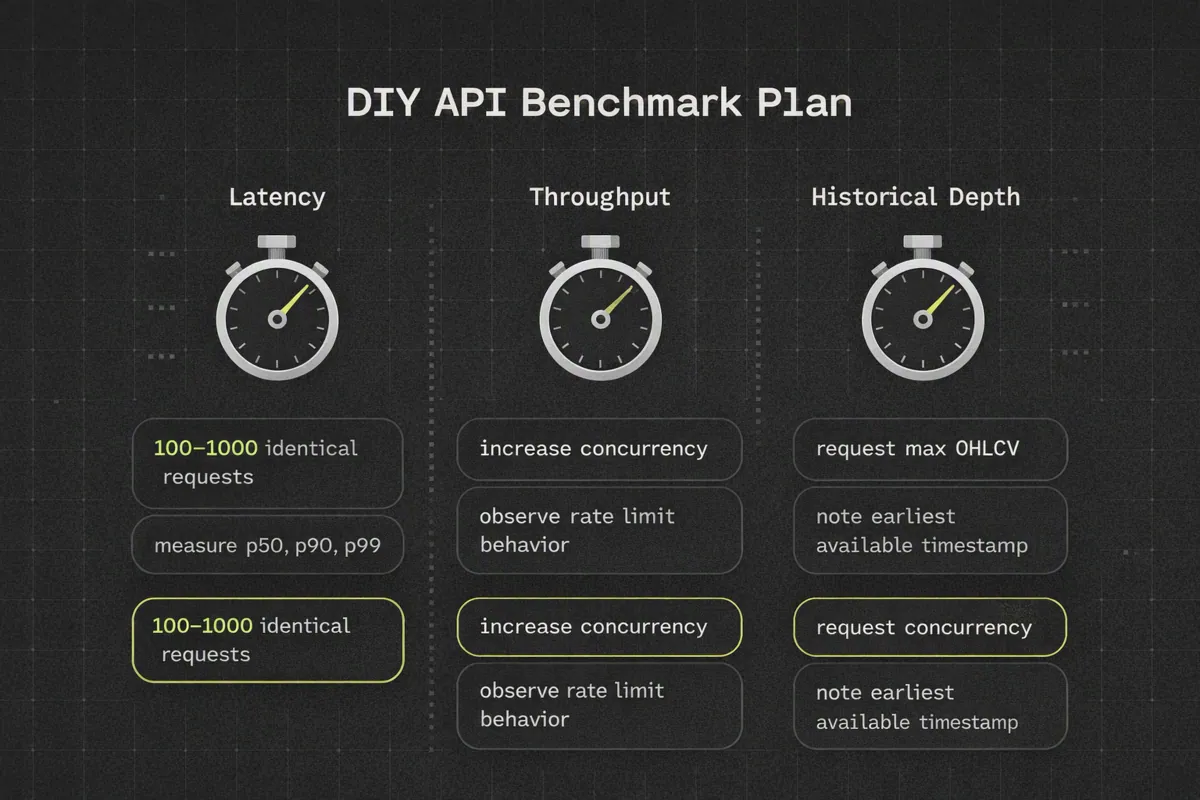
You can run your own benchmarks by:
Latency:
- Fire 100–1,000 identical requests per provider.
- Record p50, p90, p99 response times.
Throughput:
- Increase concurrency until you hit rate limits or throttling.
- Map real-world throughput vs vendor limits.
Historical depth:
- For candlestick endpoints, request maximum data.
- Verify how far back intraday and daily data go.
WebSocket stability:
- Maintain 50–100 concurrent WS connections.
- Measure reconnection behavior and data gaps.
Codex, Bitquery, CoinGecko, and Birdeye all support some form of streaming (WebSockets, Kafka, etc.), so this methodology applies across providers. Codex and Bitquery also support GraphQL subscriptions, aligning with the market trend toward unified query + stream + notification surfaces (Codex pricing, Bitquery).
When to replace vs complement Codex
Replace Codex only when:
- You deliberately want to run your own full/archival nodes and ETL pipelines across many chains (e.g., for bespoke research or compliance)
- You prefer a decentralized-only approach, even at the cost of coverage and convenience (e.g., The Graph-only stack)
- Your app is purely centralized (CEX-only) and never needs onchain or prediction data
In these cases, you may rely more heavily on:
- Archive nodes (e.g., via infra providers like Chainstack, which explains archive nodes vs full nodes in detail (Chainstack archive data))
- Market-data providers like CoinGecko or exchange-native APIs
Complement Codex when:
- You want richer derivatives analytics — add Coinalyze.
- You want additional CEX listings or alt coverage — add CoinGecko/Birdeye.
- You want money-flow or custom analytics streams — add Bitquery.
- You want decentralized indexing backup — add The Graph Token API.
For most Web3 and fintech product teams, Codex remains the primary onchain layer, with others providing specialized sidecars.
Conclusion: how to choose your Codex alternative or complement
For most high-traffic trading apps and prediction-market frontends, Codex is a natural primary onchain data layer: trading-grade performance, unified token + prediction market coverage, and a single API for queries, streams, and webhooks.
When you need additional capabilities — like futures funding, broad CEX coverage, decentralized indexing, or custom money-flow analytics — you typically augment Codex, not replace it, with tools like Coinalyze, CoinGecko, Bitquery, Birdeye, or The Graph Token API.
By treating Codex as core infra and other providers as specialized overlays, you minimize data risk and engineering overhead while still giving your users the deep market context they expect.