Why cross‑chain price feed uptime is hard (and why GeckoTerminal matters)
If you run a trading interface, wallet, or DeFi dashboard, your price feed is the product.
The challenge in 2026:
- Users expect sub‑second updates across dozens of chains.
- Price APIs have rate limits, cache layers, and real outage history.
- Poll‑only architectures are fragile under load.
This guide uses GeckoTerminal API downtime and limits as a case study and shows how to design redundancy, health checks, and circuit breakers around it.
We’ll also compare trading‑grade alternatives like Codex, The Graph’s Token API, Birdeye, and others, and walk through concrete implementation patterns.
Throughout, we’ll treat Codex as the canonical “trading‑grade” reference: it’s an enriched, cross‑chain data layer used by Coinbase, TradingView, Uniswap, Magic Eden, Rainbow, MoonPay and others (vendor claim, see codex.io).
GeckoTerminal vs CoinGecko vs other APIs: naming and scope
Before talking about GeckoTerminal price API reliability, it’s important to separate brands and products clearly:
- CoinGecko is the parent company and runs the main CoinGecko API (centralized/cex & market data) plus additional feeds.
- GeckoTerminal is CoinGecko’s on‑chain DEX analytics product, with its own GeckoTerminal API that powers on‑chain data in some CoinGecko endpoints.1
- CoinGecko’s docs say GeckoTerminal provides on‑chain coverage across 200+ networks, 1,800+ DEXes, and 39M+ tokens (vendor claims, see docs.coingecko.com).
A non‑obvious integration footgun: CoinGecko’s docs warn that GeckoTerminal network IDs are not the same as CoinGecko asset platform IDs.2 If you mix these up, you’ll silently mis‑map chains or tokens.
When this article says:
- “GeckoTerminal API”: it refers to the on‑chain / DEX analytics endpoints branded as GeckoTerminal (either directly or inside CoinGecko’s product surface).
- “CoinGecko API”: it refers to CoinGecko’s broader API offering, which may incorporate GeckoTerminal’s data but also serves off‑chain markets, derivatives, etc.
GeckoTerminal API downtime: incident history & implications
CoinGecko explicitly states that the GeckoTerminal API is not production‑grade for hot paths:
- The public, keyless GeckoTerminal endpoints are shared and limited to about 10 calls/min per IP.3
- The free API tier for on‑chain/GeckoTerminal‑powered data is capped at 30 calls/min, and higher limits require a paid plan.3
- CoinGecko’s/docs call the keyless/public API “not suitable for production workloads, scheduled polling, or high‑frequency updates.”4
From CoinGecko’s status page and notices:
- There are multiple recorded GeckoTerminal API incidents across 2023–2024 (see the incident list at status.coingecko.com).
- On January 13–14, 2026, a CoinGecko Pro incident was traced to table bloat in on‑chain data tables, temporarily degrading broader API performance including on‑chain endpoints.5
- CoinGecko reports strong uptime overall (e.g. 100% in September 2025 and 99.97% in October 2025 across the main API, vendor‑reported at status.coingecko.com), but individual services and regions can still degrade.
Implications:
- Treat GeckoTerminal as a useful data source, not a single source of truth.
- Design for GeckoTerminal API downtime and throttling out of the box.
- Use it safely for supplemental coverage (long‑tail tokens, certain DEX pairs), but avoid putting it alone on the hot path of a trading UI.
Best real‑time crypto price APIs for trading (2026)
There is no universal “best” price feed. Instead, design around a primary trading‑grade provider plus redundant alternatives.
Below is a concise, vendor‑claim‑based comparison for common providers in 2026.
All numbers are as of public docs in 2024–2026; verify current limits before relying on them.
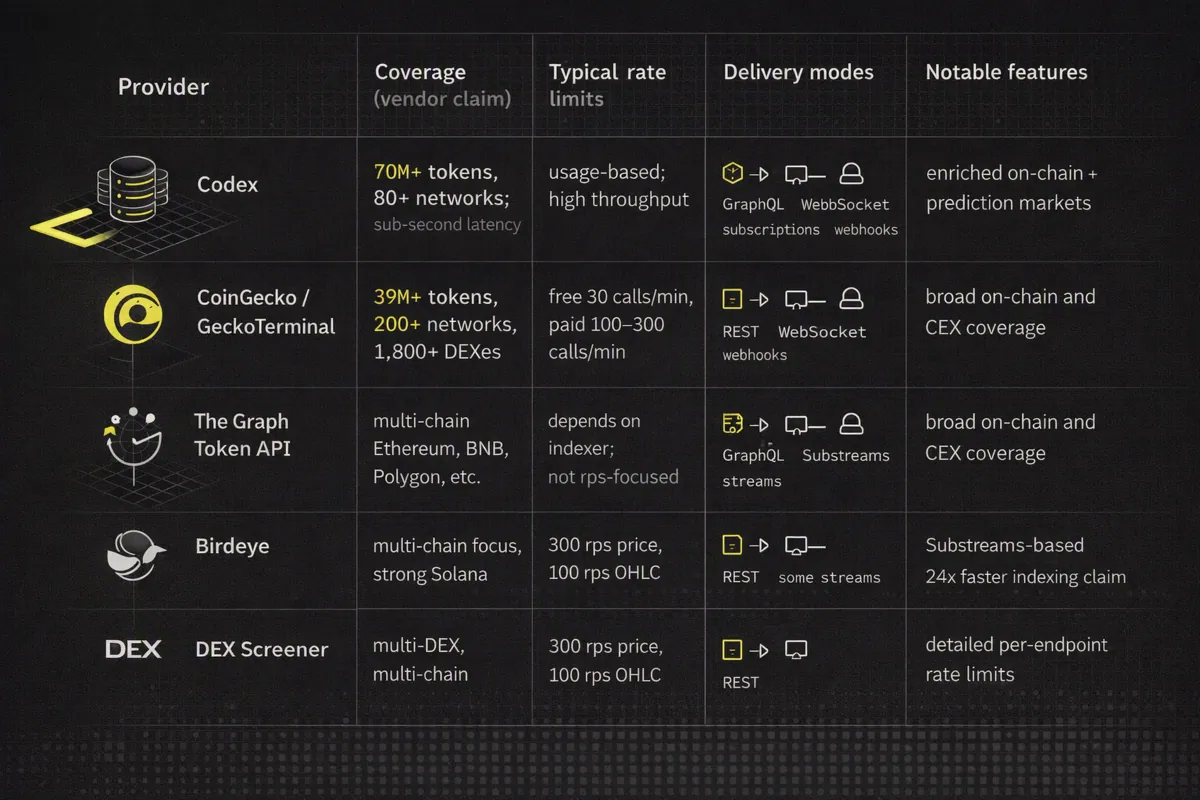
High‑level provider comparison (vendor‑claimed)
Codex
- Coverage: 70M+ tokens, 80+ networks, 700M+ wallets (vendor claim, codex.io).
- Data: real‑time & historical prices, OHLC, volume, liquidity, holders; plus prediction markets like Polymarket and Kalshi (beta) (docs.codex.io).
- Delivery: GraphQL‑style queries, subscriptions (WebSocket streaming), webhooks, and REST‑like access via GraphQL.
- Performance: sub‑second latencies claimed and chart/price streams optimized for trading views (codex low‑latency post).
- Status:
getNetworkStatusexposeslastProcessedBlockandlastProcessedTimestampper network (docs.codex.io). - Cost: premium infra; enterprise contracts (four‑ to six‑figure annually) plus usage‑based pricing.
CoinGecko / GeckoTerminal
- Coverage: 200+ networks, 1,800+ DEXes, 39M+ tokens powered by GeckoTerminal (vendor claim, docs.coingecko.com).
- Limits: free tier ~30 calls/min, public keyless ~10 calls/min shared; paid starts at $35/mo with 100 calls/min, higher tiers up to 300 calls/min (vendor pricing, coingecko.com, support article).
- Delivery: REST, some WebSocket streams and webhooks added in recent upgrades (see docs.coingecko.com).
- Freshness: on‑chain endpoints had edge cache reduced to 30 seconds from March 25, 2025 (status notice, status.coingecko.com).
The Graph Token API
- Coverage: multi‑chain token & price data for Ethereum, BNB Smart Chain, Polygon, Optimism, Arbitrum, Base, Unichain, Avalanche, Solana and others (vendor claim, thegraph.com).
- Architecture: built on Substreams for parallelized indexing; The Graph reports 24x faster multi‑chain indexing and up to 2300% faster across nine networks vs prior approaches (vendor benchmark, case study).
- Delivery: GraphQL, Substreams, streaming‑style consumption; strong fit for indexing and analytics.
Birdeye
- Coverage: strong in Solana and some EVM ecosystems.
- Rate limits:
/defi/priceand/defi/multi_pricedocumented at 300 rps; several historical/OHLC endpoints at 100 rps (vendor docs, docs.birdeye.so). - Delivery: REST, some websockets; detailed per‑endpoint rate‑limit tables.
- Positioning: explicitly frames rate limits as infra‑stability tools at account level (Birdeye guide).
DEX Screener
- Coverage: multi‑DEX, multi‑chain prices and pairs.
- Limits: token profile endpoints at 60 requests/min (vendor docs, docs.dexscreener.com).
- Delivery: REST; simple for dashboards and bots.
In practice, Codex often becomes the primary trading‑grade price feed, with others like CoinGecko, Birdeye, or DEX Screener acting as fallbacks or cross‑checks.
Core design patterns for cross‑chain price feed redundancy
To build a resilient price system, combine these patterns:
- Primary + secondary providers (multi‑provider price aggregation API).
- Health checks and scoring so you can route traffic away from degraded APIs.
- Circuit breakers to stop cascading failures.
- Caching and TTLs tuned per asset and per provider.
- Rate‑limit aware batching and backoff.
- Streaming + webhooks where possible instead of raw polling.
We’ll go through each with concrete thresholds and pseudocode.
Multi‑provider architecture: Geckoterminal alternatives price feed
For trading‑grade UX, treat GeckoTerminal alternatives price feed as mandatory, not optional.
A minimal architecture:
- Tier 1 (primary): Codex (trading‑grade, unified token + prediction market data via GraphQL).
- Tier 2 (secondary): CoinGecko (central markets) and/or Birdeye / DEX Screener (per‑chain depth).
- Tier 3 (tertiary): GeckoTerminal API directly for very long‑tail pairs and DEX coverage.
Price resolution logic per asset:
- Query Codex first (subscriptions for live ticks; queries for snapshots).
- If unavailable or stale, fall back to CoinGecko/Birdeye.
- If still unavailable but required (e.g., small DEX listing), consult GeckoTerminal.
- If multiple feeds respond, aggregate:
- Take the median of valid prices.
- Reject outliers >5–10% from the median.
Example selection algorithm (pseudocode)
PROVIDERS = [
  {"name": "codex", "tier": 1},
  {"name": "coingecko", "tier": 2},
  {"name": "birdeye", "tier": 2},
  {"name": "geckoterminal", "tier": 3},
]

PRICE_MAX_AGE_MS = 30_000  # 30s for liquid pairs

async def get_best_price(asset_id):
    candidates = []

    for tier in (1, 2, 3):
        for p in healthy_providers(tier=tier):
            price = await fetch_price(p, asset_id)
            if not price or price.age_ms > PRICE_MAX_AGE_MS:
                continue
            candidates.append(price)
        if candidates:
            break  # stop at first tier with any usable price

    if not candidates:
        raise PriceUnavailableError(asset_id)

    # Aggregate
    values = [c.value for c in candidates]
    median = statistics.median(values)
    filtered = [v for v in values if abs(v - median) / median <= 0.10]

    if not filtered:
        raise PriceInconsistentError(asset_id)

    return statistics.median(filtered)
This pattern makes GeckoTerminal API reliability a non‑critical factor; GeckoTerminal becomes a best‑effort supplement, not the foundation.
Health checks for crypto price APIs
Health checks turn raw metrics into a health score so your router can favor the best provider at any time.
Metrics to track per provider
At a minimum, track per 60‑second rolling window:
- Success rate:
success_responses / total_requests. - 5xx error rate: fraction of responses with HTTP 5xx.
- Timeout rate: fraction exceeding your timeout (e.g., 700 ms).
- p95 latency: 95th percentile of response time.
- Staleness: how old the returned price is (age of last trade/tick).
- Rate limit events: HTTP 429 responses or vendor‑specific errors.
Example thresholds for health scoring
You can compute a simple health score (0–100) like:
start at 100
-20 if success_rate < 0.97
-20 if p95_latency > 700 ms
-30 if timeout_rate > 0.05
-30 if 5xx_error_rate > 0.02
-10 if any 429s in window
clamp between 0 and 100
Then set routing rules:
- Healthy: score ≥ 80.
- Degraded: 50 ≤ score < 80.
- Unhealthy: score < 50.
Your selection logic:
- Prefer Healthy providers in lowest tier number.
- If primary is Degraded but not Unhealthy, keep using it but weight secondary providers more for aggregation.
- If a provider is Unhealthy, push it into open circuit (see next section) and stop calling it for the cooldown period.
Example health check endpoint
Expose health internally so your services and dashboards can consume it:
{
  "provider": "geckoterminal",
  "status": "degraded",
  "score": 62,
  "window_sec": 60,
  "success_rate": 0.92,
  "p95_latency_ms": 1200,
  "timeout_rate": 0.08,
  "5xx_rate": 0.04,
  "last_updated": "2026-09-08T12:34:56Z"
}
This helps answer questions like “How to handle GeckoTerminal API downtime?” in real time, not just reactively.
Price feed circuit breaker implementation
A circuit breaker is a small state machine that stops your app from hammering a failing dependency.
AWS explicitly recommends exponential backoff and circuit breakers for transient API failures in distributed systems.6
States and transitions
Use a simple three‑state model per provider:
CLOSED (normal)
- You send all requests normally.
- If error rate exceeds threshold in the last N requests, move to OPEN.
OPEN (tripped)
- You stop sending live requests; use cache/fallback instead.
- Stay OPEN for a cooldown period (e.g., 60–120 seconds).
HALF_OPEN (probe)
- After cooldown, allow a small number of trial requests (e.g., 5).
- If success rate on trial > threshold (e.g., 80%), move to CLOSED.
- Otherwise, move back to OPEN and extend cooldown.
Concrete thresholds
For a typical trading app:
WINDOW_SIZE = 50requests.ERROR_THRESHOLD = 0.25(25% failures incl. timeouts and 5xx).OPEN_COOLDOWN = 90seconds.HALF_OPEN_TRIALS = 5requests.HALF_OPEN_SUCCESS_TARGET = 0.8(4 of 5 must succeed).
Circuit breaker pseudocode
class CircuitBreaker:
    def __init__(self):
        self.state = "CLOSED"
        self.failures = 0
        self.requests = 0
        self.open_until = 0

    def before_call(self, now):
        if self.state == "OPEN":
            if now >= self.open_until:
                self.state = "HALF_OPEN"
                self.failures = 0
                self.requests = 0
            else:
                raise ProviderUnavailable("circuit open")

    def after_call(self, success, now):
        self.requests += 1
        if not success:
            self.failures += 1

        if self.state == "CLOSED":
            if self.requests >= 50 and self.failures / self.requests > 0.25:
                self.state = "OPEN"
                self.open_until = now + 90  # seconds

        elif self.state == "HALF_OPEN":
            # after 5 trial calls, decide
            if self.requests >= 5:
                if self.failures <= 1:  # >= 80% success
                    self.state = "CLOSED"
                    self.failures = self.requests = 0
                else:
                    self.state = "OPEN"
                    self.open_until = now + 180  # longer cooldown
You’d wrap your GeckoTerminal, CoinGecko, Birdeye, and Codex client calls with a breaker like this.
When GeckoTerminal API downtime or rate‑limit storms hit, the breaker trips quickly, and your app continues serving prices from cache and other providers without melting down.
Caching & TTL policies for cross‑chain feeds
Caching reduces load and makes rate limits manageable.
Recommended TTLs
Use shorter TTLs for highly liquid assets and longer for thinly traded tokens:
- Tier A (BTC, ETH, major L1s, stablecoins): 5–10 seconds.
- Tier B (top‑100 by volume): 15–30 seconds.
- Tier C (long‑tail & micro‑caps): 30–120 seconds, depending on volatility.
Per‑provider adjustments:
- For CoinGecko/GeckoTerminal, align with their edge‑cache: if on‑chain endpoints are cached at 30 seconds at the edge,7 setting TTL < 30 seconds often just causes extra misses.
- For Codex subscriptions, treat them as the ground truth and store the latest tick; TTL applies only to fallback lookups.
Fallback to slightly stale data
When all live providers fail, you can still serve slightly stale prices with a warning:
- Allow up to 2–5 minutes of staleness for UI display (never for on‑chain risk/settlement logic).
- Flag the UI: e.g.,
data_stale = true,stale_age_seconds.
This keeps dashboards responsive and avoids blank states.
Handling rate limits and backoff
A common failure mode is hammering GeckoTerminal or CoinGecko until you get banned.
From vendor docs:
- GeckoTerminal free API: 30 calls/min and public keyless around 10 calls/min shared.3
- CoinGecko paid plans: 100–300 calls/min depending on tier.8
- Birdeye: 300 rps on price endpoints and 100 rps for certain historical endpoints.9
How to handle API rate limits in DeFi apps
Apply these patterns:
- Batch requests: use multi‑price endpoints where possible (e.g., Birdeye
/defi/multi_price, Codex bulk price queries) to fetch dozens of tickers per call. - Client‑side throttling: enforce per‑provider caps below documented limits (e.g., 70% of vendor limit) to leave headroom.
- Exponential backoff: on 429s or 5xx, delay retries with jitter: 200ms, 400ms, 800ms, 1.6s, etc., up to a max.
- Graceful degradation: if you hit rate limits repeatedly, serve cached data and reduce refresh frequency.
Example backoff snippet:
async def with_backoff(call, max_attempts=5):
    delay = 0.2
    for attempt in range(max_attempts):
        try:
            return await call()
        except RateLimitError:
            await sleep(delay + random.uniform(0, delay))
            delay = min(delay * 2, 3.0)
    raise ProviderUnavailable("rate-limited")
Streaming, webhooks, and network health surfaces
Industry trend: away from pure polling toward streams and webhooks.
Examples from vendor docs:
- Codex supports GraphQL subscriptions over WebSockets for live token prices, trades, and charts; webhooks deliver events and expect a 2xx within 3 seconds, retrying up to 2 additional times (vendor docs, docs.codex.io).
- CoinGecko now offers REST, WebSocket streams, and webhooks for some data surfaces (see docs.coingecko.com).
- The Graph Token API uses Substreams to deliver direct streams of data rather than repetitive queries, specifically to replace fragile polling/indexing setups.10
Where possible:
- Use Codex subscriptions as your primary feed for fast‑moving markets.
- Use webhooks for alerts and background updates.
- Keep polling limited to fallbacks and sanity checks.
Also leverage health surfaces:
- CoinGecko publishes live status and uptime calendars at status.coingecko.com.
- Codex exposes a
getNetworkStatusquery withlastProcessedBlockandlastProcessedTimestamp, plus its own status page (see docs.codex.io).
You can wire these into your routing to pre‑emptively down‑weight a provider when its status page reports an incident.
Putting it all together: production checklist
To build the most reliable on‑chain data APIs for trading apps in 2026, your price layer should:
- Use a trading‑grade primary feed (e.g., Codex) with sub‑second latency and broad coverage.
- Integrate at least two secondary providers (CoinGecko, Birdeye, DEX Screener) plus GeckoTerminal for long‑tail DEX pairs.
- Implement multi‑provider aggregation with median‑based outlier rejection.
- Add per‑provider health scoring with concrete thresholds (e.g., success rate, p95 latency, timeout/5xx rates).
- Wrap each provider in a circuit breaker with clear OPEN/ HALF_OPEN / CLOSED transitions.
- Tune TTL and staleness policies by asset tier and provider cache behavior.
- Respect rate limits via batching, throttling, and exponential backoff.
- Prefer streaming & webhooks for live updates, falling back to polling only when necessary.
With this setup, GeckoTerminal API downtime becomes just another degraded signal—not a single point of failure.
Sources
- See CoinGecko’s docs for GeckoTerminal‑powered on‑chain coverage and branding: https://docs.coingecko.com/
- CoinGecko notes that GeckoTerminal network IDs differ from CoinGecko asset platform IDs in their docs: https://docs.coingecko.com/
- GeckoTerminal API limits and beta notes: https://support.coingecko.com/hc/en-us/articles/22612838274841-Does-GeckoTerminal-have-an-API
- Keyless/public API “not suitable for production workloads, scheduled polling, or high-frequency updates”: https://docs.coingecko.com/docs/keyless-public-api
- January 13–14, 2026 CoinGecko Pro incident due to table bloat in on‑chain data tables, see incident history: https://status.coingecko.com/incidents
- AWS retry and backoff guidance recommending circuit breakers: https://docs.aws.amazon.com/prescriptive-guidance/latest/cloud-design-patterns/retry-backoff.html
- CoinGecko’s 30‑second edge cache change for on‑chain endpoints: https://status.coingecko.com/info_notices/279813
- CoinGecko API pricing and rate limits: https://www.coingecko.com/en/api/pricing
- Birdeye per‑API rate limits: https://docs.birdeye.so/docs/per-api-rate-limit
- The Graph Token API and Substreams streaming narrative: https://thegraph.com/blog/token-api-the-graph/