
Software is rapidly changing from UI to API.
- After just one month, OpenClaw has 400,000 users running autonomous AI agents living in Mac Minis and Amazon EC2 instances.
- The x402 payment standard has already processed $600M+ in volume in just a few months.
- Stripe, Coinbase, MoonPay, and Meta are all building payment infrastructure for agents.
The shift to agentic commerce is happening fast.
But there's a problem with our legacy systems. Most APIs still require account creation, API keys, and billing dashboards. Workflows optimized for humans that agents can't navigate on their own. And traditional payment rails (cards, bank transfers, invoices) weren't built for software that needs to pay $0.001 for a single HTTP request, thousands of times a day, with no human in the loop.
Stablecoins are the perfect solution to this problem. They're programmable, instant, borderless, and always on. They're the native payment layer for autonomous software. Just like how credit cards were the native payment layer for e-commerce.
And now there's a protocol that makes it as simple as an HTTP header.
Today, Codex is one of the first production-grade data APIs to support pay-per-request access for AI agents, powered by Tempo's MPP.
What is MPP?
MPP (Machine Payments Protocol) is an open protocol created by Tempo that repurposes the HTTP 402 "Payment Required" status code for machine-to-machine payments.
The flow is simple:
- An agent requests data
- The server responds with a 402 status code and payment details
- The agent pays in stablecoins
- The server returns the data
No API key. No account. No billing setup. Just an HTTP request and a micropayment.
MPP extends the x402 standard with support for multiple payment methods (stablecoins, cards, wallets), session-based pay-as-you-go via off-chain vouchers (so you can get volume discounts), and backward compatibility with existing x402 services.
Codex's MPP integration runs on Tempo, the Layer 1 blockchain purpose-built for payments by Stripe and Paradigm. Tempo provides sub-second finality, predictably low fees, native support for stablecoins, and other Stripe payment methods.
This means payments settle instantly with the same reliability you'd expect from Stripe.
Why crypto data is a natural fit
Agents are already being built to monitor token prices, analyze wallets, track launchpad activity, and execute trades. Often trading at extremely high frequencies, not remotely achievable by a human.
As a result, they need a lot of data, and it needs to be extremely fast and reliable.
And crypto data is the right shape for micropayments: high-frequency, low-cost, and often one-off. An agent checking a token price before executing a trade, or scanning launchpad activity for a new opportunity, doesn't need a monthly subscription. It needs a fast, cheap request that returns exactly what it asked for, exactly when it needs it.
As AI agents become autonomous economic participants, they need data infrastructure built for how they work. Not dashboards. Not portals. But APIs that respond to a payment as naturally as they respond to an API key.
That's what Codex provides.
What's available via Codex MPP
At $0.001 per request, agents get access to the same production-grade API that powers Coinbase, FOMO, Rainbow, Uniswap, and hundreds more.
Here's what the data covers:
- Real-time token prices: USD pricing across 100+ networks and 70M+ tokens via getTokenPrices, with sub-1-second data freshness
- OHLCV bar charts: Full candlestick data via getBars and getTokenBars, with aggregated pricing across all pools
- Token discovery and filtering: Search and rank tokens by volume, market cap, liquidity, trending score, and dozens of other metrics via filterTokens
- Trading pair statistics: Pair metadata, liquidity locks, and transaction streams via pairMetadata and getTokenEvents
Get access to almost all of the endpoints Codex has to offer. Flat rate. Paid in USDC on Tempo.
For more details, see the Codex MPP docs.
How to get started
The fastest way is to install the Codex Skills:
npx skills add Codex-Data/skills -g --yes
Then follow these steps to get started:
- Ask the agent to use Codex to get the top 25 trending tokens (or whatever your query is)
- It will then try to execute the query using the API key. If it fails, it will fall back to MPP.
- Or you can just ask it to use MPP directly
- It will then install Tempo’s
tempoCLI to manage your Tempo wallet - It will then redirect you to the Tempo website to authorize access
- There, you can either fund your new wallet (from Base, Solana, Ethereum, etc), or use an existing one. Your new wallet must have at least 1 USDC on Tempo to continue.
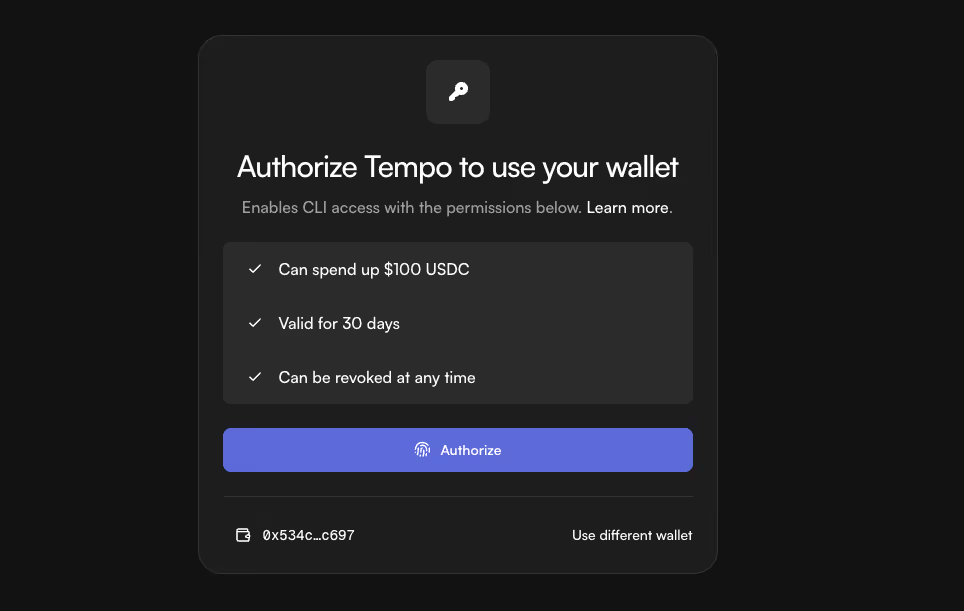
- Once funded, you press Continue, and you will be prompted to authorize Tempo to access your wallet
- Once authorized, your agent will attempt to run the query using MPP
See the Codex MPP documentation and Codex Skills documentation for full details.
Why Codex over other providers
CoinGecko was one of the first crypto APIs to go live with x402. Here's how we compare:
The data is the differentiator. Every API can bolt on pay-per-request. The question agents and their builders will ask is: which API actually has the data I need, fast enough to be useful?
What's next
Not only are AI agents starting to act and transact autonomously, but developers and builders are increasingly relying on AI agents to write code.
This is only the beginning of Codex's investment in agentic infrastructure.
Here's what we already offer:
- Docs MCP Server: So AI agents can query Codex documentation to write code.
- Codex Skills: So AI agents can grab Codex data natively.
- MPP Integration: So AI agents can pay for Codex API access directly.
Here's what we're offering soon:
- Credit bundles: Higher-volume agent usage at even lower per-request costs.
- Expanding endpoints: More of Codex's endpoints will be available via MPP over time.
- More payment options: Expanding our x402/MPP to accept other crypto networks and Stripe payment methods.
We believe we're just at the beginning of the agentic era, and Codex is being built to support it.
Get started
- Codex MPP docs: Quick start, example repo, and Claude integration
- Codex API docs: Full endpoint reference
- MPP docs: Full protocol docs, SDKs, and guides
- x402 Protocol: The open standard for HTTP-native payments
- Tempo: The payments network powering MPP settlement