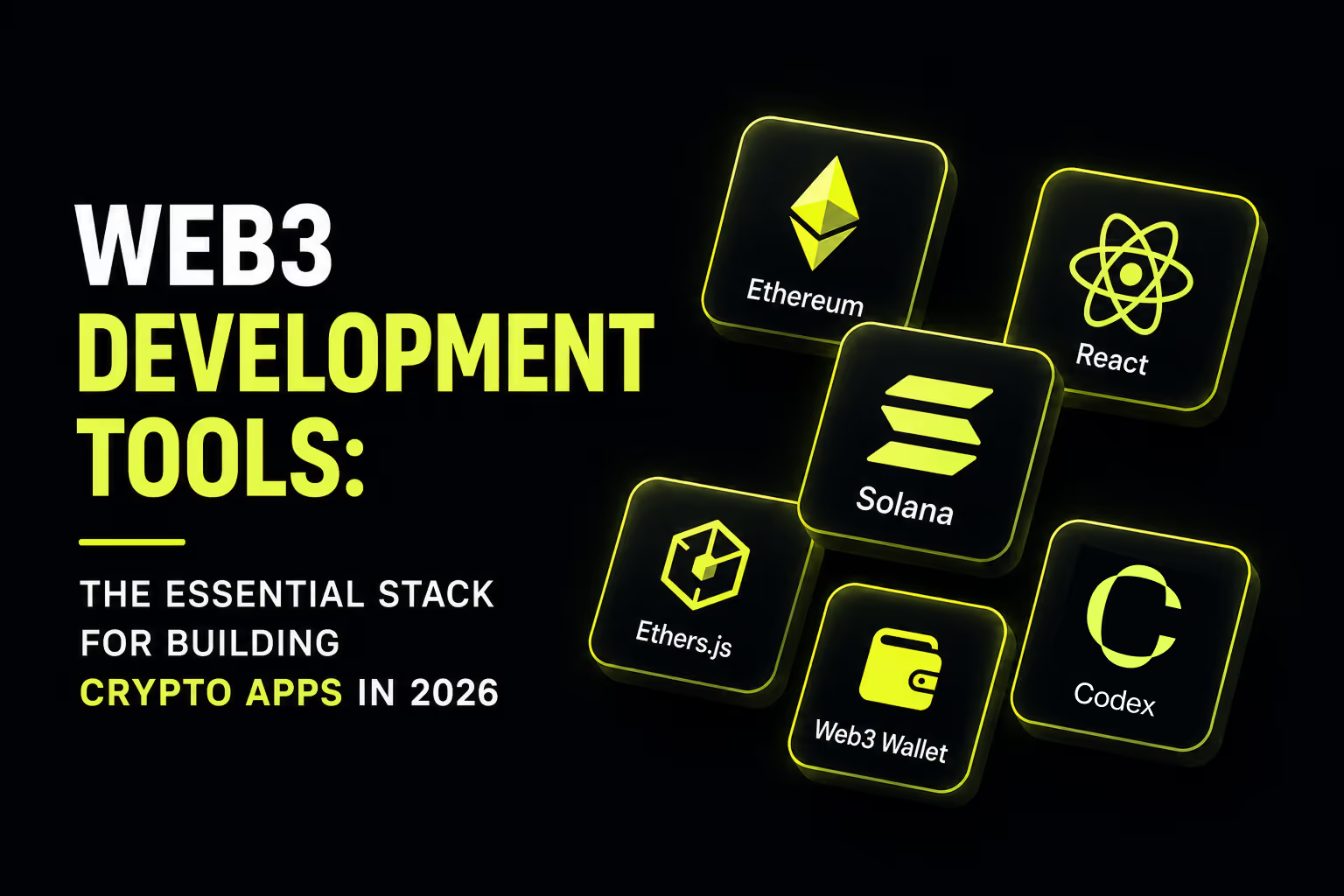
The Web3 development tools landscape has matured significantly. Three years ago, building a crypto app meant stitching together undocumented libraries, forking abandoned repos, and praying your node provider stayed online. In 2026, you have real options at every layer of the stack: production-grade frameworks, reliable infrastructure, and APIs that return actual useful data instead of raw hex strings.
But the landscape is also fragmented. There are five or more options at every layer, and half the content out there recommends tools that were current in 2023. This guide maps the essential web3 development tools by stack layer, with specific recommendations for what to use in 2026. The focus is on what you actually need to ship a crypto app, not an exhaustive list of every tool that exists.
The Web3 Stack, Layer by Layer
Before picking tools, it helps to see how the pieces fit together. Every crypto app is built on some variation of this stack:
Frontend / UI          -- React, Next.js, wagmi, viem
Wallet Connection      -- RainbowKit, ConnectKit, WalletConnect
Data Layer             -- Codex, Alchemy, The Graph
Node / RPC Access      -- Alchemy, QuickNode, Infura
Smart Contracts        -- Hardhat, Foundry, Remix
Blockchain Networks    -- Ethereum, Solana, Base, Arbitrum...
Each layer solves a different problem, and the tools you choose at one layer affect your options at others. The sections below walk through each layer bottom-up, from the blockchain itself to the UI your users interact with.
Smart Contract Development
This is the foundation. If your app deploys or interacts with smart contracts, you need a development framework for writing, testing, and deploying them.
Hardhat is the JavaScript/TypeScript standard. Massive plugin ecosystem, excellent debugging with Solidity stack traces, and great for teams already deep in the JS world. If you are hiring from a pool of JavaScript developers, Hardhat has the lowest learning curve.
Foundry is Rust-based and extremely fast. Write tests in Solidity itself (not JS), with built-in fuzzing via Forge and a powerful CLI via Cast. Foundry has become the preferred choice among serious Solidity developers because the feedback loop is significantly faster than Hardhat's. Test suites that take minutes in Hardhat run in seconds with Forge.
Remix is a browser-based IDE. No installation, no configuration. Great for quick prototyping, learning Solidity, or deploying a one-off contract. Not suitable for production workflows or team collaboration.
Anchor (Solana) is the Foundry of Solana: a framework for writing Solana programs in Rust with a structured approach to account validation, serialization, and testing. If you are building on Solana, Anchor is the default choice.
Recommendation: Foundry for Solidity development on EVM chains (Ethereum, Base, Arbitrum, etc.). Anchor for Solana. Use Remix only for quick experiments.
Node Providers and RPC Access
Node providers give you access to the blockchain itself: reading state, submitting transactions, and listening for events. You need at least one for any crypto app.
Alchemy is the market leader with support for 50+ chains. The free tier is generous (300M compute units), and their developer tooling (transaction debugging, mempool visibility, enhanced APIs) is the most mature in the space. The default choice for most EVM projects.
QuickNode supports 77+ chains, which is the broadest coverage available. Fast response times and a clean dashboard. If your project spans many chains, QuickNode gives you one provider for everything.
Infura is the original node provider, backed by ConsenSys. Ethereum-focused with strong reliability. Still widely used in production, though Alchemy has overtaken it for new projects.
Helius is Solana-specialized. Their DAS (Digital Asset Standard) API for compressed NFTs and token metadata is best-in-class for Solana. If you are building exclusively on Solana, Helius gives you deeper Solana-specific tooling than any multi-chain provider.
Recommendation: Alchemy for EVM chains. Helius for Solana. QuickNode if you need maximum chain coverage across both ecosystems.
One important distinction: node providers give you raw blockchain access. They can tell you the current state of an account or submit a transaction. They do not give you enriched data like USD prices, OHLCV charts, holder analytics, or aggregated trading volume. For that, you need a data layer on top of your node provider.
Data Layer: Where Most Teams Get It Wrong
This is the most underrated layer in the Web3 stack, and the one that causes the most rework. Every crypto app of any complexity needs data beyond what a node provider offers:
- Token prices in real-time USD
- OHLCV candle data for charts
- Wallet balances and portfolio data
- Holder analytics and distribution
- Transaction history with enriched metadata
- Real-time streaming via WebSocket
Most teams treat data as an afterthought. They start with CoinGecko for prices and a node provider for everything else, then spend months building the enrichment pipeline in between. Starting with a proper data API avoids that migration entirely. For a full breakdown of how data providers compare, see our comparison of the best crypto APIs.
Here are the main options:
Codex is an enriched data API purpose-built for crypto applications. 70M+ tokens across 80+ chains, sub-second data freshness, WebSocket support for real-time streaming. Covers token prices, OHLCV charts, holder analytics, wallet data, transaction feeds, and launchpad data (including Pump.fun). Free tier of 10,000 requests/month; the Growth plan starts at $350/month for 1 million requests plus WebSockets and webhooks. Used by TradingView, Coinbase, and Uniswap. Best for trading platforms, wallets, analytics dashboards, and bots.
Getting started takes about five minutes:
npm install @codex-data/sdkimport Codex from "@codex-data/sdk";
const sdk = new Codex("YOUR_API_KEY");
// Get real-time token prices -- one query, multiple tokens
const prices = await sdk.queries.getTokenPrices({
inputs: [
{ address: "So11111111111111111111111111111111111111112", networkId: 1399811149 },
{ address: "0xC02aaA39b223FE8D0A0e5C4F27eAD9083C756Cc2", networkId: 1 },
],
});Sign up for a free API key at dashboard.codex.io/signup. Full documentation is at docs.codex.io.
The Graph is a decentralized indexing protocol. You write custom subgraphs (in AssemblyScript) that define exactly what blockchain events to index and how to transform them. Powerful if you need a specific data shape for a specific protocol. More complex to set up and maintain: you are writing and deploying your own indexing logic, not querying a pre-built API. No built-in USD pricing or enriched metrics. For a deeper look at how indexing works, see our blockchain indexer explainer.
CoinGecko API is a market data aggregator. Solid coverage of CEX and DEX prices for established tokens. Good for basic price feeds on a budget. The catch: 60-second data freshness on the free and Basic tiers (10 seconds on Analyst, real-time only on the $499/mo Lite plan), WebSocket streaming that is beta and excluded from their SLA, and no holder or wallet analytics.
Alchemy Enhanced APIs offer some enriched data built on top of their node infrastructure. Good for basic token balances and NFT metadata. Less comprehensive than Codex for financial data: no OHLCV charts, limited holder analytics, and enrichment is secondary to their core node business.
Key insight: Most teams start with CoinGecko for prices and quickly realize they need onchain data, real-time feeds, or coverage for tokens that CoinGecko does not list. Starting with a proper data API like Codex avoids rebuilding your data layer three months in.
Wallet Connection
Wallet connection is how users authenticate and interact with your app onchain. The tool you choose here depends heavily on your target audience.
RainbowKit is a beautiful, pre-built wallet modal for React apps. Supports all major wallets out of the box. Quick to integrate (a few lines of code), customizable theming, and handles the entire connection flow. The default choice for crypto-native apps where users already have a wallet.
ConnectKit is Family's wallet connector. Clean design, easy to customize, and a slightly different aesthetic from RainbowKit. Solid alternative if you prefer Family's design approach.
WalletConnect is the underlying protocol for connecting mobile wallets to desktop apps via QR codes. WalletConnect v2 is the current standard. Most wallet modal libraries (including RainbowKit) use WalletConnect under the hood.
Dynamic provides embedded wallets plus social login (email, Google, Apple). Creates a wallet for users who do not have one. Good for onboarding non-crypto users who would otherwise bounce at the "install MetaMask" step.
Privy is similar to Dynamic: auth infrastructure with embedded wallets, social login, and progressive onboarding. Strong developer experience and clean API.
Recommendation: RainbowKit for crypto-native apps where users already have wallets. Dynamic or Privy if you are building for a broader audience and need social login or embedded wallets to reduce onboarding friction.
Frontend Libraries
These are the libraries you use to read blockchain state and build transactions from your frontend code.
wagmi provides React hooks for Ethereum and EVM chains. Handles wallet connection, contract reads and writes, ENS resolution, and transaction management. wagmi is the standard for EVM frontend development in 2026. If you are building a React app that interacts with an EVM chain, you are almost certainly using wagmi.
viem is a low-level TypeScript library for EVM interactions. Handles ABI encoding/decoding, RPC calls, contract interaction, and transaction construction. wagmi is built on top of viem. Use viem directly when you need fine-grained control or when you are not using React.
ethers.js is the previous generation standard. Still widely used in existing codebases, but viem has replaced it for new projects. viem is smaller, faster, more type-safe, and better maintained.
@solana/web3.js is Solana's official JavaScript/TypeScript library. Handles keypair management, transaction construction, RPC interaction, and program calls. The equivalent of viem for the Solana ecosystem.
Recommendation: wagmi + viem for EVM chains. @solana/web3.js for Solana.
Testing and Security
Shipping a smart contract with a bug can mean losing real money. Testing and security tooling is not optional.
Foundry (Forge) is a fast Solidity testing framework with built-in fuzz testing. Write tests in Solidity, run them against a local EVM fork. The speed advantage over Hardhat's testing environment is significant. Complex test suites run 10-50x faster.
Hardhat Network is a local Ethereum network for development and testing. Supports forking mainnet state, console.log in Solidity, and step-through debugging. If you are already using Hardhat for development, this is your testing environment.
Tenderly handles transaction simulation, debugging, and monitoring. Simulate transactions before sending them onchain, debug failed transactions with full stack traces, and set up alerts for onchain events. Useful for both development and production monitoring.
Slither is a static analysis tool for Solidity from Trail of Bits. Detects common vulnerability patterns (reentrancy, unchecked returns, access control issues) automatically. Run it as part of your CI pipeline before every deployment.
Recommendation: Forge for unit and fuzz tests. Tenderly for transaction simulation and debugging. Slither for automated security scanning before deployment.
Putting It Together: Recommended Stacks
The tools above are building blocks. Here is how they assemble into complete stacks for three common project types.
DeFi Trading Platform
| Layer | Tool | Why |
|---|---|---|
| Frontend | Next.js + wagmi + viem | Standard EVM frontend stack |
| Wallets | RainbowKit | Crypto-native users already have wallets |
| Data | Codex | Real-time prices, OHLCV charts, WebSocket feeds, wallet data |
| Node/RPC | Alchemy | Transaction submission, contract reads |
| Contracts | Foundry | Fast testing with Forge, deployment with scripts |
Multi-Chain Wallet
| Layer | Tool | Why |
|---|---|---|
| Frontend | React Native (mobile) or Next.js (web) | Cross-platform reach |
| Wallets | WalletConnect + custom | Need to support many wallet types |
| Data | Codex | Multi-chain balances, prices, transaction history in one API |
| Node/RPC | QuickNode | Broadest chain coverage for multi-chain RPC |
Solana Memecoin App
| Layer | Tool | Why |
|---|---|---|
| Frontend | Next.js + @solana/web3.js | Standard Solana frontend stack |
| Wallets | Dynamic or Privy | Social login for broader audience |
| Data | Codex | Pump.fun data, token prices, WebSocket feeds |
| Node/RPC | Helius | Best Solana-specific infrastructure |
| Contracts | Anchor | Standard Solana program framework |
These are starting points, not prescriptions. Swap pieces based on your constraints. The important thing is having a clear tool at each layer before you start building. Assembling your stack mid-project is how you end up with three data providers and two wallet libraries duct-taped together.
Need the data layer? Start with Codex. Get a free API key at codex.io with 10,000 requests/month on the free tier.