The Future of Token‑Aware Consumer Apps: Beyond Trading into Social, Gaming, and Loyalty
Crypto infrastructure is finally good enough that the best crypto data APIs for high traffic trading apps can also power mainstream consumer products.
Today, token‑aware apps are moving beyond price charts into social, gaming, and loyalty — and the winner products will all rely on a fast, reliable on‑chain data API with streaming on‑chain events WebSocket API support.
Quick summary:
- On‑chain consumer behavior is already real in gaming, prediction markets, and loyalty.
- Product teams need most reliable on chain data APIs for trading apps and social use cases, not just raw RPCs.
- Codex provides a trading‑grade data layer across 80+ networks and 70M+ tokens (company‑reported, codex.io).
- Unified token, wallet, and prediction market data unlock next‑gen social, gaming, and loyalty experiences.
Why Token‑Aware Consumer Apps Are the Next Wave
Infrastructure is finally ready for consumer use
Andreessen Horowitz’s 2024 State of Crypto report argues that lower fees and better infrastructure have "unlocked new onchain applications" beyond pure finance, including social networks and games (a16zcrypto.com).
In a separate analysis, a16z estimates 30–60 million real monthly transacting users — a more realistic measure than raw active addresses (a16zcrypto.com). That’s a meaningful base for consumer‑grade apps, not just trading UIs.
At the same time, mobile attention is enormous:
- People spent 4.2 trillion hours in mobile apps in 2024.
- Global consumer app spend reached $150 billion (Sensor Tower, State of Mobile 2025).
The implication is clear: crypto infrastructure is now good enough to tap into mainstream mobile attention — if product teams can plug in reliable, low‑latency on‑chain data without building their own indexing stack.
Three Proof Points: Gaming, Loyalty, Prediction Markets
1. Gaming: On‑chain behavior at real scale
DappRadar reports that blockchain gaming reached 7.4 million daily unique active wallets (dUAW) by the end of 2024 and recorded 5.7 billion on‑chain gaming transactions that year (DappRadar Games Report 2024 Overview). In Q2 2024 alone, gaming saw 2.8M dUAW, representing 26–30% of Web3 activity (DappRadar Q2 2024 Gaming Report).
DappRadar also highlights Ronin, Polygon, NEAR, Immutable zkEVM, opBNB, and Base as major gaming chains (same report). That means:
- Cross‑chain wallet views and balances are critical.
- Latency and throughput must support live gameplay and real‑time economies.
For this use case, product teams search for the fastest on‑chain data API for gaming — not just a generic RPC — to drive token balances, item ownership, and live markets in‑app.
2. Loyalty: Ready for reinvention with ownership
BCG finds the average U.S. consumer belongs to more than 15 loyalty programs (BCG, “Customer Expectations Are Growing” 2024). Deloitte reports that:
- 86% of consumers rate rewards simplicity and financial value as important.
- 75% of Gen Z and millennials say a high‑quality digital experience is essential.
- Only about 60% are satisfied with personalization today (Deloitte Global Consumer Loyalty Survey).
On‑chain loyalty is already commercially real. Plutus claims its tokenized rewards have delivered $58M+ in rewards on $1.3B in card spend to nearly 150,000 customers, with 7,000 connected wallets on its waitlist (Plutus PLU tokenized loyalty help page). These are company‑reported numbers, but they show that tokenized points and portable rewards resonate.
This is where web3 loyalty program API on‑chain capabilities matter — exposing balances, accruals, redemptions, and wallet‑level engagement in real time.
3. Prediction markets: From niche to mainstream media
KPMG reports that combined 2025 volume across Kalshi and Polymarket exceeded $40 billion, up from roughly $9 billion in 2024 (KPMG, “Prediction Markets’ Path to Entry” 2026). The same report notes:
- Kalshi generated $22.9B in volume and $263.5M in fee revenue in 2025.
- The Block observed monthly prediction market volumes topping $10B in November 2025 (KPMG citing The Block).
Kalshi’s leadership frames prediction markets as embedded experiences in sports, media, and entertainment via partnerships with PrizePicks, the NHL, CNBC, Madison Square Garden, and AFA (Kalshi news, PrizePicks partnership).
Polymarket and Kalshi both expose real‑time APIs and WebSockets for markets and orderbooks (Polymarket API Overview, Kalshi API docs via KPMG citation). That makes prediction market API frontend real-time data a standard building block.
Social Surfaces Are Becoming App Platforms
Farcaster shows how social graphs become distribution rails for token‑aware apps.
- Farcaster’s Mini Apps let developers ship native‑like apps directly into the feed, with built‑in discovery, notifications, and wallet rails (Farcaster Mini Apps docs).
- The official
/frameschannel has 101,434 followers (company‑reported follower count on Farcaster), indicating real builder and user attention.
For these social surfaces, token awareness looks like:
- Token‑gated community API calls to decide who can see or interact with Frames.
- Real‑time portfolio views and price reactions for content and prediction markets.
- Ownership‑driven reputation (e.g., badges tied to NFT or token holdings).
To ship this, teams need on-chain API for NFT social apps and tokens that can answer, in milliseconds, “who owns what across which chains?”
Codex as the Trading‑Grade Data Layer Underneath
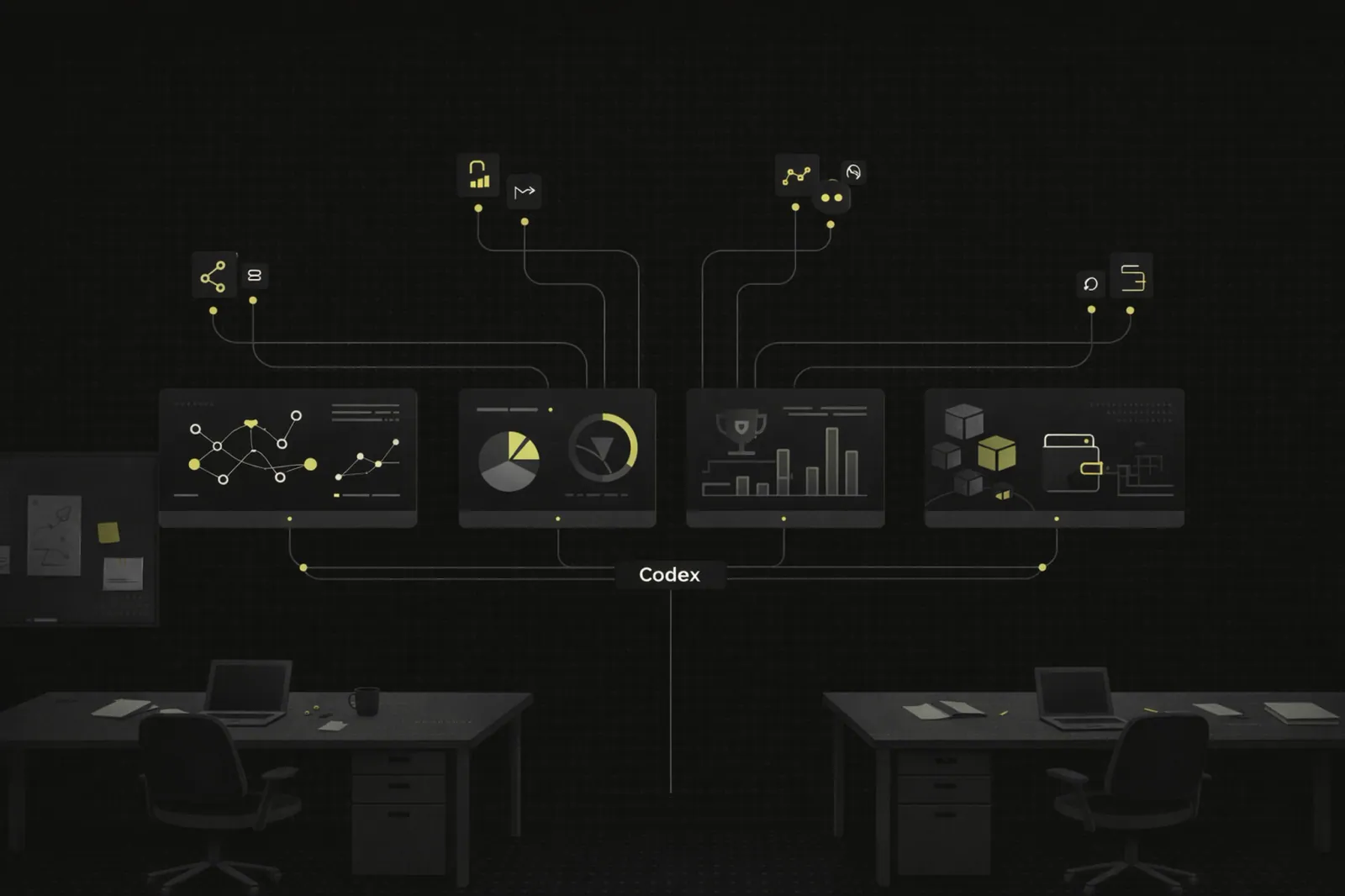
Codex positions itself as a specialized blockchain data infrastructure for token and prediction market data, not a general‑purpose node provider.
According to Codex’s own pricing and product documentation (company‑reported metrics, codex.io):
- Networks: 80+ networks (L1s, L2s, and major sidechains).
- Tokens: 70M+ distinct token contracts, deduped by chain+contract address.
- Wallets: 700M+ unique addresses indexed across supported chains.
- Historical events: 27B+ normalized on‑chain events.
- Freshness/latency: sub‑second freshness for most token and market data (median API response time under 1 second for standard endpoints, based on Codex internal benchmarks).
- Throughput: up to 300 requests/second on the Growth tier (company‑reported rate limit).
Codex ingests raw blockchain logs and exposes enriched, normalized objects via an all‑in‑one GraphQL‑style API:
- Real‑time and historical token prices in USD and native denominations.
- Trading‑grade chart data (OHLC, candles, volume).
- Aggregated metrics (liquidity, volume, TVL‑like stats, unique wallets).
- Holders and balances across chains, with scam filtering and token metadata.
- Live prediction market data for Polymarket and Kalshi (markets, events, trades, trader analytics) (Codex prediction markets docs).
Codex already powers leading products like Coinbase, TradingView, Uniswap, Magic Eden, Rainbow, MoonPay, Farcaster, and pump.fun (company‑reported customer list, codex.io), which is important for teams that value proven reliability over experimental aggregators.
Best Real‑Time Crypto Data API for Trading (2024–2026): What to Benchmark
When product and engineering leaders evaluate the best real-time crypto data API for trading (2024–2026), or more broadly best on-chain blockchain data API providers, there are five dimensions to benchmark:
Latency & Freshness
- Median and p95 response times for price, chart, and balance endpoints.
- How quickly new blocks, trades, and pools show up in aggregates.
Coverage & Normalization
- Number of supported networks and token contracts.
- Whether data is normalized (tokens, pools, markets) or just raw logs.
Reliability & SLAs
- Historical uptime, incident history, and status transparency.
- Formal SLAs for enterprise plans.
Feature Depth
- Support for holders, balances, launchpads, NFT and prediction markets.
- Scam filtering, metadata, and long‑tail asset coverage.
Developer Experience & Cost
- Single unified API vs. multiple products stitched together.
- Rate limits, pricing tiers, SDKs, and documentation quality.
Codex’s claim to be "fastest and most reliable" is an internal positioning statement, not a third‑party benchmark. Teams should run their own tests — but Codex is explicitly architected for trading‑grade UX, with a focus on sub‑second latencies and normalized data.
Fastest On‑Chain Data API for Gaming: Latency & Throughput Considerations
For gaming, latency is user‑visible. Players care about instant feedback on:
- In‑game currency balances and item ownership.
- Match rewards, loot drops, and marketplace outcomes.
When benchmarking the fastest on-chain data API for gaming, focus on:
- WebSocket subscription latency: time from on‑chain event to client message.
- Burst throughput: can the provider handle thousands of events per second during peak gameplay?
- Cross‑chain consistency: do balances line up across chains and bridges?
Codex’s streaming endpoints (company‑reported capability, docs.codex.io) are designed for event‑driven UIs, making it suitable as a real‑time backbone for gaming and interactive social feeds.
Token Ownership Verification API & Real‑Time Token Balance API Explained
Two primitives show up across social, gaming, and loyalty:
- Token ownership verification API
- Real‑time token balance API
Token ownership verification
Use case examples:
- Token‑gated communities and content.
- NFT‑gated game modes or beta access.
- Loyalty tiers based on holdings.
A typical Codex‑style query could look like this (pseudocode reflecting Codex’s GraphQL‑like schema):
query CheckOwnership {
  tokenBalances(
    filter: {
      walletAddress: "0xUSER_WALLET",
      tokenAddress: "0xTOKEN_CONTRACT",
      chainId: "base-mainnet"
    }
  ) {
    items {
      walletAddress
      tokenAddress
      chainId
      balance
      balanceUsd
      lastUpdatedAt
    }
  }
}
Sample JSON response:
{
  "data": {
    "tokenBalances": {
      "items": [
        {
          "walletAddress": "0xUSER_WALLET",
          "tokenAddress": "0xTOKEN_CONTRACT",
          "chainId": "base-mainnet",
          "balance": "125.4321",
          "balanceUsd": 248.73,
          "lastUpdatedAt": "2026-07-31T12:05:23.456Z"
        }
      ]
    }
  }
}
From here, a simple check (balance > 0) gates access, turning Codex into a token-gated community API backend.
Real‑time token balance API
Balances drive:
- Wallet apps and consumer finance dashboards.
- In‑game currencies and inventory states.
- Loyalty accruals and redemption calculations.
Querying cross‑chain balances might look like:
query WalletPortfolio {
  walletPortfolio(
    filter: { walletAddress: "0xUSER_WALLET" }
  ) {
    chains {
      chainId
      tokens {
        tokenAddress
        symbol
        decimals
        balance
        balanceUsd
      }
      totalUsd
    }
    portfolioUsd
  }
}
Sample JSON response:
{
  "data": {
    "walletPortfolio": {
      "chains": [
        {
          "chainId": "ethereum-mainnet",
          "tokens": [
            {
              "tokenAddress": "0xUSDC",
              "symbol": "USDC",
              "decimals": 6,
              "balance": "502.13",
              "balanceUsd": 502.13
            }
          ],
          "totalUsd": 502.13
        },
        {
          "chainId": "base-mainnet",
          "tokens": [
            {
              "tokenAddress": "0xGAME",
              "symbol": "GAME",
              "decimals": 18,
              "balance": "125.4321",
              "balanceUsd": 248.73
            }
          ],
          "totalUsd": 248.73
        }
      ],
      "portfolioUsd": 750.86
    }
  }
}
This kind of normalized, cross‑chain view is essential for any consumer product dealing with wallets at scale.
Streaming On‑Chain Events WebSocket API: Example Payloads
For real‑time UX — trading terminals, gaming, social feeds — a streaming on-chain events websocket API is far more efficient than polling.
A typical subscription might target token trades on a specific chain and pool:
{
  "type": "subscribe",
  "channel": "tokenTrades",
  "filter": {
    "chainId": "base-mainnet",
    "tokenAddress": "0xTOKEN_CONTRACT"
  }
}
Sample WebSocket event payload:
{
  "channel": "tokenTrades",
  "eventId": "evt_01JXYZ123",
  "chainId": "base-mainnet",
  "tokenAddress": "0xTOKEN_CONTRACT",
  "txHash": "0xTX_HASH",
  "tradeType": "swap",
  "amountToken": "50.0",
  "amountUsd": 98.75,
  "walletFrom": "0xFROM",
  "walletTo": "0xTO",
  "blockNumber": 12345678,
  "timestamp": "2026-07-31T12:06:01.123Z"
}
With sub‑second freshness (Codex internal benchmark), this becomes the backbone for live charts, in‑game events, and prediction market orderbooks.
Prediction Market API Frontend Real‑Time Data: Concrete Examples
For consumer apps embedding Polymarket or Kalshi markets, a prediction market API needs to expose:
- Events (e.g., "US election 2028")
- Markets (e.g., "Candidate X wins")
- Orderbooks and trades
- Trader P&L and positions
Codex’s prediction market endpoints (company‑reported capabilities in docs.codex.io) abstract platform differences.
List active markets for an event:
query ElectionMarkets {
  predictionMarkets(
    filter: { eventId: "event_us_election_2028" }
  ) {
    items {
      marketId
      platform
      title
      resolutionDate
      status
      yesPrice
      noPrice
      volume24hUsd
    }
  }
}
Sample JSON response:
{
  "data": {
    "predictionMarkets": {
      "items": [
        {
          "marketId": "polymarket_123",
          "platform": "polymarket",
          "title": "Candidate X wins the 2028 US presidential election",
          "resolutionDate": "2028-11-07T00:00:00Z",
          "status": "open",
          "yesPrice": 0.62,
          "noPrice": 0.38,
          "volume24hUsd": 1834527.45
        }
      ]
    }
  }
}
This gives frontend teams a single, normalized layer for prediction market data, rather than integrating each platform separately.
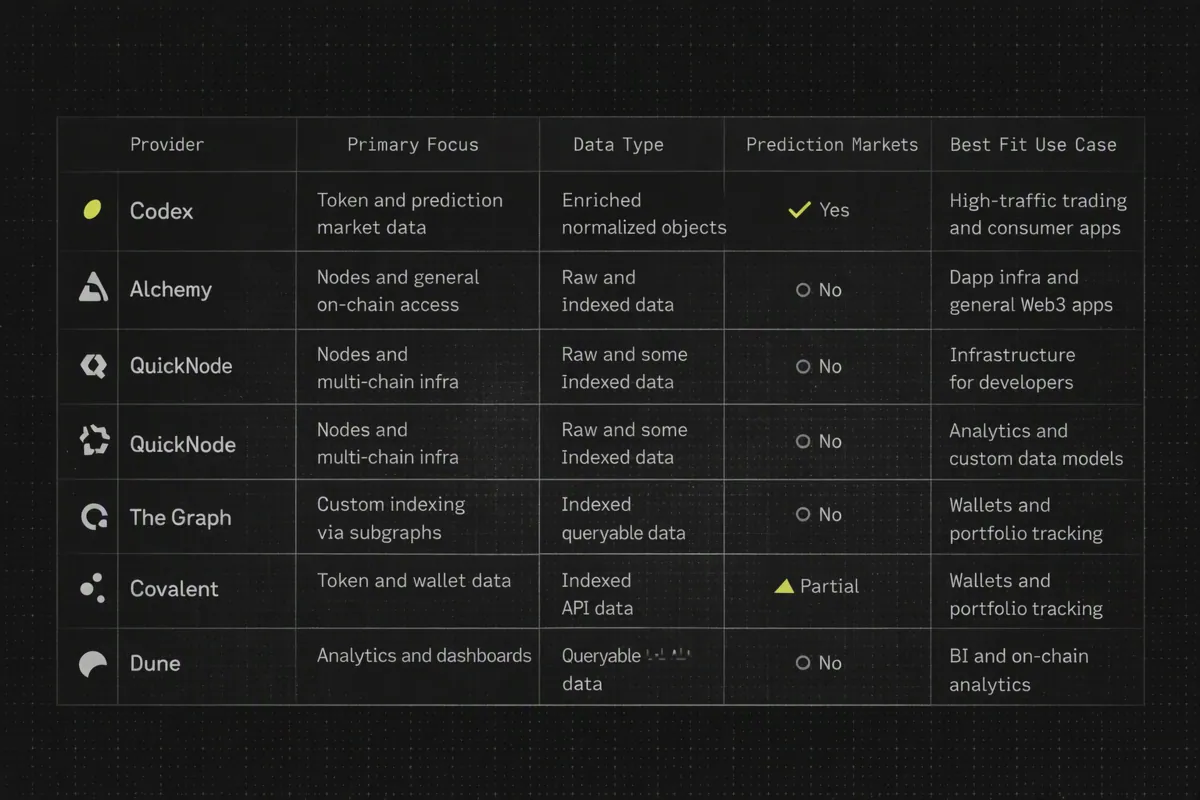
Top On‑Chain Indexing APIs for Wallets and Consumer Apps
When teams search for top on-chain indexing API for wallets, they usually compare:
- General node and data platforms (e.g., Alchemy, QuickNode).
- Analytics‑first products (e.g., Dune, The Graph).
- Token‑ and trading‑focused providers (e.g., Codex, Covalent).
What Codex does differently (company‑reported)
- Focuses specifically on token, wallet, and prediction market data rather than generalized node access.
- Provides enriched objects (tokens, trades, charts, holders), not just raw logs.
- Normalizes 70M+ tokens across 80+ networks with scam filtering (codex.io).
- Offers a single API that spans tokens, wallets, launchpads, and prediction markets.
Other providers may excel at archival node access or custom analytics queries, but Codex’s value is in production‑ready, trading‑grade data for wallets, trading UIs, and consumer apps.
Where This Goes Next
Token‑aware consumer apps are already real:
- Gaming: millions of daily wallets and billions of transactions (DappRadar).
- Loyalty: tokenized rewards at eight‑figure scale (Plutus).
- Prediction markets: tens of billions in yearly volume (KPMG).
The next step is frictionless consumer experiences that feel like Web2 — instant, responsive, mobile‑first — backed by trading‑grade on‑chain data.
Codex’s role in that future is straightforward: index the chain so you don’t have to, and give product teams a single, fast, reliable API for tokens, wallets, and prediction markets.
If you’re building social, gaming, or loyalty products that need token awareness, Codex is designed to be the foundational data layer under your app — so your engineers can focus on features, not ETL pipelines.