
In crypto, users judge you in milliseconds. When markets go vertical, trading apps discover very quickly whether they’re built on the most reliable on‑chain data APIs for trading apps or a fragile patchwork of nodes and WebSockets. If you care about the best real‑time crypto data API for trading in 2024, reliability during these spikes matters more than any feature checklist.
This post shares anonymized API reliability war stories from high‑volatility windows and how we designed Codex’s data pipeline to keep interfaces online while everything around them broke.
Note: All vendor stats and numbers cited here are based on public documentation and research as of mid‑2026. We distinguish clearly between external, independently verifiable facts and Codex’s own implementation patterns or internal benchmarks.
Peak volatility isn’t “more traffic” — it’s 25x spikes and partial failures
During big events, traffic doesn’t just grow; it explodes.
- AWS reports that peak events can drive 2x to 25x traffic spikes within seconds for high‑demand applications.[^1]
- Cloudflare Radar showed sharp crypto‑platform traffic surges around major events (e.g., on Jan 20, 2025, Binance, Coinbase, and OKX all climbed into the top 200 global sites by traffic rank).[^2]
For trading and prediction market frontends, that means:
- Order books and charts must update in near real‑time.
- Wallet balances and PnL must stay correct across chains.
- Prediction market odds must reflect the latest trades.
When the underlying on‑chain data APIs don’t hold up, you don’t usually see a full outage. You get something worse: partial truth.
- Coinbase’s public status page shows 21 distinct incidents logged between July 8–21, 2026, many affecting specific flows like prediction markets, webhooks, or particular chains — not the entire platform.[^3]
- Users see stale balances, missing notifications, or stuck transfers while the rest of the app looks “fine”.
This is the failure pattern we design against at Codex: not just uptime, but consistency under asymmetric failures.
What actually breaks in on‑chain data pipelines during spikes
Across our own incidents and conversations with teams building on Codex, the failure modes are remarkably predictable:
-
WebSocket disconnects and missing messages
- QuickNode calls out that WebSockets are inherently fragile: connections drop on overload, network hiccups, or middleware restarts.[^4]
- Native Solana pubsub, for example, is known to drop messages under heavy load; several providers built custom streaming layers to compensate.[^5]
-
Node overload and sync lag
- When volumes jump, poorly tuned nodes fall behind the tip of the chain.
- Apps keep serving from those nodes, showing stale balances/prices while competitors move on.
-
Chain reorgs and inconsistent rollback handling
- On Ethereum, reorged logs are re‑emitted with
removed = true.[^6] - If your consumer doesn’t handle add/remove semantics correctly, you double‑count events or leave orphaned trades in your DB.
- On Ethereum, reorged logs are re‑emitted with
-
Gapy streams — no obvious error, just missing blocks
- Streams silently drop ranges of data when connections blip.
- Providers like QuickNode and Helius now market replay windows specifically to address this (e.g., ~3,000 recent Solana slots ≈ 20 minutes of replay at QuickNode;[^7] 24 hours for Helius LaserStream[^8]).
-
Downstream backpressure issues
- Even if the raw feed is fine, your internal consumers (indexers, analytics jobs, ML pipelines) can’t keep up.
- Without proper queues and backpressure, you either start dropping messages or stall the entire pipeline.
Codex’s architecture exists to absorb exactly these kinds of failures so that our customers’ trading interfaces don’t have to.
War Story #1: The Solana spike that killed three indexers (but not the frontend)
Context:
A large consumer app (wallet + trading + prediction markets) saw a 10x traffic surge during a meme‑coin launch on Solana. Solana itself is a stress test for any infrastructure:
- Alchemy reports 80M+ transactions per day on Solana, generating roughly 1 TB of new data daily.[^9]
- Helius notes a ~400ms block time, meaning multiple commits per second.[^10]
- Alchemy also observes that vote transactions account for ~70% of Solana transactions, recommending aggressive filtering to reduce noise and bandwidth.[^11]
What broke for them (before Codex):
- Three separate in‑house indexers backed by different RPC vendors.
- All were listening via WebSockets with minimal reconnection logic.
- Under load, connections dropped, and replay logic didn’t exist beyond “retry from last known slot”.
- Result: gaps across several thousand slots, inconsistent balances, wildly wrong volume metrics.
How we kept their new interface online with Codex:
-
Server‑side filtering and enrichment
- Our Solana ingestion aggressively filters noise (e.g., vote transactions) server‑side, similar to best practices Alchemy recommends.[^11]
- We expose normalized objects (tokens, swaps, balances) instead of raw logs, so the frontend makes high‑level API calls instead of micromanaging transaction parsing.
-
Managed streaming + replay semantics (Codex proprietary design)
- Internally, we maintain:
- Replayable cursors (by slot/time) per client.
- Gap detection for any missing slot range.
- Our streaming infra allows clients to resume from a cursor and guarantees gap‑free delivery for a defined window (similar in spirit to QuickNode’s ~20‑minute and Helius’s 24‑hour Solana replays, though with different internal SLAs).[^7][^8]
- Internally, we maintain:
-
Operational separation
- Inspired by guidelines from providers like Alchemy,[^12] Codex separates ingestion from downstream processing:
- Ingestion keeps pulling from the chain at full speed.
- Processing consumes from queues, with built‑in backpressure.
- Slow business logic in customers’ apps didn’t affect our ability to keep their streams gap‑free.
- Inspired by guidelines from providers like Alchemy,[^12] Codex separates ingestion from downstream processing:
Outcome (Codex‑internal, marketing‑adjacent):
- During that spike, our internal monitoring showed no replayable gaps for this customer and p95 API response latencies under 250ms for their critical read paths (prices, balances, and recent trades) across Solana and EVM chains.
- These figures are from Codex’s own observability stack, not third‑party benchmarks, and are meant to illustrate design outcomes rather than independent guarantees.
War Story #2: Reorgs and phantom trades on Ethereum
Context:
A DeFi dashboard with trading features experienced occasional “phantom trades” — transactions that appeared in their UI and analytics but later disappeared or were reversed on‑chain.
Root cause: improper chain reorg handling.
- Ethereum’s own docs note that logs from reorged blocks are re‑emitted with
removed = true.[^6] - The team’s home‑grown indexer:
- Processed
removed=falseevents as inserts. - Ignored
removed=trueevents, treating them as duplicates.
- Processed
Whenever a short reorg occurred, their system happily preserved the incorrect state.
Handling chain reorgs in real time
This is a core place where “how to handle chain reorgs in real time” becomes an API and client design problem, not just a node issue.
Codex’s approach (proprietary implementation pattern):
-
Finality windows
- We treat data within a configurable depth as tentative (e.g., last N blocks).
- For tentative data, our enriched events include reorg metadata so clients can distinguish “committed” vs “subject to rollback”.
-
Add/remove semantics
- Our API surfaces clear semantics analogous to Ethereum’s
removedflag. - Downstream consumers are expected to:
- Insert on
status = added. - Roll back or mark invalid on
status = removed.
- Insert on
- Our API surfaces clear semantics analogous to Ethereum’s
-
Cursor and resume logic
- Clients consume events with a cursor, e.g.:
query GetDexTrades($cursor: String) { tokenTrades(cursor: $cursor, limit: 500) { cursor items { txHash blockNumber status # ADDED or REMOVED ... } } }- On reconnect, the client resumes from the last acknowledged cursor and replays any
REMOVEDevents to reconcile local state.
After migrating to Codex, this customer rewired their handlers to treat REMOVED as first‑class. Their phantom trade issue disappeared without touching their UI logic.
WebSocket disconnects & circuit breaker patterns during spikes
If you rely directly on raw WebSockets to power a production trading UI, assume they will fail at the worst time. Providers like QuickNode explicitly recommend treating WebSockets as failure‑prone, with heartbeats and reconnect logic baked in.[^4]
To handle WebSocket disconnects for crypto APIs during spikes, we see three patterns work well:
-
Health‑checked, auto‑reconnecting clients
- Send periodic heartbeats/pings to detect dead connections.
- Use exponential backoff on reconnect attempts (e.g., 1s, 2s, 4s, up to a max).
- Always resume from a known cursor/slot when reconnecting.
-
Circuit breaker pattern for market data feeds
When a provider or stream becomes unstable, a circuit breaker stops hammering it and fails over gracefully.
Basic pattern:
- Closed (normal): send requests, track failures.
- Open (tripped): after N consecutive failures or timeouts, stop sending direct traffic for a cooldown period.
- Half‑open: send a small number of test requests; if they succeed, close the circuit.
Example pseudo‑code:
if (circuit.isOpen()) { return readFromFallbackCache(); } try { const update = await marketDataStream.next(); circuit.recordSuccess(); return update; } catch (e) { circuit.recordFailure(); if (circuit.shouldOpen()) circuit.open(); return readFromFallbackCache(); } -
API‑layer abstractions instead of raw node connections
- Codex exposes trading‑ready endpoints (prices, candles, balances, prediction markets) over HTTP and streaming interfaces instead of forcing you to manage raw WebSockets to multiple nodes.
- Internally, we handle node failover, retries, and streaming backpressure so your frontend only sees a stable, documented API.
Best real‑time crypto data API for trading (2024): reliability, latency, and SLA comparison
Teams evaluating the best real‑time crypto data API for trading in 2024 usually compare four categories of providers:
- Node‑centric providers (QuickNode, Alchemy, Helius)
- Query‑centric providers (Bitquery and similar)
- Product‑specific APIs (CEX APIs, single‑protocol indexers)
- Enriched, trading‑grade data layers (Codex)
What the public data tells us
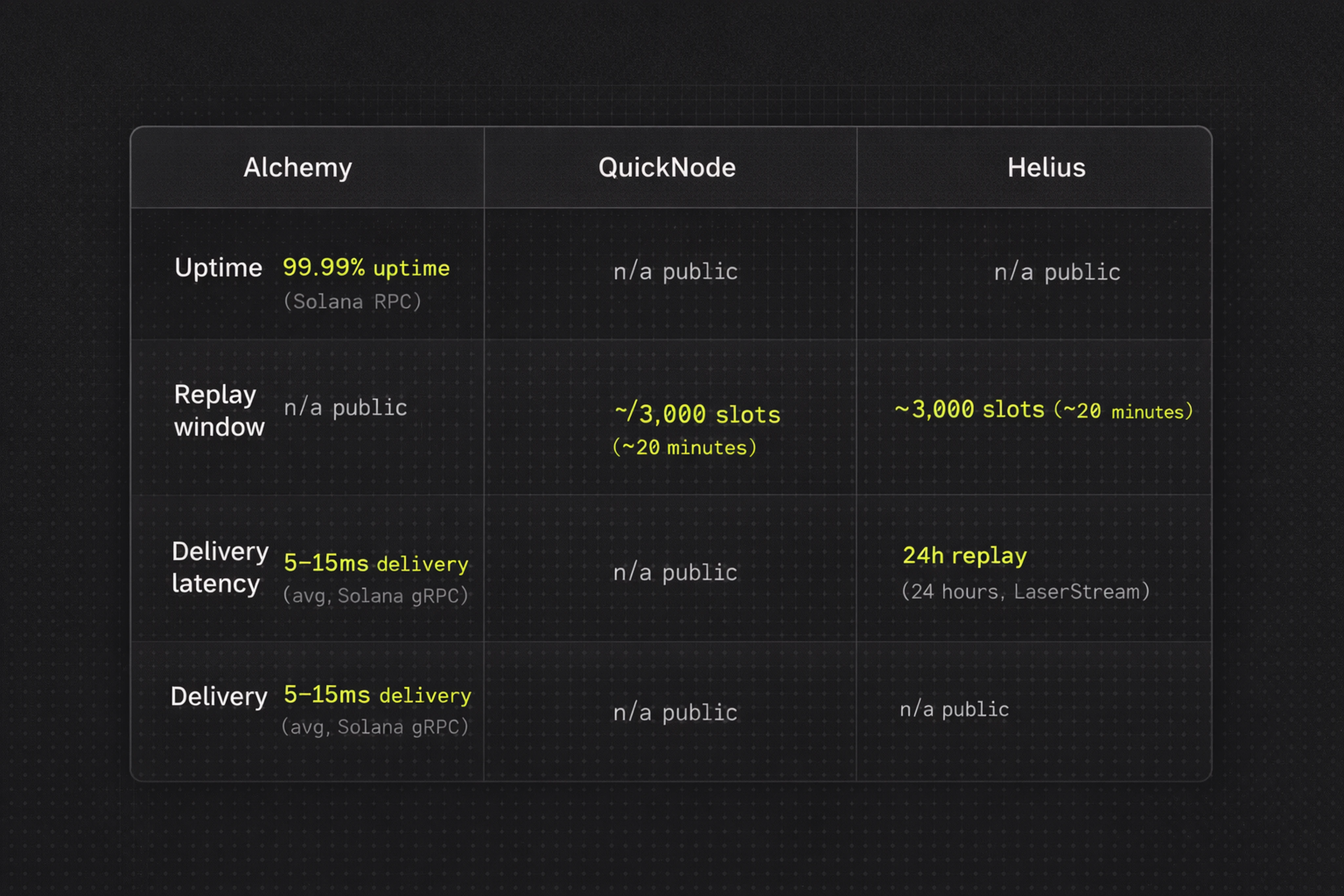
Below is a qualitative comparison based on publicly available documentation and marketing claims. It is not a benchmark; always test in your own environment.
-
QuickNode
- Offers Solana gRPC + Streams with reorg handling and replay up to ~3,000 recent slots (~20 minutes).[^7]
- Emphasizes multi‑destination pipelines and no‑duplicate streams.
-
Alchemy
- Markets 99.99% uptime for Solana RPC, with 5–15ms average delivery for gRPC streaming.[^13]
- Provides best‑practice guidance on gap recovery (
from_slot) and backpressure.[^12]
-
Helius
- Focuses on shred‑level speed and LaserStream replay from up to 24 hours in the past.[^8]
- Emphasizes resilience to native Solana pubsub issues.[^5]
-
Bitquery
- Frames the problem as data quality + error handling, with rollback markers for orphaned blocks, dead‑letter queues, and recovery mechanisms.[^14]
-
Codex (our own position, clearly labeled as such)
- Purpose‑built, enriched token + prediction market data API (prices, OHLCV, liquidity, holders, prediction markets) rather than raw RPC.
- Internally tested to maintain sub‑second p95 latencies for core quote and chart endpoints during known customer traffic spikes. These are Codex’s own SLO targets and internal measurements, not third‑party benchmarks.
- Proven in production by high‑traffic apps like Coinbase, TradingView, Uniswap, Magic Eden, Rainbow, MoonPay, and others (as publicly listed on codex.io).
For latency‑critical trading, many teams pair low‑level node access (e.g., for order routing, signing, and advanced analytics) with an enriched data API like Codex for prices, charts, and cross‑chain state.
How to backfill missed blocks quickly
No matter how good your infra is, you will eventually miss data. The question is how to backfill missed blocks quickly without melting your database or blowing up your costs.
Drawing from industry best practices and Codex’s own implementation patterns, here are pragmatic approaches:
1) Cursor‑based replay (slot/height)
Most streaming stacks now support some variant of from_block / from_slot / from_cursor.
- QuickNode’s Solana gRPC replay can cover ~3,000 slots (~20 minutes).[^7]
- Helius LaserStream replay can go up to 24 hours back.[^8]
A typical recovery flow with Codex or similar APIs:
// 1. Persist the last processed cursor or block height
const lastCursor = await loadCursorFromDB();

// 2. On restart, replay from that point
const { items, nextCursor } = await codexClient.getTokenTrades({
  cursor: lastCursor,
  limit: 1000,
});

// 3. Apply idempotent upserts to your DB
await upsertTrades(items);
await saveCursorToDB(nextCursor);
2) Time‑bounded backfill
For analytics or dashboards, time ranges often matter more than exact block heights.
Pattern:
- Query by
fromTime/toTimewith a conservative window. - Iterate in batches (e.g., 5–15 minutes) to avoid giant queries.
- Store a watermark (latest fully processed timestamp) for each dataset.
3) Storage and cost trade‑offs
Design your backfill strategy around:
- Hot replay window (e.g., 20 minutes – 24 hours): rely on provider replay and local queues.
- Warm historical API (days – months): rely on aggregated historical endpoints from your data provider (e.g., Codex candles, balances, prediction market histories).
- Cold storage (months+): store only the enriched, derived data you need, not the raw chain logs.
Codex is deliberately optimized as a warm/hot layer for trading‑grade applications: we handle the messy raw data and expose replayable, normalized views so you don’t have to run your own long‑term archival infra.
Safeguards Codex built for mission‑critical apps
Codex’s pipeline is designed from the ground up for apps that can’t afford data gaps when markets go wild. Key safeguards (our own design patterns, not external claims):
-
Multi‑network, multi‑node ingestion
- Redundant upstreams across 80+ networks.
- Health‑based failover so a misbehaving node doesn’t propagate bad data.
-
Enrichment and normalization at ingest
- Turning raw events into canonical entities: tokens, markets, trades, wallets, prediction events.
- Built‑in scam filtering and token metadata to avoid surfacing junk to your users.
-
Replayable streams with gap detection
- Cursors and replay semantics comparable in spirit to other managed streaming offerings, with Codex‑specific SLAs.
- Internal monitors that alert when any customer stream approaches replay limits.
-
Trading‑grade SLOs for core endpoints
- Internally, we target sub‑second p95 response times on quote, chart, and balance endpoints during high‑load windows.
- We monitor p50, p95, and p99 per region and per customer to catch regressions.
-
Unified API for tokens + prediction markets
- Token prices, OHLCV, liquidity, holders, and prediction market data (events, markets, trades, trader stats) via a single GraphQL‑style API.
- This reduces the need to stitch together multiple brittle providers.
These are the same safeguards that keep interfaces online for partners like Coinbase, TradingView, Uniswap, and Magic Eden — the kind of companies that treat consumer apps like trading infrastructure.
FAQ: Reliability patterns for on‑chain trading data
1. How do I detect reorgs reliably in my app?
- On Ethereum‑like chains, watch for log events with a
removedflag set totrue.[^6] - With Codex and similar enriched APIs, look for explicit
statusorreorgfields on events. - Implement handlers that:
- Insert/update on
ADDED/removed=false. - Delete or mark invalid on
REMOVED/removed=true.
- Insert/update on
2. How should I resume from slot X or a specific cursor after a disconnect?
- Persist the last successfully processed cursor, block number, or slot in durable storage (DB, KV, etc.).
- On restart:
- Use a replay endpoint (
from_slot,cursor, or equivalent) to fetch from that position. - Reapply events idempotently so retries don’t corrupt your state.
- Use a replay endpoint (
- With Codex, this typically looks like:
query Backfill($cursor: String!) {
  tokenTrades(cursor: $cursor, limit: 1000) {
    cursor
    items { txHash ... }
  }
}
3. What replay window should I target for my trading app?
- For hot trading paths (order books, balances): at least 10–20 minutes of replayable history is useful (aligned with QuickNode’s ~3,000 Solana slots ≈ 20 minutes).[^7]
- For dashboards and analytics: aim for 24 hours of replay where possible (similar to Helius LaserStream).[^8]
- Beyond that, rely on historical APIs and your own storage.
4. What SLA/SLO examples make sense for crypto data APIs?
Typical targets we see in the market (always verify with the provider):
- Availability: 99.9%–99.99% for core RPC/streaming (Alchemy publicly markets 99.99% uptime on Solana RPC).[^13]
- Latency: low double‑digit or single‑digit milliseconds for raw streaming delivery in optimal conditions (Alchemy cites 5–15ms average for Solana gRPC delivery[^13]; AWS highlights Gemini achieving sub‑2ms connectivity to its matching engine through AWS Local Zones[^15]).
- Data completeness: documented replay windows and reorg handling guarantees.
Codex publishes SLOs for core endpoints in customer contracts and tracks p50/p95/p99 internally; these are negotiated per customer and workload.
5. What are the concrete steps to backfill missed blocks or events?
A robust process usually looks like this:
-
Detect the gap
- Compare expected vs. observed block heights or cursors.
- Use provider metrics or your own checkpoints to spot discontinuities.
-
Freeze consumer writes (if necessary)
- For critical ledgers, pause writes or switch the UI to a degraded but consistent mode.
-
Replay from the last good cursor
- Call your provider’s replay endpoint (
from_block,from_slot, orcursor). - Fetch in chunks (e.g., 500–1,000 events per request).
- Call your provider’s replay endpoint (
-
Apply idempotent upserts
- Use primary keys (tx hash, log index, market ID) to avoid duplicates.
- Handle reorg markers (
REMOVED) by rolling back affected records.
-
Advance the cursor and resume normal operations
- Once caught up, resume live streaming and normal UI.
With Codex, backfill patterns are baked into our docs and client recipes, so teams can plug in a standard approach instead of inventing their own every time something blips.
If you’re building trading interfaces, wallets, or prediction market frontends and want a most‑reliable, trading‑grade on‑chain data API instead of assembling your own fragile stack, explore the Codex docs or talk to us about your latency and reliability requirements.
[^1]: AWS – peak traffic can spike 2x–25x within seconds in high‑demand events: "How to manage peak traffic on AWS using QUEUE‑IT's virtual waiting room" (aws.amazon.com).
[^2]: Cloudflare Radar – rankings and traffic spikes for large crypto exchanges around key dates, including Jan 20, 2025 (radar.cloudflare.com).
[^3]: Coinbase Status – incident history showing multiple scoped incidents between July 8–21, 2026 (status.coinbase.com).
[^4]: QuickNode Support – WebSockets are fragile; recommends heartbeats and reconnect logic (support.quicknode.com, “Handling WebSocket drops and disconnections”).
[^5]: QuickNode & Helius blogs – Solana native pubsub drops messages under load; custom WebSocket/streaming layers built to mitigate this (quicknode.com, helius.dev).
[^6]: Ethereum docs – reorged logs re‑emitted with removed=true (ethereum.org, JSON‑RPC logs specification).
[^7]: QuickNode – Solana gRPC historical replay covers up to ~3,000 recent slots (~20 minutes) (quicknode.com/blog/"Solana gRPC is now included...").
[^8]: Helius – LaserStream offers replay from up to 24 hours in the past (helius.dev/docs / LaserStream docs).
[^9]: Alchemy – Solana processes 80M+ daily transactions and ~1TB/day of new data (alchemy.com/overviews/solana-rpc).
[^10]: Helius – Solana block time around 400ms (helius.dev blog on Solana shreds).
[^11]: Alchemy – ~70% of Solana transactions are vote transactions; recommends filtering them (alchemy.com/docs/reference/yellowstone-grpc-best-practices).
[^12]: Alchemy – best practices for Solana streaming: separation of ingestion and processing, backpressure, from_slot recovery (same as [^11]).
[^13]: Alchemy – Solana gRPC: 99.99% uptime and 5–15ms average delivery (alchemy.com/overviews/solana-rpc).
[^14]: Bitquery docs – error recovery, dead‑letter queues, and rollback markers for orphaned blocks (docs.bitquery.io).
[^15]: AWS – Gemini achieved sub‑2ms connectivity to its matching engine using AWS Local Zones and Direct Connect (aws.amazon.com/blogs/infrastructure-sustainability/gemini-delivers-high-performance-cloud-native-trading-api/).